Understanding the Process for FSSAI Registration for Food Startups
Understanding the Process for FSSAI Registration for Food Startups made simple with step-by-step guidance from CA4Filings experts.
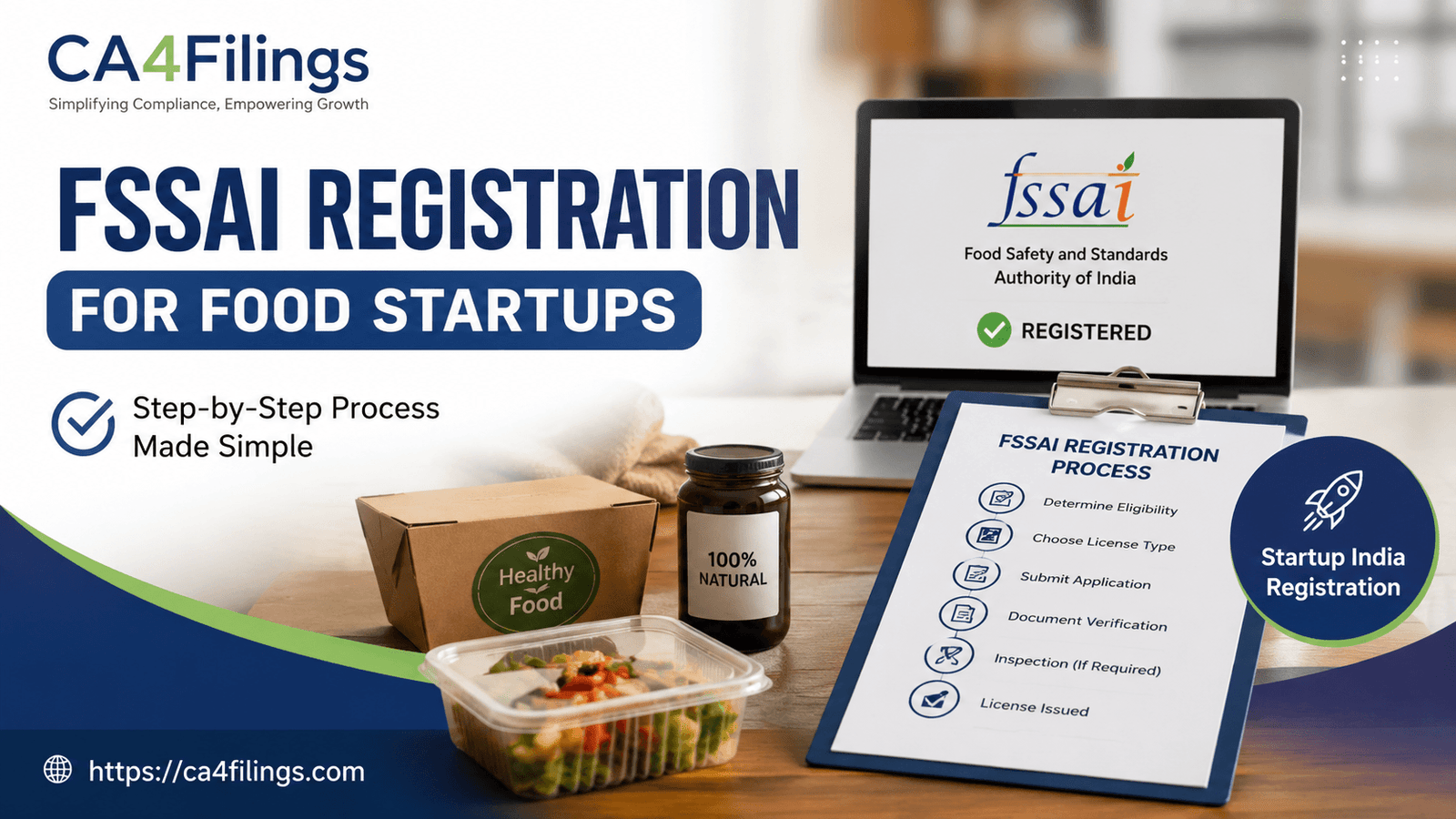
Starting a food business in India is an exciting opportunity, especially with the growing demand for cloud kitchens, packaged foods, home-based food brands, cafes, and online food delivery startups. However, before serving customers, every food entrepreneur must understand the legal requirements involved. One of the most important compliances is Understanding the Process for FSSAI Registration for Food Startups.
Whether you are launching a small homemade snacks business or planning a large-scale food manufacturing company, FSSAI registration is mandatory under Indian law. At CA4Filings, we often see startups facing delays because they ignore licensing requirements during the early stages of business planning. Along with business incorporation and tax registration, obtaining proper food licensing should be treated as a priority.
Many startups that apply for Startup India Registration also require FSSAI approval to operate legally in the food sector. Understanding these compliance requirements early helps avoid penalties and operational disruptions later.
Understanding the Process for FSSAI Registration for Food Startups
The Food Safety and Standards Authority of India (FSSAI) is the government body responsible for regulating food safety in India. Every food-related business operator (FBO) must obtain FSSAI registration or license before commencing operations.
Understanding the Process for FSSAI Registration for Food Startups is essential because the type of registration depends on factors such as:
- Annual turnover
- Nature of food business
- Production capacity
- Business location
- Import/export activities
The registration ensures that the food products being manufactured, stored, distributed, or sold meet prescribed safety standards.
Why FSSAI Registration is Important for Food Startups
Many new entrepreneurs assume that FSSAI registration is just another formality. In reality, it plays a major role in building customer trust and legal credibility.
Key Benefits of FSSAI Registration
- Legally authorizes your food business
- Enhances brand reputation
- Builds customer confidence
- Helps in obtaining funding and partnerships
- Enables selling through e-commerce platforms
- Avoids penalties and legal action
- Supports business expansion across India
For startups looking to scale quickly, Understanding the Process for FSSAI Registration for Food Startups becomes even more important because investors and marketplaces often ask for compliance documents before onboarding.
Types of FSSAI Registration for Food Startups
Understanding the Process for FSSAI Registration for Food Startups begins with identifying the correct license category.
Basic FSSAI Registration
This is suitable for small food businesses with annual turnover up to ₹12 lakh.
Applicable for:
- Home-based food businesses
- Small retailers
- Temporary food stalls
- Cottage industries
State FSSAI License
Required for businesses with annual turnover between ₹12 lakh and ₹20 crore.
Applicable for:
- Medium-sized manufacturers
- Restaurants
- Cloud kitchens
- Storage units
- Transporters
Central FSSAI License
Mandatory for businesses with annual turnover exceeding ₹20 crore or operating in multiple states.
Applicable for:
- Large manufacturers
- Importers/exporters
- Large food chains
- E-commerce food operators
Documents Required for FSSAI Registration
One major part of Understanding the Process for FSSAI Registration for Food Startups is preparing proper documentation.
Common Documents Required
- PAN card of the applicant
- Aadhaar card or identity proof
- Address proof of business premises
- Passport-size photographs
- Business constitution documents
- Rent agreement or ownership proof
- Food product details
- NOC from municipality (if applicable)
Additional Documents for State or Central License
- List of directors or partners
- Import Export Code (IEC)
- Water testing report
- Food safety management plan
- Manufacturing unit layout
At CA4Filings, we recommend startups keep digital copies of all documents ready to speed up approval timelines.
Step-by-Step Guide: Understanding the Process for FSSAI Registration for Food Startups
Step 1: Determine the Correct License Type
The first step is evaluating your business turnover and operations. Applying under the wrong category can lead to rejection or future compliance issues.
Step 2: Prepare Documentation
Collect all required business and identity documents carefully. Incorrect or incomplete documents are one of the most common reasons for delays.
Step 3: File Application Online
Applications are submitted through the FoSCoS portal of FSSAI. The form selection depends on your business category.
Step 4: Verification by Authorities
The department reviews submitted documents. In some cases, food inspectors may conduct physical inspections of the premises.
Step 5: Issuance of Registration or License
Once approved, the FSSAI certificate is issued with a unique 14-digit registration number.
Understanding the Process for FSSAI Registration for Food Startups becomes easier when entrepreneurs follow a structured compliance approach from day one.
Common Mistakes Food Startups Should Avoid
At CA4Filings, we frequently notice startups making avoidable errors during registration.
Applying Under the Wrong Category
Many businesses underestimate projected turnover and apply for basic registration instead of state license.
Incomplete Documentation
Missing agreements, incorrect addresses, or unsigned forms can delay approval.
Ignoring Renewal Deadlines
FSSAI licenses require timely renewal. Failure may attract penalties or cancellation.
Not Updating Business Changes
Any changes in address, ownership, or product category should be updated with FSSAI authorities.
Understanding the Process for FSSAI Registration for Food Startups also means understanding ongoing compliance responsibilities.
How Long Does FSSAI Registration Take?
The approval timeline depends on the type of registration and completeness of documentation.
Approximate Timelines
- Basic Registration: 7–10 working days
- State License: 15–30 working days
- Central License: 30–60 working days
Inspection requirements may increase processing time.
Penalties for Non-Compliance
Operating a food business without FSSAI registration can result in serious consequences.
Possible Penalties Include
- Heavy fines
- Business closure
- Product seizure
- Legal prosecution
- Brand reputation damage
This is why Understanding the Process for FSSAI Registration for Food Startups is not just a compliance requirement but a business necessity.
Practical Example for Better Understanding
Suppose a startup launches a cloud kitchen in Noida with projected annual sales of ₹18 lakh. Since turnover exceeds ₹12 lakh, the business would require a State FSSAI License instead of Basic Registration.
If the same startup later expands operations to multiple states through franchise outlets, it may need to upgrade to a Central License.
This practical approach helps entrepreneurs in Understanding the Process for FSSAI Registration for Food Startups based on future growth plans rather than current turnover alone.
FAQs on Understanding the Process for FSSAI Registration for Food Startups
Is FSSAI registration mandatory for home-based food businesses?
Yes, even small home kitchens and homemade food sellers require at least Basic FSSAI Registration.
Can I sell food online without FSSAI registration?
No. Most online marketplaces and food delivery platforms require valid FSSAI certification before onboarding sellers.
What is the validity period of FSSAI license?
FSSAI licenses can be obtained for 1 to 5 years depending on the applicant’s choice.
Can a startup apply for FSSAI registration before company incorporation?
Yes, in some cases registration can begin using proprietor details. However, business entity documents may later be required.
Is renewal mandatory?
Yes, timely renewal is essential to continue business operations legally.
Understanding the Process for FSSAI Registration for Food Startups is crucial for every entrepreneur entering the food industry. Proper registration not only ensures legal compliance but also builds customer confidence and strengthens business credibility.
From choosing the correct license category to maintaining ongoing compliance, every step matters for long-term business success. Food startups that ignore licensing requirements often face unnecessary legal and operational challenges later.
At CA4Filings, we help food entrepreneurs simplify the entire registration process with expert guidance, accurate documentation, and end-to-end compliance support. Whether you are launching a cloud kitchen, packaged food brand, restaurant, or food manufacturing unit, our experts ensure smooth and hassle-free FSSAI registration so you can focus on growing your business confidently.
Latest Updates
ca4filings.com Services
























-registration.png)