Pvt Ltd vs. LLP: Which Fits Better for Your Startup India Registration?
Compare Pvt Ltd vs LLP for startup india registration. Explore compliance, taxation, funding, and benefits to choose the right structure for your startup.
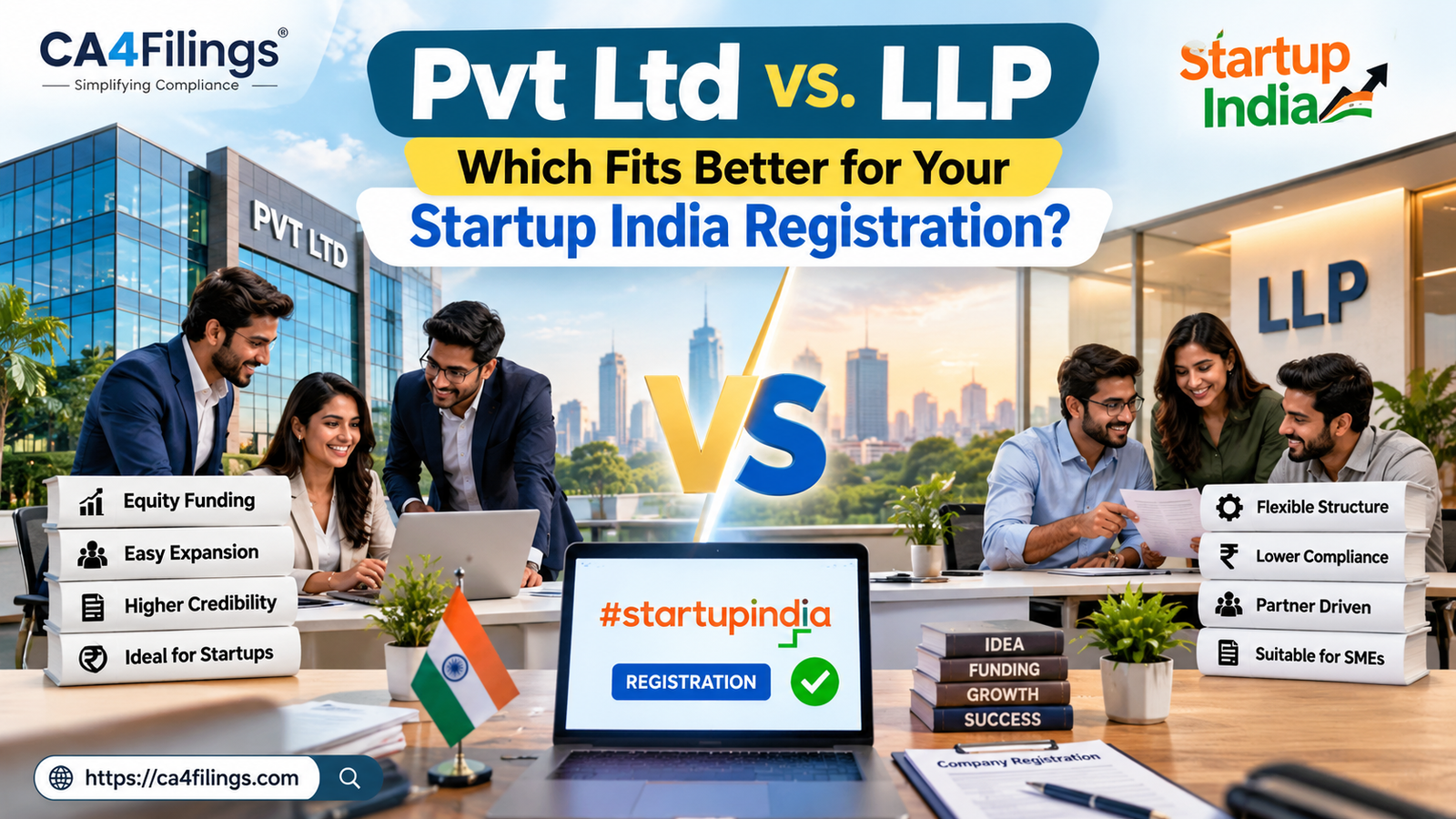
Starting a new business in India is exciting, but choosing the right legal structure can significantly influence your growth, taxation, and fundraising opportunities. When planning startup india registration, many entrepreneurs face a common question: should they register a Private Limited Company or a Limited Liability Partnership (LLP)?
Both structures offer limited liability protection, but they differ in ownership, compliance requirements, taxation, and suitability for future expansion. The right choice depends on your business model, funding plans, and long-term objectives.
At CA4Filings, we help entrepreneurs make informed decisions about business formation. Whether you are exploring Company Registration or considering an LLP, understanding these differences early can save time, money, and unnecessary compliance challenges.
Let's compare both options and identify which structure makes more sense for your startup.
What Is Startup India Registration?
Startup India registration generally refers to establishing a business entity and, where eligible, obtaining recognition under the Startup India initiative administered by the Department for Promotion of Industry and Internal Trade (DPIIT).
DPIIT recognition can help eligible startups access certain government benefits, schemes, and funding-related opportunities, subject to applicable conditions.
Before applying, entrepreneurs should understand that business incorporation and DPIIT recognition are two different processes. Registering a company or LLP does not automatically grant startup recognition or tax exemptions.
Eligible entities generally need to meet the applicable criteria, including requirements relating to their age, turnover, innovation, improvement of products or services, or potential for employment and wealth creation.
Choosing the correct legal structure is therefore an important first step in your startup india registration journey.
Pvt Ltd vs LLP: Understanding the Key Differences
A Private Limited Company and a Limited Liability Partnership are both popular choices for Indian entrepreneurs. However, their legal frameworks serve different business needs.
1. Ownership and Management
A Private Limited Company is governed by the Companies Act, 2013. Its ownership is divided into shares held by shareholders, while directors manage its affairs.
An LLP operates under the Limited Liability Partnership Act, 2008. Its partners contribute capital and participate in management according to the LLP agreement.
Choose a Private Limited Company if:
You plan to bring in investors or venture capital funds.
You want to offer equity shares to co-founders or employees through suitable share-based arrangements.
You expect rapid expansion or eventual acquisition.
Choose an LLP if:
You are starting a professional services firm or consultancy.
Two or more partners want flexible management arrangements.
You prefer a partnership-based structure without issuing company shares.
For example, a technology startup developing a scalable software platform may benefit from a Private Limited Company, whereas a small consulting business operated by two professionals may find an LLP more practical.
2. Compliance Requirements
Compliance is one of the biggest factors to consider when deciding between these structures.
A Private Limited Company generally needs to maintain statutory registers, conduct board and shareholder meetings as applicable, file annual financial statements and annual returns, and meet other requirements under company law.
An LLP generally has fewer ongoing formalities. It must maintain proper accounts, file its annual return and statement of account and solvency, and comply with applicable audit requirements.
| Compliance factor | Private Limited Company | LLP |
|---|---|---|
| Annual filings | Mandatory | Mandatory |
| Statutory audit | Generally mandatory, subject to applicable law | Required when prescribed thresholds are met |
| Board meetings | Applicable statutory requirements | No equivalent company-style requirement |
| Ownership transfer | Through share transfer, subject to restrictions | Governed by the LLP agreement and applicable law |
| Administrative workload | Generally higher | Generally lower |
Although an LLP can be less expensive to maintain, neither structure should be treated as compliance-free. Your actual costs will depend on transaction volume, professional fees, audit requirements, and business complexity.
3. Taxation and Tax Holiday Eligibility
Taxation can influence your decision, particularly if you expect profits in the first few years.
A domestic Private Limited Company may be eligible to opt for a concessional corporate tax regime under Section 115BAA of the Income-tax Act, 1961, subject to applicable conditions. The effective tax cost depends on the chosen regime and relevant provisions.
An LLP is generally taxed at the applicable LLP income-tax rate, with surcharge and cess where applicable. Partners' remuneration and interest on capital also require appropriate tax treatment under the relevant provisions.
For eligible startups, tax holiday eligibility is another consideration. Section 80-IAC provides a deduction for qualifying profits to eligible startups for three consecutive assessment years out of the first ten years, subject to statutory conditions.
However, incorporation alone does not guarantee this benefit. The entity must satisfy the applicable eligibility requirements, including the prescribed recognition, incorporation-period, and approval conditions.
Before choosing a structure solely for tax savings, consult a qualified professional who can evaluate your expected profits, available deductions, and long-term plans.
4. Equity Funding and Business Expansion
If your business requires external investment, the choice becomes particularly important.
Investors, including venture capital firms and angel investors, commonly prefer Private Limited Companies because they can invest in exchange for shares and negotiate ownership percentages, investor rights, and future funding arrangements.
A Private Limited Company can also accommodate multiple funding rounds and suitable employee stock option arrangements, subject to legal and tax requirements.
An LLP can accept partner contributions and may accommodate additional partners under its agreement. However, its ownership structure is generally less aligned with conventional venture capital investment models.
For startups targeting institutional investors, equity funding is a major reason to consider pvt ltd company registration from the beginning.
An LLP may still work well for a profitable business funded through founders' capital and operating revenue rather than external equity investment.
5. Limited Liability and Legal Protection
Both structures provide limited liability protection, meaning owners generally are not personally liable for business debts merely because they are owners or partners.
In a Private Limited Company, shareholders' liability is generally limited to the unpaid amount on their shares.
In an LLP, partners are generally not personally liable for another partner's independent wrongful acts merely because they are partners. However, personal guarantees, fraud, personal misconduct, and other legally recognised exceptions can create personal liability.
Neither structure removes every business risk. Maintaining separate business accounts, accurate records, and proper legal documentation remains essential.
Which Structure Is Better for Startup India Registration?
There is no universal winner. The right option depends on what you want your business to become.
Choose a Private Limited Company When:
You plan to raise venture capital or angel investment.
You want to issue shares to co-founders or investors.
You intend to build a technology-driven or high-growth business.
You expect multiple funding rounds or strategic acquisitions.
Your long-term plans require a conventional corporate ownership structure.
Choose an LLP When:
You are establishing a consultancy, agency, or professional services firm.
You want flexible arrangements between partners.
Your business will primarily rely on internal capital and revenue.
You want to avoid some of the additional company-law formalities.
You prioritise operational flexibility over conventional equity fundraising.
Our recommendation at CA4Filings: If your business model depends on external equity funding and rapid scaling, a Private Limited Company is generally the more suitable option. If you are building a partner-led business with modest funding requirements, an LLP may be a sensible alternative.
Remember that DPIIT recognition and individual tax benefits have their own eligibility conditions. The legal structure should be chosen for its overall suitability, not simply on the assumption that it guarantees government benefits.
Step-by-Step Process for Startup India Registration
Once you have selected the appropriate structure, follow these steps.
Step 1: Finalise your business structure. Decide whether a Private Limited Company or LLP aligns with your ownership, investment, and compliance needs.
Step 2: Arrange the required documents. Typically, founders need PAN, identity and address proofs, photographs where required, registered office address evidence, and applicable consent or incorporation documents.
Step 3: Complete incorporation. A Private Limited Company is incorporated through the applicable MCA process, while an LLP is registered under the relevant LLP incorporation procedure.
Step 4: Obtain PAN and other applicable registrations. Complete tax registrations, bank account formalities, GST registration where applicable, and other sector-specific requirements.
Step 5: Apply for DPIIT recognition. If eligible, submit the startup recognition application through the official Startup India process with the required business details and supporting information.
Step 6: Review additional benefits separately. Check the specific conditions for any tax deduction, intellectual property support, funding scheme, or other benefit before relying on it.
Professional assistance can help reduce documentation errors and ensure that your incorporation and recognition applications follow the applicable requirements.
Latest Updates
ca4filings.com Services



























-registration.png)