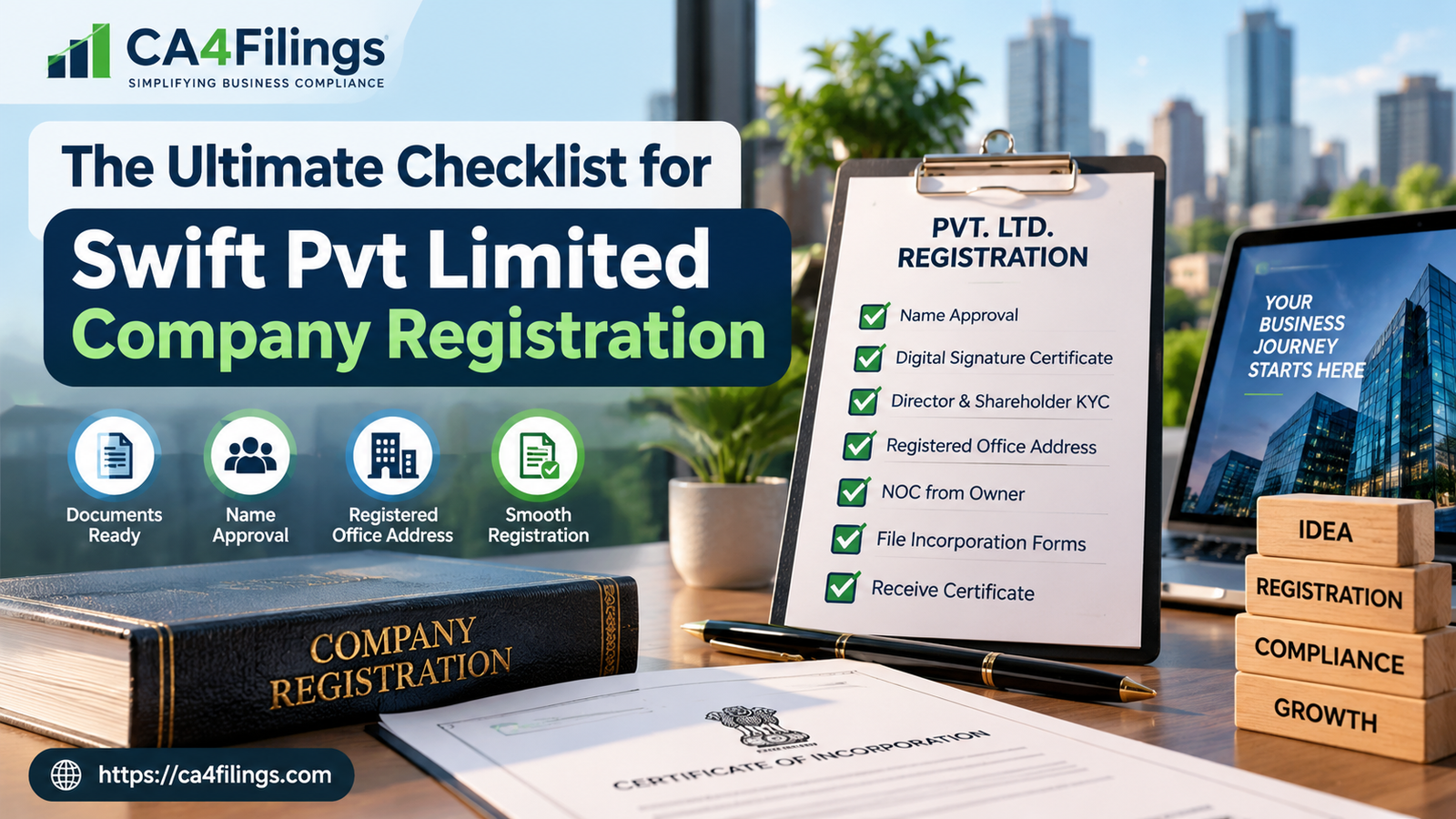
The Ultimate Checklist for Swift Pvt Limited Company Registration
Simplify pvt limited company registration with our ultimate checklist covering documents, eligibility, legal compliance, and expert tips from CA4Filings.
Starting a business is exciting, but choosing the right legal structure is one of the first important decisions an entrepreneur must make. For founders who want limited liability, a separate legal identity, and better opportunities to attract investors, a private limited company is often a suitable choice. However, completing pvt limited company registration requires careful planning, accurate documentation, and compliance with the Companies Act, 2013.
At CA4Filings, we understand that entrepreneurs want to focus on building their businesses rather than getting caught up in paperwork. Whether you are launching a startup, expanding a family business, or planning to bring investors on board, understanding the registration process can save time and prevent unnecessary delays. Our Company Registration services help business owners navigate the process with greater clarity.
In this guide, we share a practical checklist to help you understand the eligibility requirements, essential documents, registration steps, and common mistakes to avoid before submitting your application.
Why Choose a Private Limited Company?
Before starting the registration process, it is worth understanding why this business structure is popular among Indian entrepreneurs.
A private limited company offers several advantages:
Limited liability: Shareholders' liability is generally limited to the unpaid amount on their shares.
Separate legal identity: The company can own assets, enter into contracts, and conduct business in its own name.
Better credibility: Many customers, vendors, and investors prefer dealing with a formally incorporated entity.
Investment opportunities: The company structure makes it easier to issue shares and bring eligible investors on board, subject to applicable laws.
Business continuity: The company's existence is not ordinarily affected by a change in shareholders or directors.
If you intend to register as a company and build a business for the long term, this structure can provide a solid legal foundation.
The Ultimate Checklist for Pvt Limited Company Registration
A smooth registration process begins with preparation. Before filing any forms, use the following checklist to ensure that the essential requirements are covered.
1. Confirm the Eligibility Requirements
The first step in pvt limited company registration is to confirm that your proposed business meets the basic legal requirements.
Under the Companies Act, 2013, a private company generally requires:
At least two shareholders.
At least two directors.
At least one director who satisfies the applicable Indian residency requirement.
A lawful business objective.
Compliance with the statutory requirements governing the company's name, capital, and incorporation.
The same individuals can generally act as both shareholders and directors, provided they meet the relevant eligibility conditions.
CA4Filings tip: Discuss the ownership ratio with your co-founders before incorporation. For example, if two founders plan to hold 60% and 40% of the shares, agree on the initial capital contribution and document the arrangement clearly.
2. Keep the Required Documents Ready
Incomplete or inconsistent documentation is a common reason for incorporation applications to require additional clarification.
Prepare the following documents for each proposed director and shareholder, as applicable.
Identity and address documents
PAN card for Indian individual applicants, where applicable.
Aadhaar card, passport, voter ID, or driving licence as appropriate for identity or address verification.
Recent bank statement or utility bill, where required to establish residential address.
Valid passport and applicable supporting documents for foreign nationals.
Photographs and contact details
Recent passport-sized photographs, where required.
Active email addresses and mobile numbers.
Make sure the name, date of birth, and other particulars are consistent across the documents. The exact documentation requirements can vary depending on the applicant's nationality, residential status, and role.
3. Obtain a Digital Signature Certificate
A digital signature certificate (DSC) is an essential part of the electronic incorporation process. Proposed directors and certain subscribers need valid digital signatures to authenticate the relevant electronic forms.
Before proceeding, check that:
The DSC is obtained from an authorised certifying authority.
The applicant's identification details are correct.
The certificate is valid and usable for the intended filing.
The necessary digital signature credentials are available when forms are submitted.
Obtaining the DSC early helps avoid last-minute delays, especially when multiple founders are involved.
4. Select and Approve the Company Name
Your proposed company name should be distinctive, appropriate for your business, and compliant with the naming provisions under company law.
Before finalising a name:
Search existing company names on the Ministry of Corporate Affairs (MCA) portal.
Check for potentially conflicting trademarks.
Avoid names that are misleading, prohibited, or too similar to existing entities.
Prepare alternative names in case your first preference is rejected.
Ensure the proposed name reflects the company's intended activities.
For example, a technology startup should select a name that is distinguishable from existing businesses rather than relying on a generic name that could cause confusion.
Remember that company name approval and trademark protection are separate matters. Incorporation alone does not automatically provide trademark rights.
5. Arrange the Registered Office Address
Every private limited company must have a registered office in India for receiving official communications and notices.
Depending on the circumstances, you may use a commercial property, an office space, or a residential property, provided the arrangement meets the applicable legal requirements.
Commonly required documents include:
Proof of ownership or an appropriate occupancy document.
A recent utility bill or other acceptable address proof.
A rental or lease agreement, where applicable.
An NOC from owner when the property belongs to someone else and consent is required.
Check that the address documents are current and that the address is consistent across the application. If the registered office is not finalised at incorporation, the company must comply with the statutory timeline and filing requirements for establishing it.
6. Prepare the Incorporation Documents
The next step is to prepare and submit the prescribed incorporation forms through the MCA's electronic filing system.
The process generally involves the SPICe+ incorporation framework, along with linked forms where applicable.
The documentation may include:
Memorandum of Association (MoA), which sets out the company's objectives and fundamental scope.
Articles of Association (AoA), which establish internal governance rules.
Details of directors and subscribers.
Registered office information and supporting documents.
Declarations and consents required under the applicable provisions.
Review the business activities carefully before finalising the MoA. If your company plans to provide consulting services, sell products, or develop software, its stated objects should appropriately reflect its intended business.
7. Submit the Application and Track Approval
Once the documentation is complete, the incorporation application can be submitted to the MCA.
The Registrar of Companies reviews the application and may request additional information or corrections.
To keep the process moving:
Verify all personal and company details before submission.
Check that attachments are legible and properly formatted.
Ensure the relevant forms are signed correctly.
Respond promptly to any resubmission or clarification request.
Processing time depends on the completeness of the application, the proposed name, and any additional scrutiny. Avoid relying on guaranteed approval timelines.
8. Collect the Certificate and Complete Post-Incorporation Formalities
After approval, the company receives its Certificate of Incorporation and Corporate Identification Number (CIN). PAN and TAN are generally allotted through the incorporation process, subject to the applicable procedures.
However, pvt limited company registration does not mean that all compliance obligations are complete.
After incorporation, review the following requirements:
Open a company bank account and complete the bank's verification process.
Deposit the subscribed share capital within the applicable statutory timeline.
File the commencement of business declaration in Form INC-20A, where applicable, within 180 days of incorporation.
Issue share certificates and complete applicable stamp duty formalities.
Maintain statutory registers, accounting records, and minutes.
Evaluate GST registration and other licences based on business activities and applicable thresholds.
Track annual ROC filings and income tax return deadlines.
Practical advice: Create a compliance calendar immediately after incorporation. Missing a post-registration deadline can result in additional fees, penalties, or other legal consequences.
Common Mistakes to Avoid During Pvt Limited Company Registration
Even a straightforward application can face delays when basic details are overlooked.
Watch out for these common mistakes:
Submitting outdated address proof or incomplete identity proof.
Selecting a company name without checking existing names and trademarks.
Using a registered office without the necessary supporting documents or owner consent.
Entering inconsistent details across forms and attachments.
Describing business objectives too narrowly or inaccurately.
Ignoring post-incorporation filings and statutory deadlines.
Taking time to verify the documents before submission is usually more efficient than correcting avoidable errors later.
Latest Updates
ca4filings.com Services



























-registration.png)