How to Company Registration Audits Work: Staying Compliant Year After Year
How to company registration works beyond incorporation: understand audits, annual filing compliance, records, taxes, and ongoing business compliance.
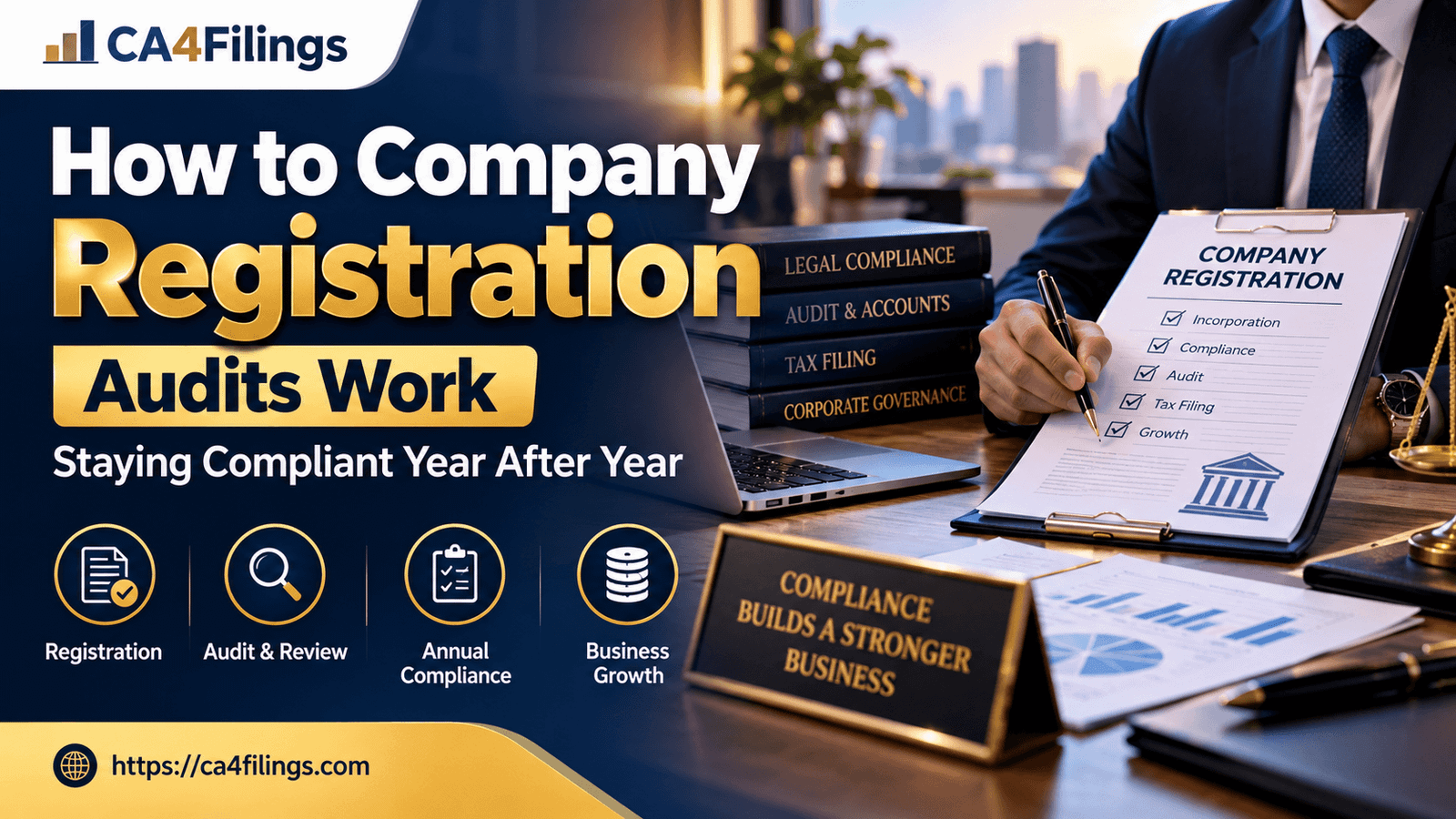
How to Company Registration Audits Work: Staying Compliant Year After Year
When business owners search for how to company registration, they often focus only on incorporation documents, certificates, and getting the company legally formed. But registration is only the beginning. Once a company is incorporated, it must continue meeting statutory, financial, tax, and record-keeping requirements every year. If you are exploring Company Registration, it is equally important to understand what happens after incorporation and how compliance audits help keep your business on the right track.
At CA4Filings, we regularly advise businesses that the real value of understanding how to company registration lies in knowing what comes next. A properly registered company can still face notices, penalties, or compliance issues if its annual filings, financial records, board documentation, and tax obligations are neglected.
What Happens After Company Registration?
Understanding how to company registration does not end with receiving the Certificate of Incorporation. Companies have continuing obligations under applicable corporate, tax, and regulatory laws.
Depending on the company's structure and activities, these may include:
- Maintaining statutory registers and corporate records
- Holding required board and shareholder meetings
- Preparing financial statements
- Completing annual filing compliance
- Filing income tax returns
- Maintaining accounting records
- Completing statutory audits where applicable
- Paying applicable taxes and government fees
- Maintaining supporting documents for business transactions
A common mistake is assuming that a company that has not generated significant revenue has no compliance obligations. In practice, certain filings and statutory requirements may continue even when business activity is limited.
How to Company Registration Audits Actually Work
Many business owners misunderstand the word "audit." An audit is not simply a government officer visiting your office and checking documents.
In most cases, compliance review involves examining whether the company has maintained proper records and fulfilled its applicable legal and financial obligations.
Step 1: Review of Corporate Records
The first stage is usually checking the company's foundational and ongoing records.
A professional may review:
- Certificate of Incorporation
- Memorandum and Articles of Association
- Shareholding information
- Director details
- Board resolutions
- Shareholder resolutions
- Statutory registers
- Agreements and important corporate documents
A properly maintained corporate minute book is particularly useful. It provides a chronological record of important company decisions, approvals, meetings, and resolutions.
Step 2: Checking Financial Records
The next stage involves reviewing the company's books of accounts and supporting documents.
This may include:
- Sales invoices
- Purchase invoices
- Bank statements
- Expense records
- Payroll records
- Fixed asset registers
- Loan documents
- Investment records
- Receivables and payables
Good documentation makes an audit or compliance review considerably easier. It also helps management identify errors before they become expensive problems.
Step 3: Reviewing Statutory Filings
The reviewer then checks whether the company has completed its required filings within the applicable deadlines.
This is where annual filing compliance becomes especially important. Depending on the company and applicable laws, annual obligations may involve corporate filings, financial statements, income tax returns, tax payments, and other regulatory submissions.
The important point is simple: incorporation creates an ongoing compliance responsibility.
How to Company Registration Compliance Is Maintained Year After Year
Once you understand how to company registration works, the next question should be: how do I keep the company compliant?
The best approach is to treat compliance as a recurring business process rather than a once-a-year emergency.
Maintain a Compliance Calendar
Create a calendar containing:
- Annual return deadlines
- Financial statement filing deadlines
- Income tax deadlines
- Board meeting requirements
- Tax payment dates
- Licence renewals
- Regulatory reporting dates
- Other industry-specific obligations
Assign responsibility for every deadline. A calendar without an owner is easy to ignore.
Maintain Proper Records Throughout the Year
Do not wait until the annual filing period to collect documents.
Follow strong record-keeping standards by maintaining invoices, contracts, bank statements, resolutions, tax records, and accounting documents systematically.
Digital records should also be backed up securely. Important corporate records should not exist only in one employee's laptop or email account.
Reconcile Accounts Regularly
Monthly or quarterly reconciliation can identify problems much earlier than an annual review.
For example, suppose a company discovers at year-end that several customer payments were incorrectly classified or that expenses were recorded under the wrong accounts. Correcting these issues becomes more time-consuming when records have accumulated for twelve months.
Regular bookkeeping reduces this risk.
What Happens If a Company Receives an Audit Notice?
Receiving a notice does not automatically mean that the company has committed a serious violation. Notices can arise for different reasons, including missing information, inconsistencies, late filings, or routine verification.
The first step is to understand exactly what the authority is asking for.
Practical Response Process
- Read the notice carefully.
- Check the deadline for responding.
- Identify the documents requested.
- Compare the request with your accounting and corporate records.
- Prepare a factual response.
- Correct genuine errors where appropriate.
- Keep proof of submission and communication.
- Take professional advice when the matter is complex.
In jurisdictions where state-level obligations apply, businesses may also need to address matters such as franchise tax payment requirements. The terminology and rules vary by jurisdiction, so companies operating across states or countries should obtain advice relevant to their specific circumstances.
Why Good Documentation Matters During State Audit Defense
If a business is selected for a tax or regulatory review, documentation can become its strongest line of support.
For example, imagine a company claims a business expense but has no invoice, contract, payment proof, or accounting trail. Even if the expense was genuine, proving it later can be difficult.
This is why state audit defense, where applicable, is much easier when records have been maintained consistently from the beginning.
A good compliance file should allow an independent professional to understand:
- What the transaction was
- Why it occurred
- Who approved it
- How it was recorded
- How it was paid
- What supporting documents exist
That level of clarity can save considerable time during an enquiry.
Common Company Compliance Mistakes to Avoid
Understanding how to company registration is useful, but avoiding common post-registration mistakes is equally important.
Ignoring Annual Filings
Some owners believe that no revenue means no filing obligation. This assumption can lead to unnecessary penalties or notices.
Poor Corporate Documentation
Important decisions should be properly documented through appropriate resolutions and records.
Mixing Personal and Business Transactions
Using company accounts for personal spending can create accounting, tax, and governance complications.
Delaying Tax Payments
Businesses should monitor tax liabilities throughout the year rather than waiting until the deadline.
Losing Supporting Documents
Invoices, contracts, bank records, and payment proofs should be stored systematically and retained according to applicable requirements.
Treating Compliance as a One-Time Task
Registration is a starting point. Compliance is an ongoing responsibility.
A Simple Yearly Compliance Routine
For many small and growing companies, the following routine can provide a practical starting point:
Monthly
- Update bookkeeping
- Reconcile bank accounts
- Organise invoices
- Review outstanding taxes and payments
Quarterly
- Review financial performance
- Check statutory obligations
- Update corporate records
- Review upcoming deadlines
Annually
- Prepare financial statements
- Complete required audits
- Review statutory registers
- Complete annual filing compliance
- Review tax returns and payments
- Update the corporate minute book
This structured approach makes how to company registration much easier to manage in the long run because compliance becomes part of normal business operations.
FAQs About How to Company Registration and Audits
1. Is an audit required for every registered company?
No. Audit requirements depend on factors such as the company's legal structure, turnover, applicable laws, and other prescribed criteria. A professional should review the company's circumstances before determining its audit obligations.
2. What is a corporate minute book?
A corporate minute book is a collection of important company records, including meeting minutes, resolutions, and other corporate documentation. Maintaining it properly helps demonstrate that significant company decisions were formally documented.
3. What is annual filing compliance?
Annual filing compliance refers to completing the statutory filings that a company is required to submit periodically, particularly its annual corporate and financial filings, within prescribed timelines.
4. Can a company be penalised for late compliance?
Yes. Depending on the requirement and applicable law, late filings or non-compliance may result in additional fees, penalties, interest, notices, or other consequences.
5. How can professional CA support help?
A Chartered Accountant can help businesses understand their applicable obligations, maintain financial records, prepare filings, identify compliance gaps, and respond appropriately to regulatory or tax queries.
How to Company Registration Is Only the Beginning
Knowing how to company registration helps you establish a business legally, but long-term success depends on what you do after incorporation. Regular bookkeeping, timely annual filing compliance, proper corporate documentation, tax planning, and reliable record-keeping standards can significantly reduce compliance stress.
At CA4Filings, we believe business owners should spend their time building their businesses rather than worrying about missed statutory deadlines. From understanding how to company registration to managing ongoing compliance and audit requirements, professional guidance can help you maintain a cleaner and more organised corporate structure year after year.
Ready to keep your company compliant? Connect with CA4Filings for professional company registration, accounting, tax, and ongoing compliance support tailored to your business.
Latest Updates
ca4filings.com Services
























-registration.png)