How Can I Register a Company if I Am Not a US Citizen? (The LLC Strategy)
Learn how can i register a company in the USA as a non-citizen, including LLC formation, EIN, banking, taxes, and compliance.
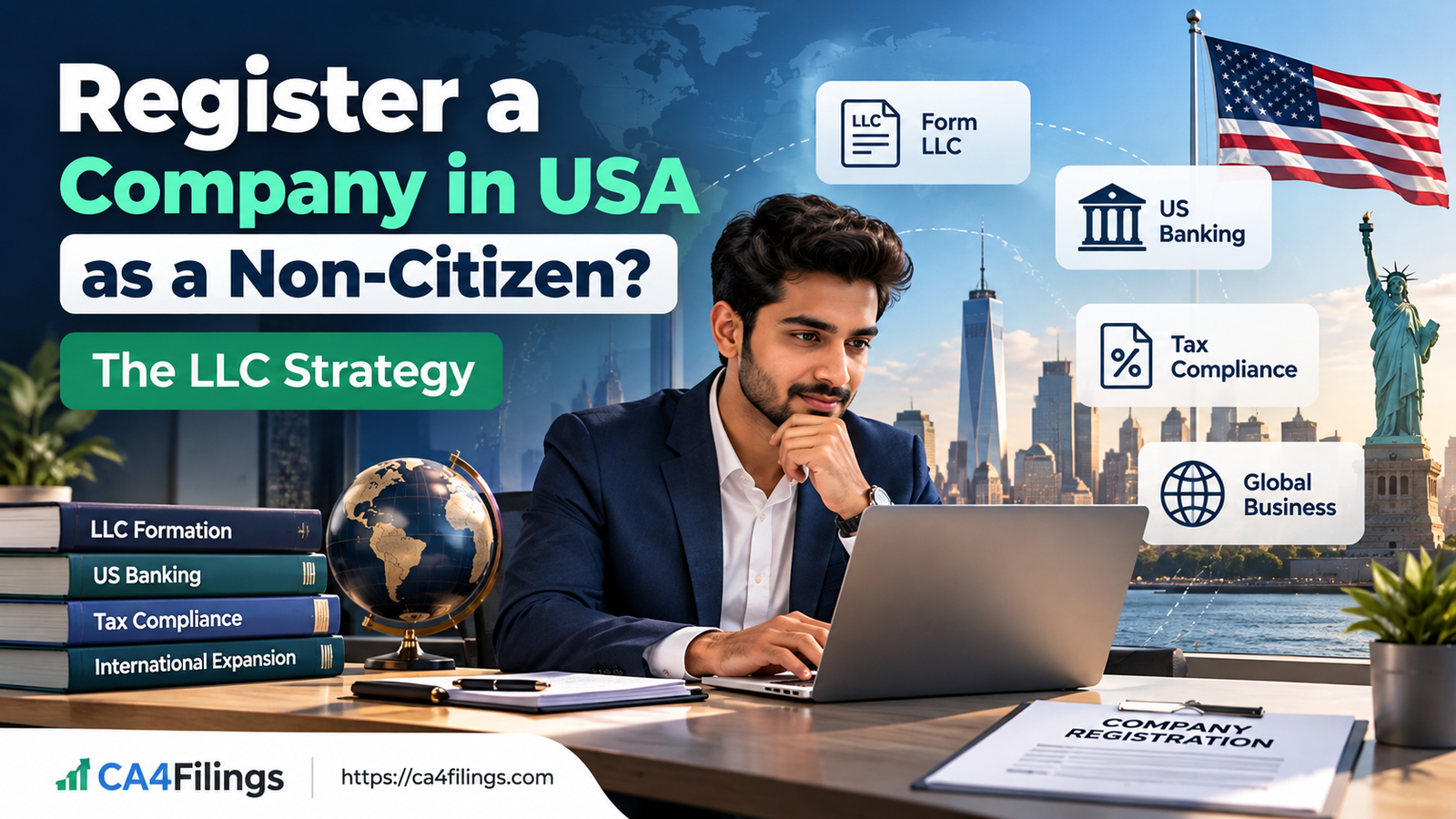
If you are an Indian entrepreneur, freelancer, consultant, or business owner planning to expand into the United States, you may be wondering, how can i register a company in the USA if I am not a US citizen? The good news is that US law generally allows foreign nationals to establish and own American businesses without becoming US citizens or permanent residents. For many international entrepreneurs, forming a Limited Liability Company (LLC) is a practical starting point.
At CA4Filings, we help business owners understand international business structures, documentation requirements, and compliance responsibilities before taking the first step. Whether you want to serve American clients, launch an online business, or build an international brand, understanding the registration process is essential. Our Company Registration services can also help you explore the right business structure for your broader expansion plans.
However, registering a US company is not simply about filing paperwork. You must also consider taxation, banking, ownership disclosures, and your obligations in India. Let us understand how the LLC strategy works and how you can approach it confidently.
How Can I Register a Company in the USA Without Citizenship?
The first thing to understand is that US citizenship is generally not required to own an LLC or a corporation. Foreign entrepreneurs can establish businesses in many US states without physically residing in America.
An LLC is often preferred because it offers operational flexibility, relatively straightforward administration, and liability protection when properly maintained.
For example, suppose you operate a digital marketing agency in India and want to work with American clients. You could establish a foreign-owned LLC in a suitable US state, obtain an Employer Identification Number (EIN) when eligible, and arrange appropriate payment and banking facilities.
Before proceeding, remember that company ownership does not automatically grant a visa, immigration status, or permission to work physically in the United States.
Why Choose an LLC Instead of a Corporation?
An LLC may be suitable for small businesses, independent professionals, consultants, e-commerce sellers, and software service providers.
Its main advantages include:
Flexible ownership: Non-US citizens can generally own 100% of an LLC.
Limited liability: Personal assets may receive protection from business liabilities, subject to applicable law and proper business practices.
Flexible management: Members can manage the company themselves or appoint managers.
Simplified administration: An LLC generally has fewer corporate formalities than a traditional corporation.
Tax classification options: Federal tax treatment depends on ownership, elections, and the nature of the business.
A corporation may be more appropriate if you intend to raise venture capital, issue different classes of shares, or build a business designed for institutional investment.
Which US State Should You Choose for Your LLC?
Choosing a state is an important decision because filing costs, annual fees, reporting requirements, and business regulations vary.
Popular options include:
Wyoming: Often considered by entrepreneurs seeking comparatively straightforward administration and relatively low ongoing state costs.
Delaware: Common among businesses that anticipate outside investment or prefer its established corporate legal framework.
New Mexico: Sometimes considered by small businesses evaluating formation and maintenance costs.
There is no universally best state for every non-resident.
If your business operates primarily online and has no physical presence in the United States, a state with manageable ongoing compliance costs may be suitable. However, if you have employees, an office, or other business activities in a particular state, you may need to register there even if your LLC was formed elsewhere.
Compare the complete cost of ownership, including registered agent fees, annual reports, franchise taxes, and other state-specific obligations, rather than choosing a state based only on its initial filing fee.
Step-by-Step Guide: How Can I Register a Company Through an LLC?
Once you have selected the business structure and state, the registration process becomes easier to understand.
Step 1: Select a Business Name
Choose a name that complies with your selected state's naming rules. The name must be distinguishable from existing registered entities, and certain words may require special approval.
Check name availability through the relevant Secretary of State's website before filing.
Step 2: Appoint a Registered Agent
A registered agent is responsible for receiving official correspondence, legal notices, and service of process on behalf of the LLC.
Most states require an agent with a physical street address in that state. A non-resident owner can generally hire a professional registered agent service.
Step 3: File the Articles of Organization
Submit the required formation document to the relevant state authority. It is commonly called the Articles of Organization, although the terminology may vary.
You will typically provide:
The LLC's legal name.
The registered agent's details.
The business address and other required information.
Details of the organizer.
Any additional information required by the state.
Once the filing is accepted, the LLC is legally formed under that state's law.
Step 4: Prepare an Operating Agreement
An operating agreement explains how the LLC will operate, who owns it, how decisions will be made, and how profits and distributions will be handled.
Even where it is not mandatory to file this document with the state, maintaining one is good business practice. It can also help demonstrate that the company is separate from its owner.
Step 5: Apply for an EIN
An Employer Identification Number is issued by the Internal Revenue Service (IRS) and is commonly needed for tax filings, hiring employees, and opening business financial accounts.
Foreign applicants who do not have and are not eligible for a Social Security Number may still be able to obtain an EIN through the applicable IRS process.
The appropriate application method depends on your circumstances. Do not assume that every non-resident must apply online or that an SSN is always required.
Step 6: Arrange Business Banking and Payment Facilities
The next step is exploring us banking for non-residents.
Some US banks and financial technology providers accept foreign-owned LLCs, while others require an in-person visit, a US residential address, or additional identification.
You may be asked to provide:
LLC formation documents.
EIN confirmation.
Passport and identity verification.
Operating agreement.
Business address and ownership information.
Evidence of the nature and source of business funds.
Approval is not guaranteed merely because the LLC has been registered. Compare the provider's eligibility rules, transaction fees, foreign exchange costs, and compliance requirements before applying.
Understanding Taxes for a Foreign-Owned LLC
Company formation and tax registration are two different matters. A foreign-owned LLC can create US tax obligations even when its owner lives outside America.
Federal Tax Treatment of a Single-Member Foreign LLC
A single-member foreign LLC owned by an individual is generally treated as a disregarded entity for US federal income tax purposes unless it elects a different classification.
This means that the LLC's income is not necessarily taxed as a separate corporation. Instead, the tax treatment generally depends on the owner's circumstances and the nature and source of the income.
However, disregarded status does not mean exemption from every reporting obligation. A foreign-owned, single-member US LLC may have to file Form 5472 with a pro forma Form 1120 when the relevant reporting requirements apply, including certain reportable transactions with its foreign owner.
Penalties for failing to meet applicable information-reporting requirements can be substantial. Professional tax advice is therefore important even if the business has limited activity.
What Is Effectively Connected Income?
Effectively connected income refers broadly to income connected with conducting a trade or business in the United States. Its treatment depends on the applicable tax rules and the taxpayer's circumstances.
For example, a non-resident consultant serving US customers should not assume that every payment from an American client is automatically US-taxable—or automatically tax-free. The services performed, business activities, source-of-income rules, and applicable tax provisions all matter.
International tax treaties may modify certain tax outcomes where a relevant treaty applies, but treaty benefits are not automatic and can depend on residency, income classification, and eligibility requirements.
What About Indian Tax Obligations?
If you are an Indian resident operating a US LLC, you should examine Indian tax treatment separately from US obligations.
Depending on your circumstances, relevant considerations may include:
Reporting foreign assets and income where required.
Indian tax treatment of overseas business profits and distributions.
Foreign tax credit eligibility and documentation.
Applicable foreign exchange and overseas investment rules.
US and Indian filing deadlines.
The correct treatment depends on your tax residency, ownership structure, business activities, and the way income is earned and received. Do not assume that incorporating abroad removes your Indian tax responsibilities.
Common Mistakes Non-US Entrepreneurs Should Avoid
When considering how can i register a company in the USA, avoid these common mistakes:
Choosing a state without calculating annual maintenance costs.
Assuming that an LLC automatically makes all business income tax-free.
Using a personal account for business transactions without checking the provider's terms.
Ignoring IRS information returns because the company has no employees.
Overlooking state-level registration and tax obligations.
Confusing company ownership with US immigration or work authorization.
Failing to maintain accurate records of transactions between the LLC and its foreign owner.
A properly structured business should be designed around your commercial goals, not just the lowest registration fee.
Latest Updates
ca4filings.com Services



























-registration.png)