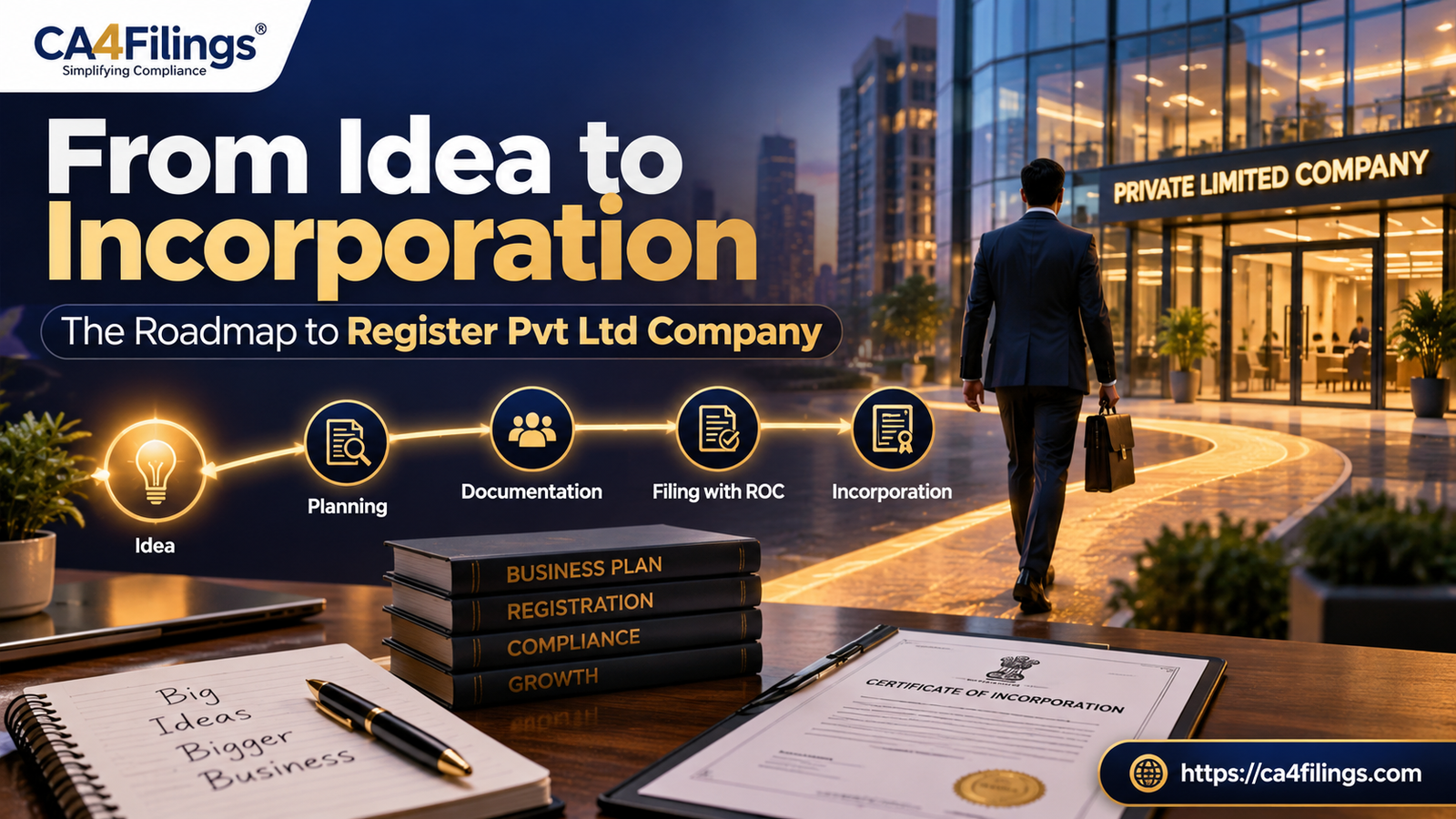
From Idea to Incorporation: The Roadmap to Register Pvt Ltd Company
Learn how to register pvt ltd company in India, from choosing a business structure to filing incorporation documents and launching your startup.
Turning Your Business Idea into a Registered Company
Every successful business begins with an idea, but turning that idea into a legally recognised business requires careful planning. Whether you want to launch a technology startup, build an e-commerce brand, or establish a consulting firm, choosing the right legal structure is an important first step. For many entrepreneurs, the decision to register pvt ltd company offers a practical way to build credibility, protect personal assets, and prepare for future growth.
However, company incorporation involves more than submitting an application. You must select a suitable business name, arrange the necessary documents, appoint directors, and comply with the requirements of the Ministry of Corporate Affairs (MCA). At CA4Filings, we help entrepreneurs understand these requirements and complete the process with greater confidence. Our Company Registration services can guide you through the formalities, allowing you to focus on developing your business.
Let's explore the roadmap from an initial idea to a fully incorporated private limited company in India.
Why Register Pvt Ltd Company Instead of Choosing Another Business Structure?
Before starting the registration process, it is important to understand why a private limited company may suit your business goals.
A private limited company is a separate legal entity, which means it can own assets, enter into contracts, and conduct business in its own name. Its shareholders generally enjoy limited liability, subject to applicable laws and circumstances.
Here are some important advantages:
Limited liability: Shareholders' liability is generally limited to the unpaid amount on their shares.
Separate legal identity: The company operates independently of its owners.
Better business credibility: A registered company may inspire greater confidence among clients, suppliers, and potential investors.
Growth opportunities: The company can issue shares in accordance with applicable legal requirements, making it suitable for businesses planning to raise investment.
Business continuity: Changes in ownership or the departure of a shareholder do not automatically bring the company to an end.
For example, suppose two entrepreneurs start a software development business. Registering a private limited company can help them establish clear ownership, formalise their working relationship, and prepare for investment.
However, incorporation also involves annual compliance, accounting, and statutory filing obligations. Your business structure should therefore reflect your long-term plans, not just your immediate requirements.
Step-by-Step Guide to Register Pvt Ltd Company in India
Step 1: Finalise Your Business Idea and Ownership Structure
Begin by defining what your business will do, who will own it, and how responsibilities will be divided.
Under the Companies Act, 2013, a private limited company generally requires at least two members and two directors. At least one director must satisfy the applicable requirement of having stayed in India for the prescribed period during the financial year.
Before proceeding, discuss the following with your co-founders:
The percentage of shares each founder will hold.
The initial share capital.
The roles and responsibilities of each director.
The proposed registered office address.
The business activities the company will undertake.
For instance, if two founders contribute different amounts, they should agree on their shareholding and decision-making rights before incorporation. A clear understanding at this stage can help prevent disputes later.
Step 2: Choose a Unique Company Name
Your company name represents your brand, so choose something distinctive, professional, and relevant to your business.
The proposed name must comply with MCA naming rules and should not be identical or too similar to an existing company or registered trademark in a manner prohibited by law.
You can check name availability through the MCA portal and conduct a trademark search before applying.
Keep two or three alternative names ready in case your preferred option is unavailable. Also, consider whether the name is easy to remember and suitable for your future branding plans.
Step 3: Obtain Digital Signatures and Director Identification Numbers
The incorporation process is largely digital, making electronic authentication essential.
Proposed directors and subscribers who need to sign incorporation documents electronically generally require a Digital Signature Certificate (DSC).
A Director Identification Number (DIN) is also required for appointment as a director. For new directors, DIN allotment can generally be requested through the applicable incorporation process, subject to the prescribed rules and limits.
Make sure the names and other details in the applications match the supporting documents. Even a minor discrepancy can cause delays or require corrections.
Step 4: Prepare the Required Documents
Document preparation is one of the most important stages when you register pvt ltd company.
Typically, the following documents and details are required:
PAN and identity proof of Indian individual subscribers and proposed directors, as applicable.
Address proof, such as an accepted bank statement or utility bill.
Recent photographs, where required by the process.
Registered office address proof.
A recent utility bill and the owner's no-objection certificate, where applicable.
Details of proposed shareholders, directors, shareholding, and business activities.
Additional requirements may apply depending on whether the subscribers are Indian residents, foreign nationals, or corporate entities.
Check that the documents are valid, legible, and consistent. Proper preparation reduces the likelihood of resubmission and helps keep your startup launch on schedule.
Step 5: File the Incorporation Application with the MCA
Once the documents and company name are ready, the next step is filing the prescribed incorporation forms electronically.
The integrated SPICe+ process allows applicants to complete several incorporation-related formalities through the MCA system. Depending on eligibility and requirements, the process may include:
Application for company incorporation.
DIN allotment for eligible proposed directors.
Application for PAN and TAN.
Filing of the Memorandum of Association (MoA).
Filing of the Articles of Association (AoA).
Other applicable registrations or declarations.
The MoA defines the company's principal objectives and permitted scope, while the AoA establishes important rules governing its internal management.
After submission, the application is examined by the relevant authorities. The Registrar of Companies (ROC) may approve it or request clarification or corrections.
Step 6: Receive Your Certificate of Incorporation
Once the application is approved, the ROC issues the Certificate of Incorporation. The certificate contains the company's Corporate Identity Number (CIN) and confirms that the company has been incorporated.
PAN and TAN are generally allotted through the integrated process, as applicable.
At this point, your company has a separate legal identity. However, incorporation is the beginning of your compliance journey rather than the end of it.
Understanding Share Capital and Registration Costs
When planning pvt ltd company registration, entrepreneurs often assume that they need a large amount of capital. In reality, there is no general statutory minimum paid-up capital requirement for an ordinary private limited company under the Companies Act, 2013.
You should determine the authorised and subscribed share capital based on the business's actual needs, ownership arrangement, and future funding plans.
Registration costs can vary depending on factors such as:
State-specific stamp duty.
Applicable government filing fees.
DSC charges.
Professional fees for incorporation assistance.
Any additional registrations or services required.
Rather than choosing an arbitrary capital figure, discuss your expected expenses, working capital needs, and growth plans with a qualified professional.
What to Do After You Register Pvt Ltd Company
After receiving the incorporation certificate, complete the applicable post-incorporation formalities.
Open a Current Bank Account
Approach a bank with the incorporation certificate, PAN, constitutional documents, and other KYC documents it requires.
Complete Initial Compliance
Depending on the company's circumstances, important requirements may include:
Holding the first board meeting within the prescribed period.
Appointing the first statutory auditor within the applicable deadline.
Issuing share certificates within the prescribed period.
Filing the declaration for commencement of business in Form INC-20A, where applicable, within 180 days of incorporation.
Maintaining statutory registers and accounting records.
Also assess whether GST registration, Shops and Establishments registration, professional tax registration, or industry-specific licences are required.
Remember that compliance requirements vary according to the company's activities, location, and circumstances.
Common Mistakes to Avoid During Company Registration
Even a straightforward incorporation can become time-consuming when basic details are overlooked.
Avoid these common mistakes:
Selecting a name without checking availability and trademark conflicts.
Using inconsistent information across identity and address documents.
Choosing an unsuitable shareholding arrangement.
Providing incomplete registered office documentation.
Ignoring post-incorporation deadlines.
Assuming that incorporation automatically completes every tax or business licence requirement.
Working with an experienced professional can help you identify these issues before they become costly problems.
Latest Updates
ca4filings.com Services



























-registration.png)