ISO Certification in the Manufacturing Sector: Key Benefits and Challenges
ISO Certification in the Manufacturing Sector: Key Benefits and Challenges explained with practical insights for Indian manufacturers.
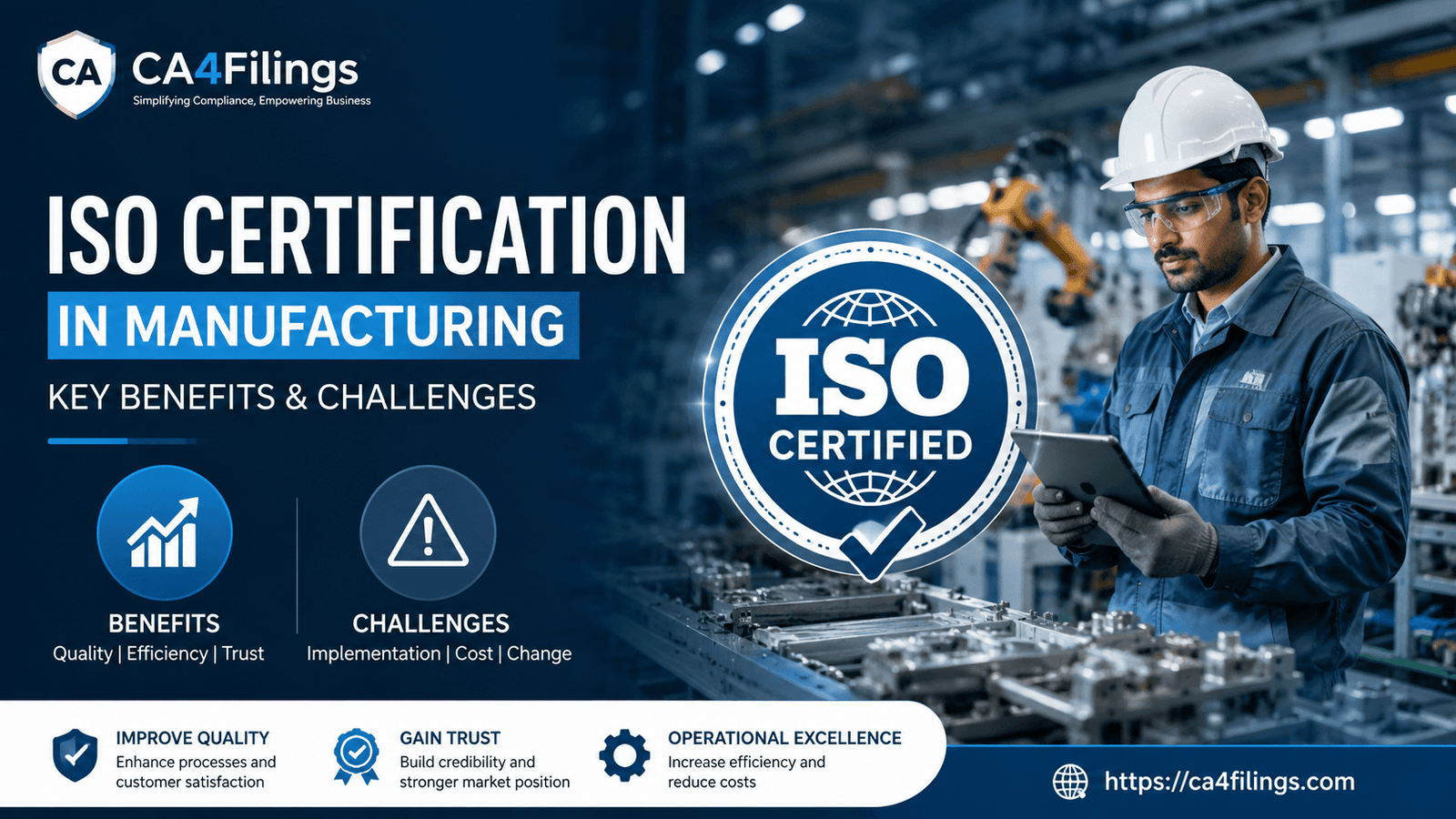
Manufacturing businesses today operate in a highly competitive and quality-driven market. Customers expect consistent product quality, timely delivery, safety compliance, and international standards. This is where ISO Certification in the Manufacturing Sector: Key Benefits and Challenges becomes an important topic for every manufacturer in India.
Whether you run a small factory, a medium-scale production unit, or a large industrial setup, ISO certification helps build trust and improve operational efficiency. At CA4Filings, we often guide manufacturers who want to streamline processes, increase customer confidence, and expand into global markets through proper compliance systems.
If your business is planning to improve quality management and gain industry recognition, obtaining ISO Certification can be a smart long-term investment for sustainable growth.
Understanding ISO Certification in Manufacturing
ISO stands for the International Organization for Standardization. It develops globally accepted standards that help businesses maintain quality, efficiency, safety, and consistency.
In the manufacturing industry, some commonly used ISO standards include:
- ISO 9001 – Quality Management System
- ISO 14001 – Environmental Management System
- ISO 45001 – Occupational Health and Safety
- ISO 22000 – Food Safety Management
- ISO 27001 – Information Security Management
ISO Certification in the Manufacturing Sector: Key Benefits and Challenges is especially relevant because manufacturing processes involve multiple departments, machinery, manpower, raw materials, and quality controls.
An ISO-certified manufacturing unit demonstrates that it follows internationally accepted systems and procedures.
Why ISO Certification Matters for Manufacturers
Today’s buyers are more quality-conscious than ever before. Large corporations, government departments, exporters, and international clients often prefer dealing with ISO-certified manufacturers.
Improved Credibility in the Market
An ISO-certified business gains better credibility among customers, suppliers, and investors. It sends a strong message that the company follows standardised systems and quality procedures.
For example, many Indian auto-component manufacturers secure contracts from multinational companies only after obtaining ISO certification.
Better Product Quality
One major advantage discussed under ISO Certification in the Manufacturing Sector: Key Benefits and Challenges is improved product consistency.
ISO systems help manufacturers:
- Reduce defects
- Standardise production
- Maintain documentation
- Monitor quality checkpoints
- Improve inspection procedures
This directly reduces customer complaints and product returns.
Increased Operational Efficiency
Manufacturing businesses often face production delays, wastage, inventory issues, and process inefficiencies.
ISO certification introduces structured workflows that help:
- Minimise material wastage
- Improve productivity
- Reduce machine downtime
- Enhance employee accountability
- Streamline internal communication
Over time, these improvements contribute to better profitability.
ISO Certification in the Manufacturing Sector: Key Benefits and Challenges for Export Businesses
Indian manufacturers targeting international markets greatly benefit from ISO certification.
Easier Access to Global Markets
Many foreign buyers and international distributors require ISO certification before entering into business partnerships.
ISO-certified manufacturers often find it easier to:
- Participate in global tenders
- Export products internationally
- Build trust with overseas buyers
- Meet international compliance expectations
This is particularly important for sectors like engineering, pharmaceuticals, textiles, chemicals, and food processing.
Better Customer Satisfaction
Customer satisfaction is a core principle of ISO standards.
Manufacturers that implement ISO systems usually experience:
- Better complaint handling
- Faster response times
- Consistent product quality
- Improved customer retention
Satisfied customers often lead to repeat orders and long-term business growth.
Key Challenges in ISO Certification for Manufacturing Companies
While the benefits are substantial, ISO Certification in the Manufacturing Sector: Key Benefits and Challenges also includes certain practical difficulties that businesses must understand before implementation.
Documentation Requirements
One common challenge is maintaining proper documentation.
Manufacturers need to create and maintain:
- Quality manuals
- Standard operating procedures
- Process records
- Audit reports
- Training records
Small businesses sometimes find this process time-consuming initially.
Employee Resistance to Change
Employees may resist new systems, reporting structures, or quality procedures.
In many factories, workers are accustomed to traditional methods. Implementing ISO standards requires proper training and awareness sessions.
Without employee cooperation, successful implementation becomes difficult.
Initial Implementation Cost
ISO certification involves expenses related to:
- Consultancy
- Documentation
- Staff training
- Internal audits
- Certification body fees
However, these should be viewed as long-term investments rather than short-term expenses.
Most manufacturers recover these costs through improved efficiency and reduced wastage.
Continuous Compliance and Audits
ISO certification is not a one-time process.
Businesses must undergo:
- Internal audits
- Surveillance audits
- Periodic renewals
Maintaining compliance consistently can be challenging if management commitment is weak.
How Manufacturers Can Successfully Implement ISO Standards
Understanding ISO Certification in the Manufacturing Sector: Key Benefits and Challenges is only the first step. Proper implementation is equally important.
Conduct a Gap Analysis
Before applying for certification, businesses should evaluate current systems and identify gaps.
This helps understand:
- Existing process weaknesses
- Documentation gaps
- Compliance deficiencies
- Operational risks
Train Employees Properly
Employee awareness plays a critical role in successful ISO implementation.
Training should cover:
- Quality objectives
- Standard operating procedures
- Safety practices
- Documentation methods
- Process responsibilities
Appoint an Internal ISO Team
Creating a dedicated internal team ensures smoother implementation and monitoring.
This team can:
- Coordinate audits
- Maintain records
- Track compliance
- Monitor corrective actions
Choose the Right Certification Body
Manufacturers should always select a recognised and credible certification agency.
A trusted certification body ensures proper audit practices and global acceptance of the certificate.
Industries That Benefit Most from ISO Certification
ISO Certification in the Manufacturing Sector: Key Benefits and Challenges applies across various industries, including:
- Automobile manufacturing
- Food processing
- Pharmaceuticals
- Textile production
- Engineering goods
- Electronics manufacturing
- Chemical industries
- Packaging industries
Even small and medium-sized manufacturers can benefit significantly from ISO compliance.
Common Mistakes Manufacturers Should Avoid
Many businesses face difficulties because of poor planning during certification.
Here are some mistakes to avoid:
Ignoring Employee Involvement
ISO implementation should not remain limited to management alone. Workers at every level must participate actively.
Treating ISO as a Formality
Some businesses obtain certification only for marketing purposes without genuinely improving systems.
This approach usually fails during audits and affects long-term business performance.
Poor Documentation Practices
Improper record maintenance can create compliance issues during certification and surveillance audits.
Delaying Corrective Actions
Audit observations should be addressed immediately to avoid repeated non-compliance issues.
FAQs on ISO Certification in Manufacturing
Is ISO certification mandatory for manufacturing companies in India?
No, ISO certification is generally voluntary. However, many clients, government tenders, and export markets prefer ISO-certified manufacturers.
Which ISO standard is best for manufacturers?
ISO 9001 is the most commonly used standard for quality management in manufacturing businesses.
How long does ISO certification take?
The timeline depends on the size and complexity of the business. Usually, it may take between 1 to 6 months.
Does ISO certification improve sales?
Yes, ISO certification can improve customer trust, market reputation, and business opportunities, which may positively impact sales.
Can small manufacturers apply for ISO certification?
Absolutely. Small and medium manufacturing businesses can also obtain ISO certification and gain operational advantages.
ISO Certification in the Manufacturing Sector: Key Benefits and Challenges is an important consideration for every manufacturing business aiming for long-term growth and operational excellence.
While the certification process may involve documentation, training, audits, and initial investment, the long-term advantages far outweigh the challenges. Improved quality control, higher customer satisfaction, global market access, and enhanced efficiency make ISO certification a valuable business asset.
At CA4Filings, we help manufacturing businesses simplify the ISO certification process with professional guidance, documentation support, and compliance assistance. Whether you are a startup manufacturer or an established industrial unit, our team ensures a smooth and hassle-free certification journey.
Connect with CA4Filings today and take your manufacturing business towards stronger credibility, better quality standards, and sustainable growth.
Latest Updates
ca4filings.com Services


























-registration.png)