The Legal Lifespan: What Happens After You Register One Person Company Status
Share post:
Register one person company with confidence. Learn OPC compliance, business lifespan, succession, ownership transfer, and long-term legal responsibilities.
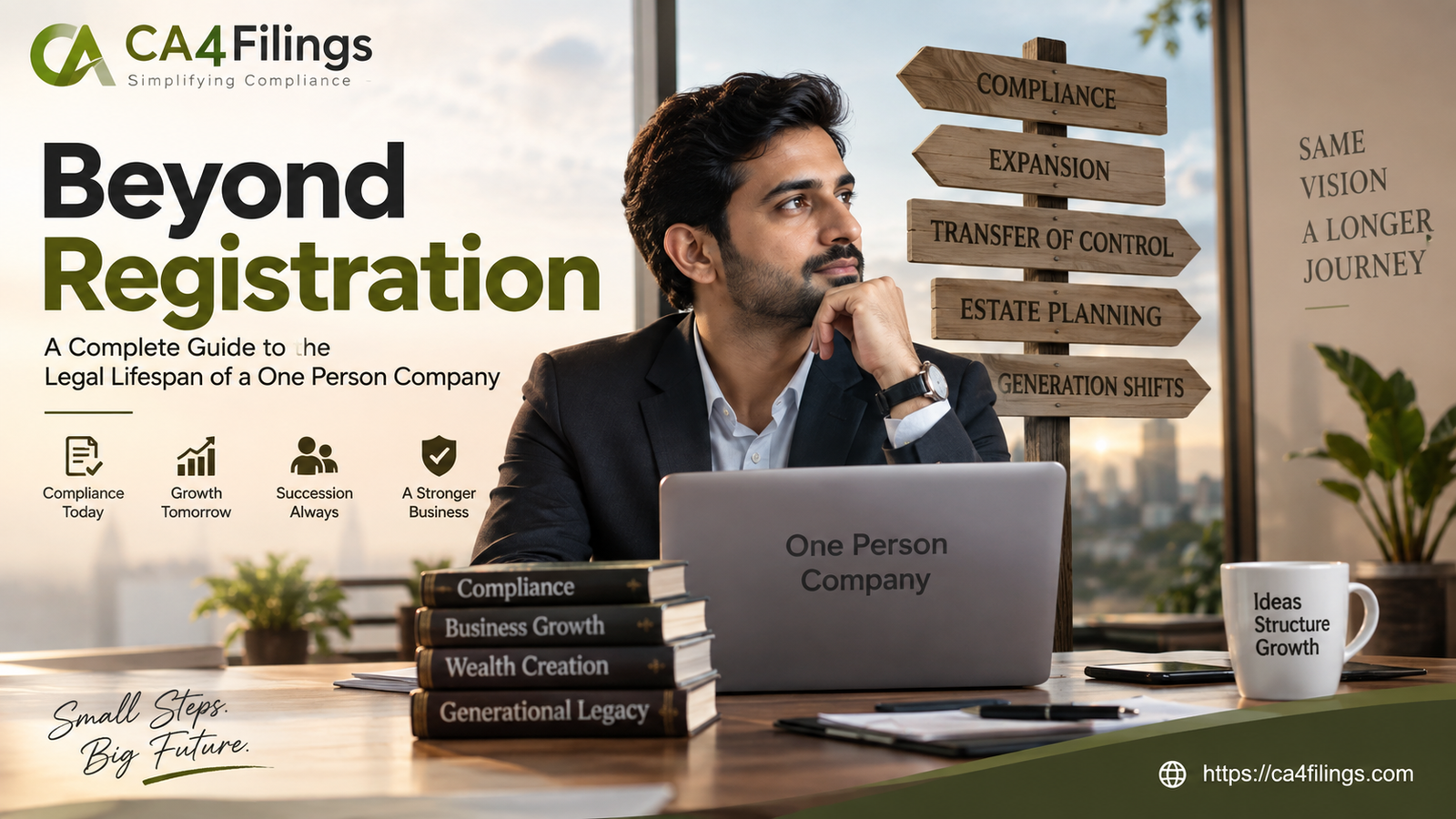
When you register one person company status in India, the journey does not end when the Certificate of Incorporation arrives. In fact, incorporation is only the beginning of the company's legal lifespan. An OPC gives a single entrepreneur the benefits of a separate legal entity, limited liability and a structured business framework, but it also comes with continuing legal and financial responsibilities.
If you are planning to start your business as an OPC, understanding the complete process of Company Registration is important because your responsibilities continue long after incorporation. At CA4Filings, we often advise founders to think beyond registration and consider how the company will operate, remain compliant and eventually handle changes in ownership or management.
So, what actually happens after you register one person company? Let's understand the legal lifespan of an OPC in simple terms.
What Happens After You Register One Person Company?
Once the OPC is incorporated, it becomes a separate legal person under the Companies Act, 2013. This means the company has its own legal identity, assets, liabilities, bank account and contractual obligations.
The shareholder and director may be the same individual, but legally, the individual and the company are not identical.
After you register one person company, some of the important ongoing responsibilities include:
- Maintaining proper books of accounts.
- Filing annual financial statements and annual returns.
- Conducting statutory compliance within prescribed timelines.
- Maintaining required company records and registers.
- Keeping the registered office information updated.
- Completing income-tax and other applicable tax compliances.
- Maintaining proper separation between personal and company finances.
This distinction is one of the biggest advantages of incorporating an OPC, but it also means the founder must treat the company as a genuine business entity rather than simply an extension of a personal bank account.
The Business Lifespan of an OPC
A common misconception is that an OPC is suitable only for a short-term business. In reality, its business lifespan can continue for many years as long as the company remains active and compliant.
There is no automatic expiry simply because the company has been operating for a particular number of years.
For example, suppose Raj starts a digital consultancy and decides to register one person company to establish a formal business structure. Five years later, the consultancy has regular clients, employees and substantial revenue. The OPC can continue operating as long as its legal and statutory obligations are properly maintained.
The company's lifespan may eventually end through:
- Voluntary closure.
- Striking off, where legally applicable.
- Conversion into another permitted business structure.
- Amalgamation or other restructuring.
- Insolvency or liquidation in applicable circumstances.
Therefore, founders should think about business longevity from the beginning rather than focusing only on incorporation.
Compliance Continues After You Register One Person Company
The legal identity of an OPC comes with continuing compliance obligations. Missing these responsibilities can result in additional fees, penalties and unnecessary regulatory complications.
Annual Compliance
An OPC generally needs to prepare and file its financial statements and annual return with the Registrar of Companies within the applicable statutory timelines.
Depending on the company's circumstances, compliance may also involve:
- Income-tax return filing.
- Maintenance of accounting records.
- Audit requirements.
- GST compliance, where applicable.
- TDS compliance, where applicable.
- Other industry-specific registrations or licences.
The exact requirements can differ depending on turnover, business activity, taxation status and other factors.
Maintain Separate Financial Records
Once you register one person company, maintaining a clear distinction between company money and personal money becomes particularly important.
For example, if the company receives ₹10 lakh from customers, that money belongs to the company. The founder should not casually treat the entire amount as personal income. Withdrawals, salaries, reimbursements, loans or other transactions should be properly recorded and accounted for.
This simple discipline can prevent significant accounting and tax problems later.
What Happens When the Founder Wants to Expand?
An OPC is designed around a single member, but businesses often grow beyond their original structure.
A founder may eventually want:
- Additional investors.
- Co-founders.
- Outside shareholders.
- Greater access to capital.
- A structure suitable for larger operations.
- Expansion requiring a different corporate model.
In such situations, the founder may need to examine whether conversion into another eligible company structure is appropriate under the applicable law.
The important point is that incorporation should not be viewed as a permanent business model. Your company's structure should evolve with your commercial requirements.
Transfer of Corporate Control and Ownership
One of the most important long-term considerations is the transfer of corporate control.
A single founder may eventually retire, sell the business, transfer ownership or make arrangements for succession. Since an OPC has one member, any change in ownership needs to be handled through proper legal and corporate documentation.
This is particularly relevant when the business has accumulated valuable assets, intellectual property, contracts, goodwill or investments.
A founder should avoid informal arrangements such as simply handing over company documents, bank credentials or business assets to another person. Corporate ownership and management should change through legally valid procedures.
Single Founder Estate Planning Matters
Single founder estate planning is another area that is often overlooked.
When you register one person company, you nominate a person who can become the member in certain circumstances, subject to applicable legal requirements. This is important because the founder's death or incapacity should not leave the business without a clear succession mechanism.
Good estate planning can involve:
- Reviewing the nominee arrangement.
- Maintaining updated company records.
- Preparing a suitable personal estate plan.
- Documenting important business assets.
- Keeping financial and legal documents organised.
- Informing trusted family members or professional advisers about essential business arrangements.
The objective is not merely to protect personal wealth. It is also to reduce disruption to the business.
Generation Shifts and Business Continuity
Many successful businesses eventually experience generation shifts. A founder may build a company independently and later want a child, family member or professional successor to continue it.
For this reason, founders should think about succession before it becomes urgent.
A practical succession discussion should consider:
- Who will eventually own the business?
- Who will manage daily operations?
- What happens if the founder becomes unavailable?
- How will valuable company assets be protected?
- Will the existing corporate structure still be suitable?
Planning early gives the founder more flexibility and reduces the possibility of disputes.
Business Longevity Models for OPC Founders
There is no single formula for business longevity. Different businesses may follow different business longevity models.
Founder-Led Model
The founder continues to own and manage the company personally. This can work well for professional services, consulting and specialised businesses.
Succession Model
The business is gradually prepared for transfer to a family member or another successor.
Expansion Model
The company grows and eventually adopts a more suitable corporate structure as its capital and ownership requirements change.
Exit Model
The founder builds the business with the intention of eventually transferring ownership or exiting after achieving specific commercial objectives.
Thinking about these possibilities early can make future decisions much easier.
When Should You Consider Closing an OPC?
Not every business continues indefinitely. If the company has stopped operations and the founder does not intend to restart it, keeping an inactive company alive without proper compliance may create unnecessary costs and obligations.
Before deciding to close an OPC, the founder should review:
- Pending statutory filings.
- Tax liabilities.
- Outstanding loans.
- Vendor and customer obligations.
- Employee-related liabilities.
- Bank accounts and assets.
- Applicable closure or strike-off requirements.
A professional review can help determine the appropriate route instead of simply abandoning the company.
Practical Checklist After You Register One Person Company
Keep this checklist handy after incorporation:
- Open and properly operate the company's bank account.
- Maintain accurate accounting records.
- Complete applicable tax registrations.
- Track statutory filing deadlines.
- Preserve invoices, contracts and financial documents.
- Review the nominee arrangement periodically.
- Keep the registered office details updated.
- Separate personal and business transactions.
- Review insurance and contractual requirements where relevant.
- Reassess the company structure as the business grows.
- Plan for succession or eventual exit.
FAQs
Is an OPC valid for only a limited number of years?
No. An OPC does not automatically expire after a fixed period. It can continue as a legal entity while complying with applicable laws and remaining active.
Can I change the structure after I register one person company?
Depending on the circumstances and applicable legal provisions, an OPC may be converted into another permitted company structure. The requirements depend on the company's situation.
What happens to an OPC if the sole member dies?
The nominee mechanism and applicable corporate procedures become important in such circumstances. Proper documentation and succession planning can help ensure continuity.
Does an OPC need annual compliance?
Yes. An OPC has continuing statutory and tax compliance responsibilities. The exact requirements depend on its activities, financial position and applicable laws.
Is an OPC suitable for long-term business?
It can be. The suitability depends on the founder's objectives, business model, funding requirements, growth plans and future ownership expectations.
Conclusion: Think Beyond the Day You Register One Person Company
To register one person company is to create a legal foundation for your business, not to complete the business journey. The real value of an OPC comes from maintaining proper compliance, protecting company assets, planning for growth and preparing for eventual succession or exit.
A thoughtful founder considers the entire legal lifespan of the business—from incorporation and annual compliance to transfer of corporate control, estate planning and generation shifts.
At CA4Filings, we help entrepreneurs understand not only how to register one person company, but also how to manage the responsibilities that follow. If you are starting an OPC or reviewing an existing company's structure, professional guidance can help you make informed decisions and keep your business on a compliant path.
Latest Updates
ca4filings.com Services























-registration.png)




Call Now