How Do You Register a Company to Minimize Corporate Tax Liability?
Share post:
Learn how do you register a company to legally reduce corporate tax liability through smart structuring, deductions, tax planning and compliance.
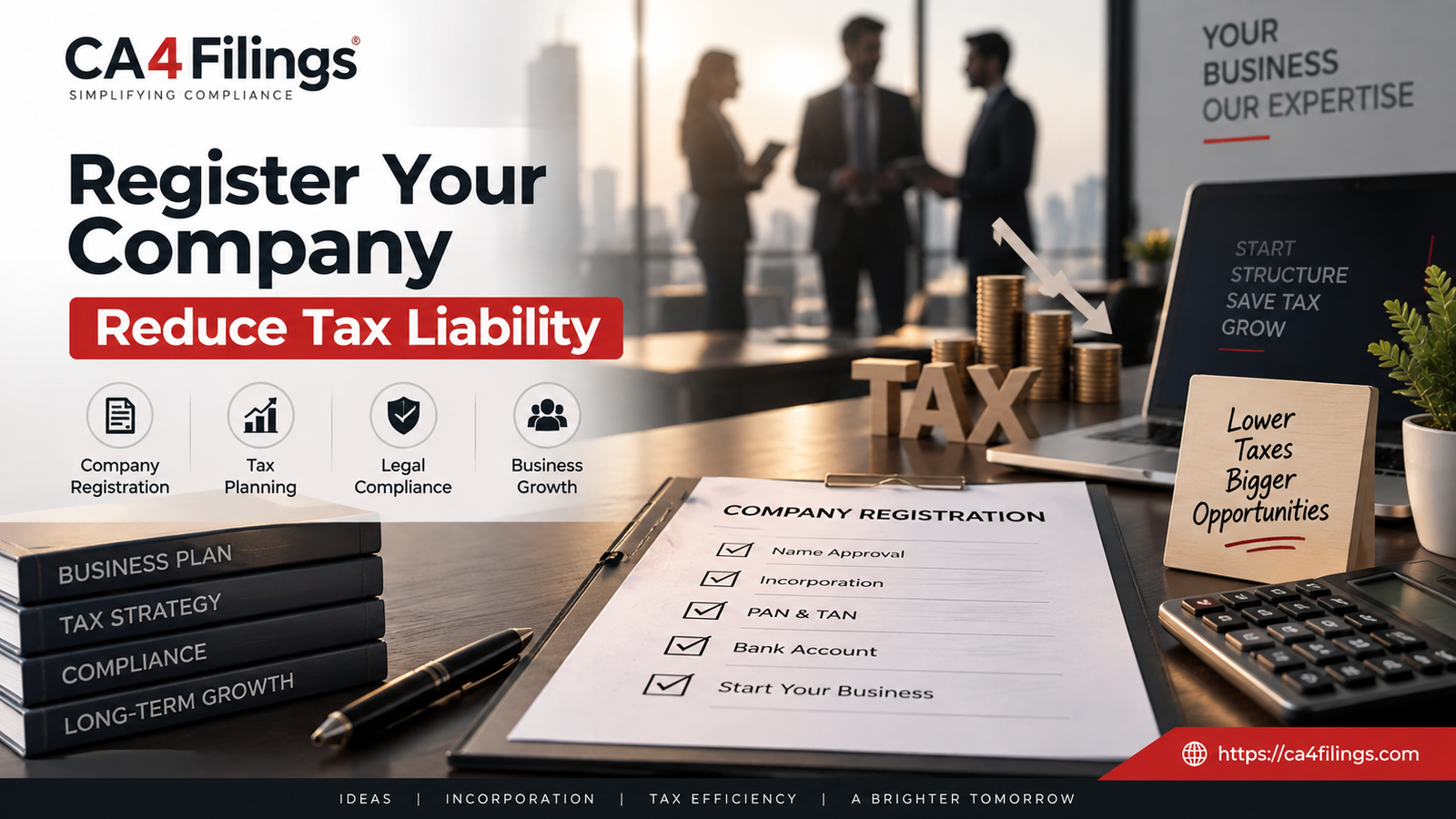
Starting a business is not only about choosing a name, getting incorporation documents ready, and opening a bank account. The way you set up your company can also influence how efficiently you manage taxes in the future. So, how do you register a company while keeping its tax position efficient? The answer lies in choosing the right business structure, understanding available deductions, and planning your finances from the beginning. If you are looking for professional assistance, CA4Filings can help you with Company Registration and guide you through the incorporation process.
Many entrepreneurs think tax planning begins after the company starts making profits. In practice, good tax planning starts much earlier. When you understand corporate structuring, eligible tax write-offs, accounting requirements, and fiscal year planning before incorporation, you can avoid unnecessary tax costs while remaining fully compliant.
How Do You Register a Company With Tax Efficiency in Mind?
The first question business owners should ask is not simply how do you register a company, but what structure is appropriate for the nature and scale of the business.
In India, entrepreneurs commonly consider structures such as:
- Private Limited Company
- One Person Company (OPC)
- Limited Liability Partnership (LLP)
- Partnership Firm
- Sole Proprietorship
Each structure has different compliance requirements, taxation rules, funding possibilities, and liability protections.
For example, a startup expecting external investment may find a Private Limited Company more suitable because its corporate structure supports equity investment and shareholding arrangements. On the other hand, an individual professional may have different priorities when choosing between an LLP, OPC, or another structure.
The right answer to how do you register a company therefore depends on your expected turnover, profitability, funding requirements, number of founders, business risks, and long-term plans.
How Do You Register a Company and Choose the Right Corporate Structure?
Corporate structuring is one of the most important parts of tax-efficient business planning.
A company should not be created solely to obtain a lower tax bill. Instead, the structure should match the actual commercial purpose of the business. Artificial arrangements designed only to avoid tax can create compliance problems.
When deciding how do you register a company, consider:
1. Expected profitability
A business with substantial projected profits needs to understand the applicable corporate tax rate and available deductions before selecting its structure.
2. Number of owners
If there are several founders, ownership and profit-sharing arrangements become important. A Private Limited Company and an LLP, for example, operate differently from a sole proprietorship.
3. Future funding
If you intend to approach angel investors, venture capital funds, or institutional investors, your corporate structure should accommodate future investment.
4. Business expansion
A structure that works for a small consultancy may not necessarily be ideal for a company planning to build multiple branches or attract international investment.
This is why how do you register a company should always be considered alongside your three-to-five-year business plan.
How Do You Register a Company and Use Legitimate Tax Write-Offs?
Tax efficiency does not mean avoiding tax illegally. It means claiming every deduction and business expense that the law legitimately permits.
Depending on the business and applicable tax rules, common business expenses may include:
- Employee salaries and professional fees
- Office rent and utilities
- Business-related software subscriptions
- Advertising and marketing expenses
- Internet and communication costs
- Travel expenses incurred for business purposes
- Depreciation on eligible business assets
- Accounting and professional consultancy fees
These tax write-offs can reduce taxable business income when they are genuine, properly documented, and allowable under applicable tax provisions.
For instance, suppose a company earns ₹30 lakh in revenue but incurs ₹12 lakh in legitimate business expenses. The taxable income is not automatically the full ₹30 lakh. Proper accounting and treatment of eligible expenses can significantly affect the final tax computation.
Therefore, when considering how do you register a company, also think about how your accounting system will capture business expenses from day one.
How Do You Register a Company With Better Fiscal Year Planning?
Fiscal year planning is another area that business owners often overlook.
The timing of revenue, expenses, asset purchases, employee bonuses, and other business transactions can affect the financial position reported for a particular year. Businesses should therefore maintain proper accounting records throughout the year instead of waiting until the tax return deadline.
A practical approach is to:
- Prepare monthly or quarterly management accounts.
- Track revenue and expenses consistently.
- Review cash flow before major purchases.
- Maintain invoices and supporting documents.
- Monitor advance tax obligations.
- Review tax positions before the end of the financial year.
If you are wondering how do you register a company and simultaneously establish good tax practices, setting up accounting and compliance systems immediately after incorporation is a sensible approach.
What About International Tax Concepts Like S-Corp Election?
Indian entrepreneurs sometimes encounter terms such as s-corp election and pass-through taxation while researching foreign business structures, particularly in the United States.
An S-corp election is a US tax concept and should not be confused with the Indian Private Limited Company structure. Similarly, pass-through taxation generally refers to situations where business income is passed through to owners and taxed at the owner level rather than being taxed as corporate income in the same way as a conventional corporation.
These concepts can be useful when comparing international business structures, but they should not be directly applied to an Indian company without understanding Indian tax law.
For an Indian entrepreneur, the more relevant question is how do you register a company under the Indian framework while selecting an appropriate structure and complying with the applicable Income Tax Act and Companies Act requirements.
How Do You Register a Company Without Creating Tax Problems Later?
Tax planning should always be accompanied by proper compliance.
Some common mistakes include:
- Mixing personal and business expenses
- Maintaining incomplete invoices
- Paying business expenses from personal accounts
- Ignoring statutory filing deadlines
- Treating every expenditure as automatically deductible
- Failing to maintain proper accounting records
- Choosing a structure solely because someone claims it has a lower tax rate
The objective should be sustainable tax efficiency, not aggressive tax avoidance.
Before deciding how do you register a company, discuss your business model with a qualified tax professional. A CA can assess the proposed activities, expected income, ownership pattern, funding plans, and compliance requirements.
Step-by-Step: How Do You Register a Company for Long-Term Tax Planning?
Here is a practical roadmap for new entrepreneurs:
Step 1: Define your business model
Clearly identify what you will sell, who your customers are, and how you expect to earn revenue.
Step 2: Estimate financial projections
Prepare realistic estimates for turnover, operating costs, salaries, capital expenditure, and expected profits.
Step 3: Compare suitable structures
Evaluate a Private Limited Company, OPC, LLP, or other applicable structure based on your circumstances.
Step 4: Complete incorporation
Prepare the required documents and complete the applicable registration and incorporation procedures.
Step 5: Establish accounting controls
Create separate business banking, bookkeeping, invoicing, and expense-recording systems.
Step 6: Plan taxes throughout the year
Do not wait until year-end. Review profits, expenses, advance tax, GST obligations where applicable, and other compliance requirements periodically.
Step 7: Review the structure as the business grows
Your original structure may need professional review if you add shareholders, raise investment, expand overseas, or significantly increase turnover.
This approach makes the answer to how do you register a company much more practical because incorporation becomes part of a broader financial strategy.
FAQs About How Do You Register a Company and Reduce Tax Liability
1. Does company registration automatically reduce corporate tax?
No. Registration itself does not automatically reduce tax liability. Tax depends on the applicable structure, taxable income, deductions, exemptions, rates, and prevailing tax laws.
2. Can I choose a company structure only because it has a lower corporate tax rate?
Tax should be one consideration, not the only consideration. Liability protection, investment requirements, compliance costs, ownership, and business objectives should also be evaluated.
3. Are all business expenses tax deductible?
No. An expense generally needs to satisfy the applicable tax requirements and be properly supported by records. Personal or unsupported expenses should not simply be treated as tax deductions.
4. Is an S-corp election applicable to an Indian company?
S-corp election is a US tax concept. Indian businesses should follow the structures and tax provisions applicable under Indian law.
5. When should tax planning begin?
Ideally, tax planning should begin before incorporation. Early planning allows entrepreneurs to choose an appropriate structure, establish accounting systems, and maintain proper documentation from the beginning.
Conclusion: How Do You Register a Company the Right Way?
So, how do you register a company while minimizing corporate tax liability legally? Start with the right business structure, understand the applicable corporate tax rate, maintain accurate accounts, claim legitimate tax write-offs, and review your tax position throughout the year.
Good corporate structuring is not about finding shortcuts. It is about making informed decisions that align taxation, compliance, cash flow, ownership, and long-term business objectives.
At CA4Filings, we help entrepreneurs approach company incorporation with a broader financial perspective. From selecting an appropriate structure to completing registration and understanding ongoing compliance requirements, professional guidance can make the process more organised and less stressful.
If you are planning to start a business and want to understand how do you register a company with sound tax and compliance planning, connect with CA4Filings and take the first step toward building your business on a strong foundation.
Latest Updates
ca4filings.com Services


























-registration.png)





Call Now