How Do I Register a Company Anonymously? Understanding Privacy States
Share post:
Learn how do i register a company privately, understand anonymous LLCs, privacy states, registered agents, BOI rules and legal compliance.
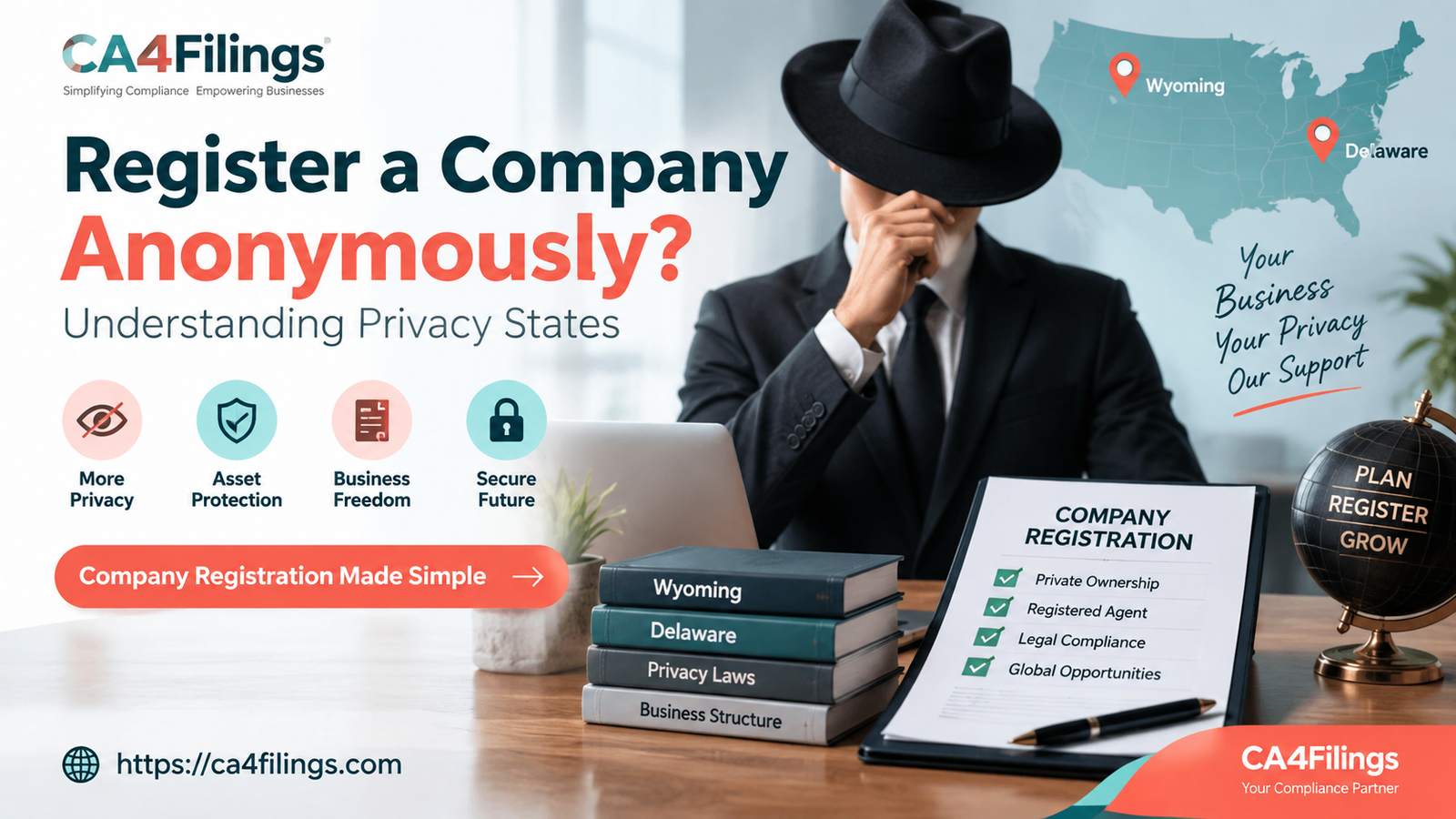
How Do I Register a Company Anonymously? Understanding Privacy States
If you are searching for how do i register a company while keeping your personal details away from public records, you are not alone. Many entrepreneurs, investors and online business owners value privacy when setting up a business. However, there is an important distinction between business privacy and complete anonymity. A company may offer privacy from casual public searches, but that does not mean the real owner can legally remain unknown to banks, tax authorities or regulators.
If you are planning a business in India, the right starting point is understanding the legal structure and compliance requirements. For professional assistance with Company Registration, CA4Filings can help you choose an appropriate structure and complete the required registrations correctly.
How Do I Register a Company Without Revealing My Personal Information?
The first thing to understand about how do i register a company is that the answer depends heavily on the country and state where you form the business.
In India, company incorporation involves statutory disclosures. The Companies Act, 2013 requires companies to maintain information relating to members and beneficial interests, so simply using another person's name does not create lawful anonymity.
In the United States, however, some states are known for offering greater public-record privacy. This is where terms such as anonymous LLC, Wyoming corporation and Delaware business often appear in business-formation discussions.
The practical objective should therefore be privacy where legally permitted, rather than attempting to hide ownership from authorities.
What Does an “Anonymous Company” Actually Mean?
When people ask how do i register a company anonymously, they often mean one of three things:
- They do not want their home address displayed publicly.
- They do not want their personal name easily discoverable through a state business registry.
- They want to separate their personal identity from the business for legitimate privacy or security reasons.
- These are different from hiding ownership from government authorities.
For example, a privacy-oriented structure may use a commercial address instead of an owner's residential address on certain public filings. A registered agent service may also receive official legal notices on behalf of the company.
That can improve public-facing privacy, but the business owner may still need to identify themselves to financial institutions, tax authorities and professional service providers.
How Do I Register a Company in a Privacy-Friendly U.S. State?
For entrepreneurs considering a U.S. entity, states such as Wyoming and Delaware are frequently discussed because of their business-friendly legal frameworks.
Wyoming Corporation and LLC Privacy
A Wyoming corporation or LLC can be attractive to entrepreneurs seeking a degree of public-record privacy. Depending on the entity and filing, certain personal information may not appear in the same way it would in other jurisdictions.
A registered agent can also provide a physical address for official correspondence. This can help an entrepreneur avoid unnecessarily publishing a personal residential address.
However, privacy should not be confused with invisibility. Banks, payment processors, tax authorities and other regulated institutions may still require information about the people who own or control the company.
Delaware Business Structures
A Delaware business is another common choice, particularly for companies expecting investors, multiple shareholders or more sophisticated corporate arrangements.
Delaware is well known for its corporate legal system and established business infrastructure. But forming a Delaware entity does not automatically make the owner anonymous.
The exact information available to the public depends on the entity type, filing requirements and applicable law. Therefore, anyone considering Delaware should examine the current filing rules rather than relying on generic claims about “anonymous companies.”
How Do I Register a Company Using a Registered Agent?
A registered agent service is often an important part of privacy-conscious U.S. business formation.
The registered agent generally acts as the official recipient of legal and government correspondence for the entity. Instead of publishing an owner's home address as the company's registered office, a business may be able to use the registered agent's qualifying address.
A typical process looks like this:
- Choose the business structure – Decide whether an LLC or corporation is appropriate.
- Select the state – Compare formation requirements, fees, taxes and privacy rules.
- Appoint a registered agent – Use a legitimate service that meets the state's requirements.
- File formation documents – Submit the required documents to the relevant state authority.
- Obtain tax registrations – Apply for an EIN or other required tax identification.
- Open a business bank account – Expect the bank to request ownership and identity information.
- Maintain annual compliance – Complete state filings, tax returns and other applicable obligations.
This approach answers how do i register a company from a privacy perspective without suggesting that the owner should conceal their identity unlawfully.
What About Beneficial Ownership Information?
This area has changed significantly, so older articles about company anonymity can be misleading.
As of August 2026, the U.S. Financial Crimes Enforcement Network (FinCEN) states that U.S.-created companies are exempt from federal Beneficial Ownership Information (BOI) reporting under the current rule. Certain foreign companies registered to conduct business in the U.S. remain subject to BOI requirements, with specific rules concerning foreign beneficial owners.
This means an article written a few years ago may give you outdated information about beneficial ownership information requirements.
There is another important point: BOI reporting is not the only compliance requirement. For example, the IRS generally requires an EIN application to identify a responsible party—the individual who owns, controls or exercises effective control over the entity.
So, if someone promises that you can form a company and “never disclose your identity anywhere,” be cautious.
How Do I Register a Company While Protecting My Privacy Legally?
For most business owners, privacy should be treated as part of proper structuring rather than secrecy.
Here are practical steps CA4Filings recommends:
- Use a registered business address where legally permitted.
- Consider a professional registered agent for eligible U.S. entities.
- Keep personal and business banking completely separate.
- Avoid publishing your residential address unnecessarily.
- Understand the applicable privacy laws before selecting a jurisdiction.
- Maintain accurate ownership records.
- Complete tax and regulatory disclosures honestly.
- Review contracts and online business listings for unnecessary personal information.
This approach can provide meaningful privacy while keeping the business compliant.
Does Privacy Help With Asset Protection?
Privacy and asset protection are related but not identical concepts.
A properly structured LLC or corporation may create separation between the business and its owners, subject to applicable law. However, simply choosing a “private” state does not automatically protect personal assets.
For example, if an entrepreneur operates through a properly maintained entity, keeps separate accounts and follows corporate formalities, the legal separation may be stronger than if the owner treats the company bank account as a personal wallet.
On the other hand, fraudulent transfers, personal guarantees, commingling of funds or failure to follow applicable laws can create significant problems.
Therefore, how do i register a company should always be followed by another question: How will I operate and maintain the company correctly?
Common Mistakes When Trying to Create an Anonymous Company
Entrepreneurs commonly make these mistakes:
Using a Nominee Without Understanding the Law
Some formation providers promote nominees as a way to hide the real owner. This can create serious legal and tax complications. The IRS specifically states that nominees are not authorized to apply for an EIN and that the actual responsible party must be identified.
Assuming a Privacy State Means Total Anonymity
A state registry may provide some public privacy, but that does not prevent disclosure to banks, tax agencies, courts or other legally authorised parties.
Relying on Outdated BOI Information
U.S. beneficial ownership requirements have changed materially. Always check current FinCEN guidance before acting on information published in older articles.
Ignoring Tax Residency
If you live in India and operate a foreign company, forming the company overseas does not automatically remove Indian tax or reporting considerations. Cross-border structures can involve additional tax, FEMA and compliance questions.
How Do I Register a Company: India vs. the U.S.
For an Indian entrepreneur, the choice between an Indian company and a U.S. entity should be based on the actual business requirement—not simply the desire for privacy.
Consider:
- Where you live and manage the business
- Where customers are located
- Where revenue is generated
- Banking requirements
- Tax obligations
- Foreign exchange regulations
- Investor requirements
- Compliance costs
- Privacy requirements
- Long-term business plans
An overseas company can be useful in certain circumstances, but it should not be treated as a shortcut around Indian legal or tax obligations.
FAQs About How Do I Register a Company Anonymously
Can I completely hide my identity when forming a company?
Generally, you should not assume complete anonymity is possible or lawful. Public-record privacy is different from keeping your identity hidden from authorities, banks and regulated institutions.
Is an anonymous LLC really anonymous?
An anonymous LLC generally refers to an LLC structure designed to limit certain owner information appearing in public records. It does not necessarily mean that the owner's identity is unknown to every authority or financial institution.
Is Wyoming better for privacy?
Wyoming is frequently considered for privacy-conscious business formation, but the appropriate state depends on your business activities, tax position, compliance requirements and other factors.
Does Delaware provide company anonymity?
A Delaware business may offer certain public-record privacy characteristics, but incorporation in Delaware does not mean that the company owner can conceal their identity from all parties.
Can an Indian resident form a U.S. company?
An Indian resident may be able to establish a U.S. business entity, but the structure can create additional U.S. and Indian tax, regulatory and reporting considerations. Professional cross-border advice is advisable before incorporation.
How Do I Register a Company Safely and Legally?
Ultimately, how do i register a company is not simply a question of filling out a formation form. If privacy matters to you, the better approach is to identify what information genuinely needs to remain private, understand which information must legally be disclosed, and then select a structure that balances privacy, tax, compliance and business objectives.
At CA4Filings, we believe company formation should be built around your actual business needs—not internet claims about “secret companies” or guaranteed anonymity. Whether you are setting up an Indian company or evaluating an international structure, getting the legal and compliance framework right from the beginning can save considerable trouble later.
Need help with how do i register a company? Connect with CA4Filings for professional guidance on company formation, documentation, compliance and the right structure for your business.
Latest Updates
ca4filings.com Services






















-registration.png)



Call Now