How Do I Register a Company for a Nonprofit Organization? Step-by-Step
Learn how do i register a company for a nonprofit in India, including Section 8 company registration, documents, legal compliance, and tax benefits.
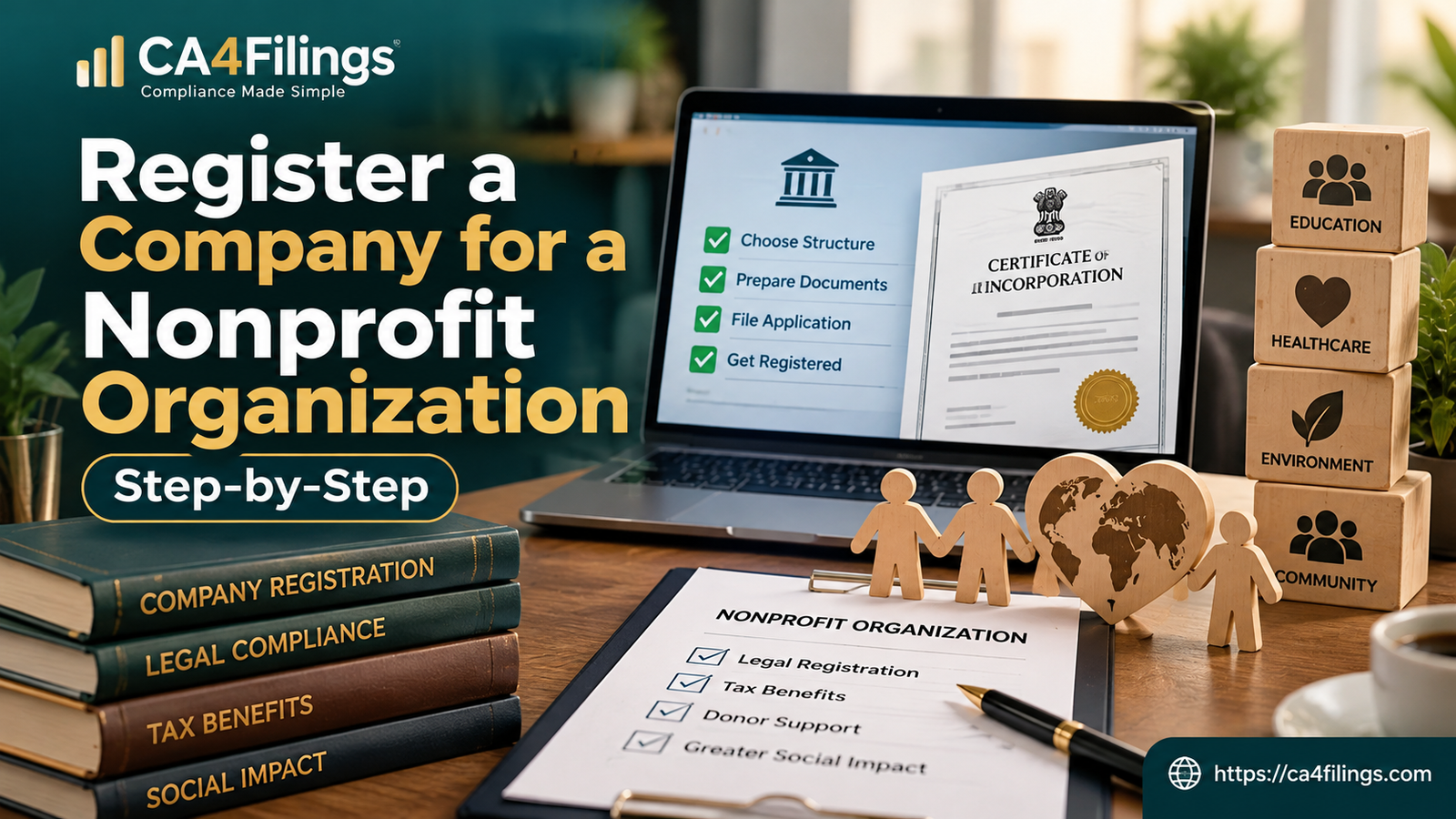
Starting a nonprofit organization is a meaningful way to create a positive impact on society. Whether you want to support education, healthcare, environmental protection, women’s empowerment, or community development, choosing the right legal structure is the first step. Many aspiring founders ask, how do i register a company for a nonprofit organization and ensure that it operates legally while remaining financially sustainable.
In India, a Section 8 Company is a popular option for establishing a nonprofit with a formal corporate structure. It allows eligible organizations to pursue charitable objectives without distributing profits among their members. At CA4Filings, we help founders understand the registration process, prepare the necessary documents, and complete the required legal formalities. If you are exploring Company Registration, understanding the rules applicable to nonprofit entities will help you make an informed decision.
Let us walk through the registration process, from selecting your objectives to meeting your ongoing compliance responsibilities.
How Do I Register a Company for a Nonprofit in India?
Before beginning the application, you should understand which legal structure suits your charitable activities. In India, nonprofits can generally operate as:
Section 8 Company: Registered under the Companies Act, 2013, for charitable or other specified public-benefit objectives.
Public Charitable Trust: Established through a trust deed, subject to applicable state laws.
Society: Generally formed by a group of individuals for educational, charitable, scientific, cultural, or similar purposes.
A Section 8 Company is often suitable when founders want a structured governance system, greater organizational credibility, and a clear framework for accountability.
Unlike a conventional commercial company, a Section 8 Company must apply its profits and income towards its permitted objectives. It cannot distribute dividends to its members.
Expert advice: If you plan to work with institutional donors, corporate social responsibility (CSR) programs, or government agencies, consider your future funding requirements before selecting the legal structure.
Step-by-Step Process to Register a Nonprofit Company
Step 1: Define Your Charitable Objectives
The first step is to clearly identify the purpose of your nonprofit. Under Section 8 of the Companies Act, 2013, eligible objectives include promoting education, social welfare, environmental protection, research, charity, and other specified public-benefit activities.
Your objectives should explain:
What social problem your organization intends to address.
Which beneficiaries you plan to support.
How your organization will achieve its goals.
How income and donations will be used.
For example, if you intend to provide affordable educational resources to children in rural areas, your objectives should specifically cover education, learning resources, and related charitable activities.
Clear objectives make it easier to prepare incorporation documents and demonstrate that your organization meets the applicable requirements.
Step 2: Choose a Suitable Name
Select a unique name that reflects your nonprofit's mission and complies with the Ministry of Corporate Affairs (MCA) naming requirements.
The name should not improperly resemble an existing company or trademark. A Section 8 Company must also satisfy the applicable naming and incorporation rules.
Prepare two or three alternatives to reduce the possibility of rejection. Check name availability and avoid wording that could mislead the public about your organization's activities or legal status.
Step 3: Appoint Directors and Obtain Digital Signatures
A Section 8 Company must have at least two directors if incorporated as a private company or at least three directors if incorporated as a public company.
At least one director must satisfy the applicable Indian residency requirement under the Companies Act.
The proposed directors will generally need:
A valid identity document, such as PAN for eligible Indian applicants.
Address proof.
Passport-sized photographs, where required.
A Digital Signature Certificate (DSC) for electronic filing.
A DSC enables authorized individuals to sign incorporation forms digitally. Foreign applicants may need additional documentation depending on their nationality and circumstances.
Step 4: Prepare the MOA, AOA, and Governance Documents
The Memorandum of Association (MOA) describes the company's objectives, while the Articles of Association (AOA) establish its internal rules and governance framework.
Founders sometimes refer to internal governance documents as board of directors bylaws. In India, the AOA and applicable company law govern the formal corporate structure; separate policies may also be adopted for board meetings, financial approvals, conflicts of interest, and donation management.
Your documents should address:
Charitable objectives and permitted activities.
How funds and income will be applied.
Membership and director responsibilities.
Appointment and resignation procedures.
Rules governing the company's assets and winding up.
Professional drafting helps avoid inconsistencies that could delay approval or create governance problems later.
Step 5: File the Incorporation Application with the MCA
The next step is to submit the applicable incorporation application electronically through the MCA portal.
The process generally involves the SPICe+ incorporation form and associated filings, together with the relevant declarations, constitutional documents, and supporting attachments. Section 8 applications also require compliance with the specific licensing requirements applicable to such companies.
Depending on the current filing process and applicant circumstances, documents may include:
Proposed directors' declarations and consents.
Registered office address proof.
MOA and AOA.
Details of subscribers and directors.
Declarations relating to the company's objectives and compliance.
The Registrar of Companies (ROC) reviews the application and may request clarification or additional documents. Once approved, the company receives its Certificate of Incorporation and applicable registration details.
Step 6: Open a Bank Account and Establish Financial Controls
After incorporation, open a bank account in the company's name and establish a proper accounting system.
Keep donations, grants, and operating expenses clearly documented. Maintain supporting invoices, receipts, bank statements, and records of how funds are used.
A nonprofit should have transparent financial controls, including:
Documented approval of significant expenses.
Separation of organizational and personal finances.
Regular accounting and bank reconciliations.
Proper recording of restricted donations and grants.
These practices help build donor confidence and make audits and regulatory reporting easier.
Step 7: Apply for Tax Benefits and Relevant Registrations
Company incorporation does not automatically provide every tax exemption or donor benefit.
If eligible, your organization may apply for registration under Section 12AB of the Income-tax Act, 1961, and approval under Section 80G, subject to the applicable conditions and procedures. Section 80G approval can enable eligible donors to claim deductions for qualifying donations.
Organizations planning to receive foreign contributions must also assess the requirements of the Foreign Contribution (Regulation) Act, 2010 (FCRA). CSR funding may involve additional eligibility and registration requirements.
If you are researching international nonprofit terminology, a tax-exempt 501c3 filing and state charity registration are relevant concepts in the United States. They are not substitutes for Indian registrations and should not be confused with the requirements applicable to an Indian philanthropic entity.
Where Section 80G approval applies, issue accurate donor tax receipts and comply with the applicable reporting requirements, including Form 10BD and Form 10BE where required.
Documents Required for Nonprofit Company Registration
Keep the following documents ready, as applicable:
PAN and identity proof of proposed directors and subscribers.
Residential address proof.
Registered office address proof and required owner consent.
MOA and AOA.
Digital Signature Certificates.
Declarations and consents required for incorporation.
Details of the proposed nonprofit's activities and funding arrangements.
Requirements can vary depending on the company's structure, the applicants involved, and the latest MCA filing rules.
Common Mistakes to Avoid
Even a well-intentioned nonprofit can face unnecessary delays if its documentation or governance is incomplete.
Avoid these common mistakes:
Choosing a name without checking availability.
Drafting vague or inconsistent charitable objectives.
Assuming incorporation automatically provides income-tax exemptions.
Mixing personal and organizational funds.
Overlooking annual filings and accounting obligations.
Accepting foreign contributions without checking FCRA requirements.
A qualified professional can review your documents before submission and help you plan for compliance beyond incorporation.
Latest Updates
ca4filings.com Services