Deep Tech Extensions: Navigating the New Rules for Startup India Registration
Explore startup india registration rules for deep tech startups, extended eligibility, DPIIT recognition, and compliance tips with CA4Filings.
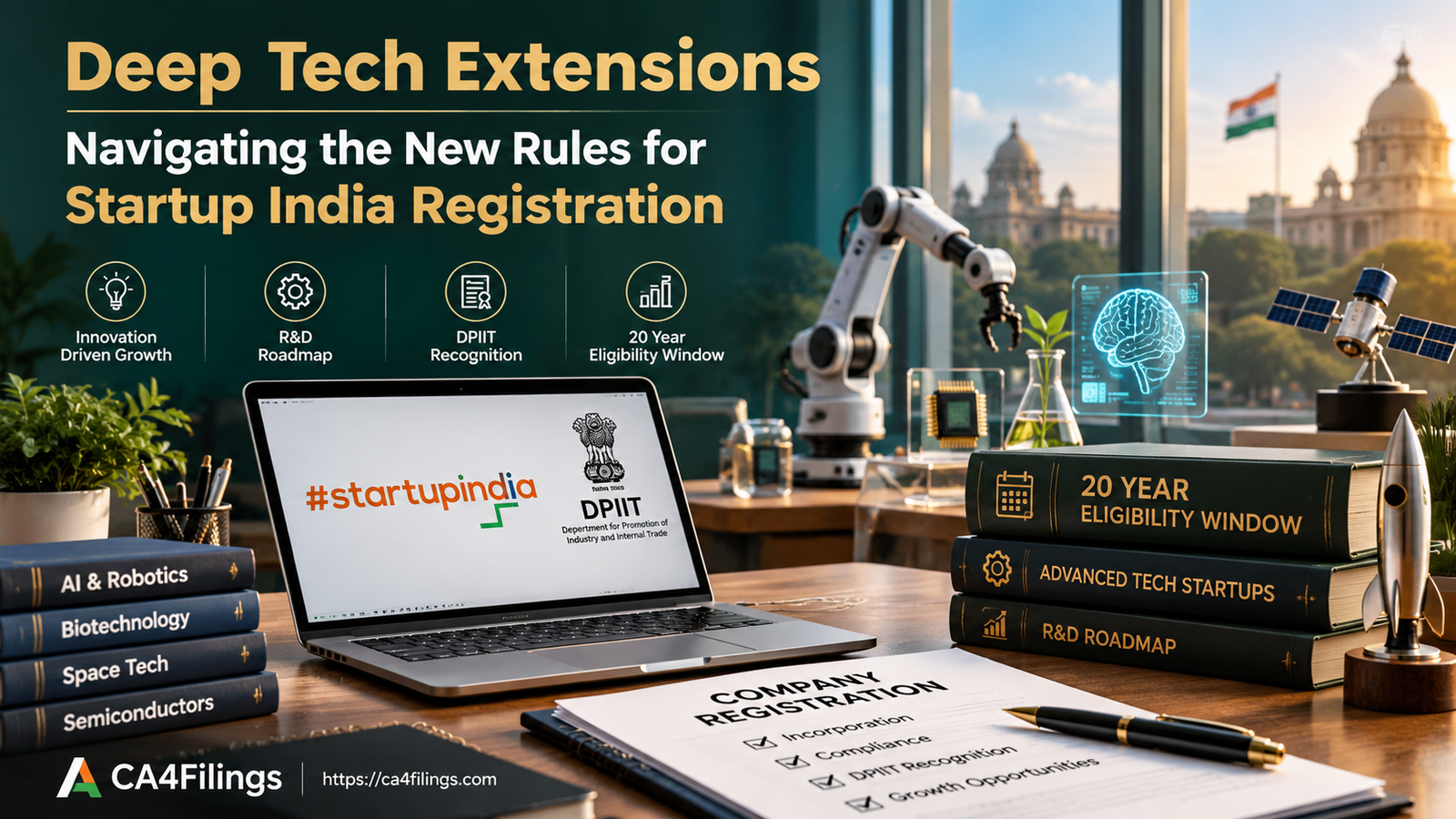
Why Deep Tech Startups Need to Understand the New Rules
India's startup ecosystem is evolving rapidly, particularly in areas such as artificial intelligence, robotics, biotechnology, semiconductors, space technology, and quantum computing. These businesses often require years of research, significant capital, and specialised talent before they can bring a commercially viable product to market. Recognising these challenges, the government has introduced changes to the Startup India framework to support innovation-driven businesses for longer periods.
For founders planning startup india registration, understanding the updated eligibility rules is essential. The extended recognition period for deep tech ventures can provide valuable time to develop intellectual property, conduct research, and establish a sustainable business model. At CA4Filings, we help entrepreneurs understand these regulatory requirements and complete the necessary formalities, including Company Registration, so they can focus on building their businesses.
In this article, we explain the new rules, eligibility requirements, documentation, application process, and practical considerations for deep tech startups.
What Is Startup India Registration?
Startup India is a government initiative designed to encourage entrepreneurship, innovation, and employment generation. The Department for Promotion of Industry and Internal Trade (DPIIT) grants recognition to eligible startups under the applicable government framework.
Completing startup india registration helps an eligible business access certain benefits, subject to the relevant conditions and approvals. These may include:
Eligibility to apply for specified government funding and support schemes.
Potential tax benefits under applicable provisions of the Income-tax Act.
Access to certain intellectual property facilitation measures.
Eligibility for specified public procurement relaxations.
Opportunities to participate in innovation programmes and startup initiatives.
It is important to understand that DPIIT recognition does not automatically provide every benefit. Each scheme has its own eligibility criteria, application process, and compliance requirements.
Deep Tech Extensions: What Has Changed?
Understanding the Extended Eligibility Window
Traditional startup recognition has generally operated within a limited period from the date of incorporation or registration. Deep tech companies, however, may require considerably longer to develop commercially viable technologies.
The revised framework announced by the government in 2025 introduced a longer recognition period for eligible deep tech startups. Under the updated criteria, the general startup recognition period was extended from 10 years to 20 years for qualifying deep tech startups, alongside an increase in the applicable turnover threshold.
The 20 year eligibility window is particularly relevant for businesses developing technologies that require extensive experimentation, validation, and regulatory approvals.
For founders considering startup india registration, the distinction between an ordinary startup and an eligible deep tech startup is important. The longer period is not automatically available to every technology company.
What Qualifies as a Deep Tech Startup?
Deep tech startups typically develop products or services based on substantial scientific or engineering advances rather than simply applying existing technologies.
Examples include:
Artificial intelligence systems involving proprietary research and advanced models.
Semiconductor design and next-generation chip development.
Biotechnology ventures developing novel therapeutic platforms.
Robotics companies building advanced autonomous systems.
Quantum computing and quantum communication ventures.
Space technology businesses developing satellites, propulsion systems, or specialised launch technologies.
A business using standard software tools or providing routine IT services may not qualify merely because it describes itself as a technology startup. The underlying innovation, research activity, and technological development matter.
Eligibility Criteria for Startup India Registration
Before submitting an application, founders should check whether their business meets the applicable requirements.
1. Eligible Business Structure
The entity must operate under a recognised legal structure permitted by the Startup India framework, such as:
A private limited company.
A registered partnership firm.
A limited liability partnership (LLP).
A sole proprietorship does not qualify for DPIIT startup recognition under the standard eligible entity structures.
2. Age and Turnover Requirements
For general startups, the standard recognition period is ordinarily up to 10 years from incorporation or registration, subject to applicable rules. Qualifying deep tech startups may receive recognition for up to 20 years under the revised framework.
The applicable turnover threshold must also be satisfied. Under the revised framework, the general startup turnover ceiling was increased to ₹200 crore, while qualifying deep tech startups may benefit from a higher ceiling of ₹300 crore.
Founders should verify the current notification and category-specific conditions before applying, particularly where the business has undergone restructuring or has multiple related entities.
3. Innovation and Scalability
The business should demonstrate innovation, improvement, or a scalable model with the potential to generate employment or create wealth.
For deep tech businesses, this often involves presenting evidence of original research, technical differentiation, product development, or intellectual property.
4. Independent Business Operations
The entity must satisfy applicable restrictions concerning the formation of a business through the splitting up or reconstruction of an existing business. It should also meet the relevant incorporation, registration, and operational requirements.
How to Complete Startup India Registration: Step-by-Step Process
A structured approach can reduce application errors and avoid unnecessary delays.
Step 1: Complete Company Registration
Choose the appropriate legal structure based on ownership, fundraising plans, liability, and operational requirements. Complete incorporation or registration before applying for DPIIT recognition.
Step 2: Prepare Your Documents
Keep the following information ready:
Certificate of Incorporation or registration.
PAN and basic entity details.
Details of directors, partners, or authorised representatives.
A clear description of the product, service, and business model.
Supporting evidence of innovation and technological development, where applicable.
Deep tech applicants should also prepare research summaries, prototype details, patent information, technical publications, or other relevant evidence.
Step 3: Apply Through the Official Portal
Create the required account and submit the application through the official Startup India recognition process. Follow the current portal instructions and provide accurate information about the entity and its activities.
Step 4: Explain Your Innovation Clearly
Describe the problem your business solves, how the technology works, what makes it different, and how it can scale.
For example, a startup developing an indigenous semiconductor component could explain its research process, technical advantages, testing milestones, and potential applications in Indian manufacturing.
Step 5: Track the Application
Monitor the application for updates or requests for additional information. Respond promptly and retain copies of submitted documents.
Professional assistance during startup india registration can help founders organise their evidence and address avoidable documentation gaps.
Why an R&D Roadmap Matters for Deep Tech Startups
An effective R&D roadmap is more than an internal project plan. It can help explain why a deep tech venture requires a longer development cycle and how its research is expected to translate into commercial value.
A practical roadmap should cover:
Research objectives and technical milestones.
Prototype development and testing schedules.
Intellectual property strategy.
Funding requirements and anticipated expenditure.
Regulatory approvals, where applicable.
Commercialisation plans and target markets.
For example, a biotechnology startup may spend several years on laboratory research, preclinical testing, and regulatory preparation before launching a product. Documenting these stages helps demonstrate the business's research-intensive nature.
At CA4Filings, we recommend maintaining regular records of research expenditure, product iterations, technical achievements, and funding utilisation. These records can also support investor discussions and future compliance requirements.
Common Mistakes to Avoid
Even promising ventures can encounter difficulties if they approach the application without adequate preparation.
Avoid these common mistakes:
Selecting an unsuitable business structure.
Assuming every technology business qualifies as deep tech.
Providing vague descriptions of innovation.
Overlooking turnover and incorporation-date requirements.
Treating DPIIT recognition as automatic approval for tax exemptions.
Failing to maintain accurate financial and research records.
Before submitting startup india registration, review the latest eligibility rules and ensure that all information is consistent with official company records.
Latest Updates
ca4filings.com Services