How Do We Register a Company to Protect Against Co-Founder Departure?
Learn how do we register a company with safeguards against co-founder departure, including equity vesting, buy-sell clauses, and exit planning.
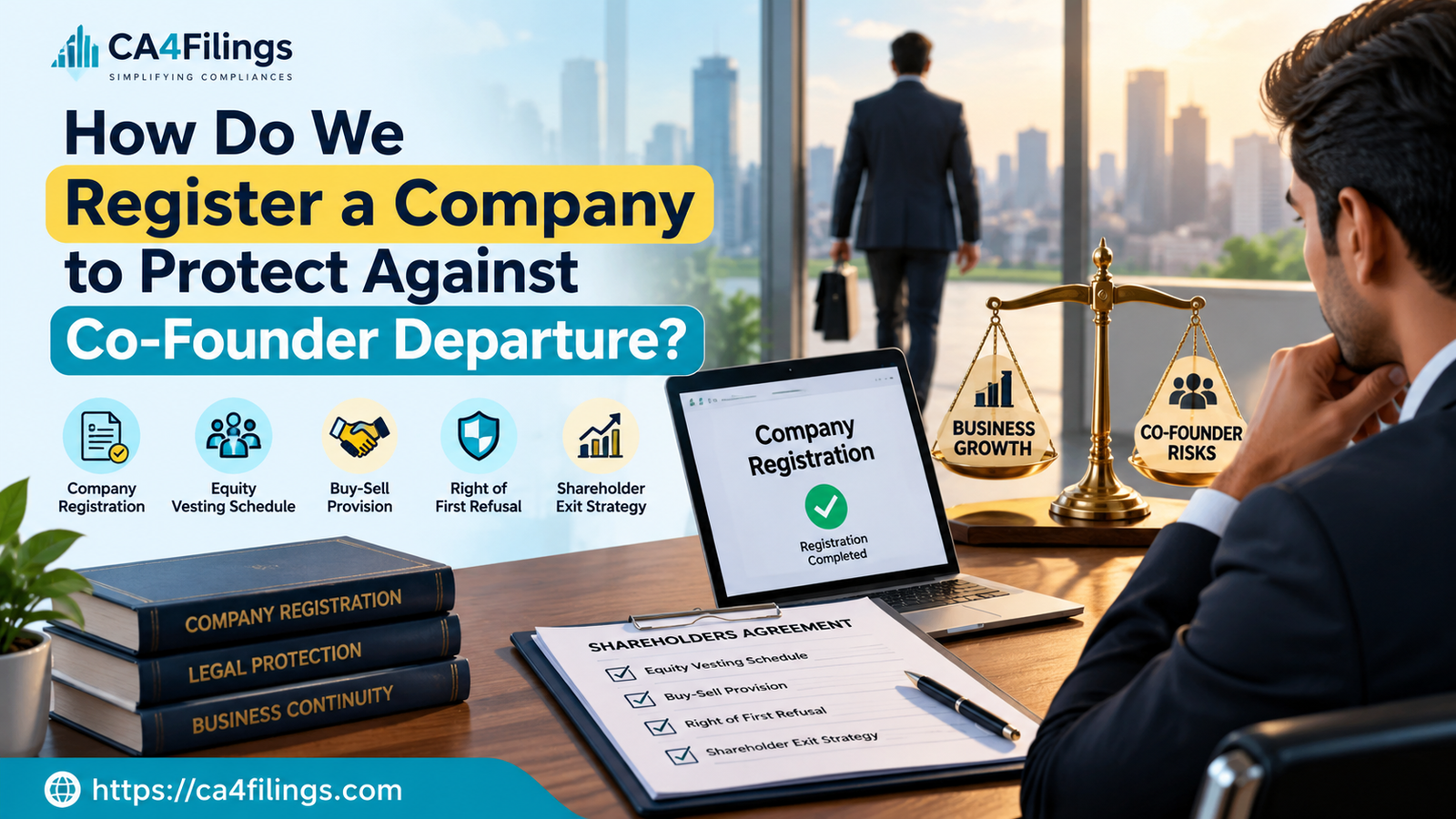
Starting a business with a co-founder is exciting, but what happens if one partner decides to leave after a few months or years? Disagreements, personal commitments, financial difficulties, or different business goals can lead to an unexpected departure. Without proper planning, the remaining founders may face operational disruptions, ownership disputes, and financial losses.
This is why understanding how do we register a company with appropriate legal safeguards is essential for entrepreneurs in India. Company registration establishes the legal structure of your business, but protecting it against co-founder departure requires additional planning through shareholder agreements, equity vesting, and clear exit provisions. At CA4Filings, we help entrepreneurs approach Company Registration with a long-term perspective, so they can build a business with clarity, accountability, and stronger legal protection.
Let's understand the practical steps you can take before and during incorporation to protect your business from potential co-founder disputes.
How Do We Register a Company With Co-Founder Protection?
The first step is to select a suitable business structure. For startups planning to raise investment, distribute equity, and establish clear ownership rights, a Private Limited Company is often a practical option.
However, simply incorporating a company does not prevent a founder from leaving or selling their shares. You must establish rules governing ownership, responsibilities, and exit procedures.
Here is a practical approach:
Choose the company structure: Decide whether a Private Limited Company suits your business objectives, funding plans, and ownership requirements.
Define founder contributions: Record each founder's financial investment, responsibilities, intellectual property contributions, and expected involvement.
Determine shareholding: Decide the initial share allocation based on agreed contributions and future responsibilities.
Draft a shareholders' agreement: Establish rules for share transfers, voluntary departures, disputes, and buyouts.
Include protective provisions: Consider equity vesting, a buy-sell provision, and a right of first refusal.
Complete incorporation and documentation: File the required incorporation documents with the Ministry of Corporate Affairs (MCA) and ensure the company's constitutional documents support the agreed arrangements.
When considering how do we register a company effectively, remember that legal incorporation and founder protection are related but separate exercises. Both deserve attention from the beginning.
Why Is an Equity Vesting Schedule Important?
One of the biggest risks in a startup arises when a co-founder receives a substantial equity stake immediately but leaves before contributing meaningfully to the business.
For example, suppose two founders own 50% each of a startup. After six months, one founder leaves but retains their entire 50% shareholding. The remaining founder may have to run the business alone while sharing future profits and control with someone who is no longer involved.
An equity vesting schedule can help address this concern.
Under a vesting arrangement, a founder earns the right to retain or acquire specified equity over an agreed period, subject to the arrangement's legal structure and conditions.
A typical startup arrangement might include:
A four-year vesting period.
A one-year cliff, meaning no equity vests before the first anniversary.
Monthly vesting of the remaining eligible equity after the cliff.
Clear provisions for resignation, termination, disability, or other exceptional circumstances.
These terms are illustrative, not mandatory legal requirements.
Indian companies must implement founder equity arrangements carefully. Share allotments, transfers, company buybacks, and contractual restrictions may be subject to the Companies Act, 2013, the company's Articles of Association, and applicable tax and securities rules. Vesting does not automatically cancel shares already legally issued to a founder.
How Do We Register a Company With a Buy-Sell Provision?
A buy-sell provision establishes how a founder's shares may be purchased or transferred when a specified event occurs.
Such events may include voluntary resignation, retirement, prolonged non-participation, serious misconduct, or a deadlock between founders.
A well-drafted clause should address:
Events that trigger the provision.
Who can purchase the departing founder's shares.
How the share price will be determined.
The payment timeline and permitted payment arrangements.
Procedures for resolving disagreements over valuation.
Applicable restrictions and legal approvals.
For example, if a co-founder wants to leave after three years, the agreement might provide a valuation mechanism based on an independent professional assessment. The remaining founder or another eligible purchaser could then acquire the shares in accordance with the agreed terms.
Avoid vague language such as "shares will be transferred at a fair price." Define how fairness will be determined, who appoints the valuer, and what happens if the parties disagree.
Importantly, a company cannot repurchase its own shares merely because a shareholders' agreement says so. A stock buyback must satisfy the applicable statutory requirements.
What Is the Role of a Right of First Refusal?
A right of first refusal (ROFR) gives designated existing shareholders or another eligible party the first opportunity to purchase shares before the departing shareholder transfers them to an outside buyer, subject to the agreed terms.
This provision is particularly useful when a founder wants to sell their shares to an investor or another individual.
For instance, imagine a founder owns 30% of a technology startup and receives an offer from an outside buyer. A properly drafted ROFR clause may require the founder to offer those shares to the existing shareholders first on the specified terms.
The agreement should clarify:
The notice required before a proposed transfer.
The time allowed to exercise the right.
The price and other terms applicable to the offer.
What happens if the existing shareholders decline.
Whether the company's Articles of Association need corresponding provisions.
A ROFR helps prevent unexpected third-party shareholders from entering the business and disrupting existing relationships.
How Do We Register a Company With a Clear Shareholder Exit Strategy?
A shareholder exit strategy should be documented before a disagreement arises. Founders often discuss how they will start a company but overlook what happens when their plans change.
Consider including the following arrangements in your legal documentation.
1. Define good-leaver and bad-leaver situations
A good leaver might be a founder who leaves because of retirement, serious illness, or another agreed circumstance. A bad leaver might involve specified misconduct or a serious contractual breach.
Define each category objectively. Avoid automatic penalties that could be unreasonable or legally unenforceable.
2. Establish a valuation method
The agreement can specify an independent valuation, an agreed financial formula, or another appropriate method. Different departure circumstances may require different treatment, subject to applicable law.
3. Address stock buyback restrictions
A stock buyback may appear to be a straightforward way for the company to purchase a departing founder's shares. However, a company buyback is regulated under Section 68 and related provisions of the Companies Act, 2013, including applicable limits, approvals, and procedural requirements.
Where a company buyback is unavailable or unsuitable, a transfer to continuing founders or another eligible purchaser may be considered instead.
4. Plan for business continuity
Document access to company accounts, client relationships, confidential information, intellectual property, software repositories, and operational records. Ensure that ownership and access rights are handled lawfully and consistently with employment and confidentiality agreements.
Common Mistakes Founders Should Avoid
When deciding how do we register a company while protecting the business, avoid these common mistakes:
Allocating equal equity without considering individual contributions and future responsibilities.
Relying only on verbal promises between friends or business partners.
Signing a shareholders' agreement without checking the Articles of Association.
Ignoring intellectual property ownership and confidentiality obligations.
Assuming that a departing founder's shares automatically return to the company.
Using restrictive transfer clauses without considering enforceability under Indian law.
Failing to update statutory records and share-transfer documentation when ownership changes.
Professional legal and tax advice can help ensure that the proposed arrangements are practical and consistent with applicable Indian law.
Latest Updates
ca4filings.com Services