Avoid the Drafts: How to Correctly File for Company Registration on MCA
Avoid delays and rejected forms with our expert guide to company registration on MCA. Learn filing steps, document checks, fees and compliance tips.
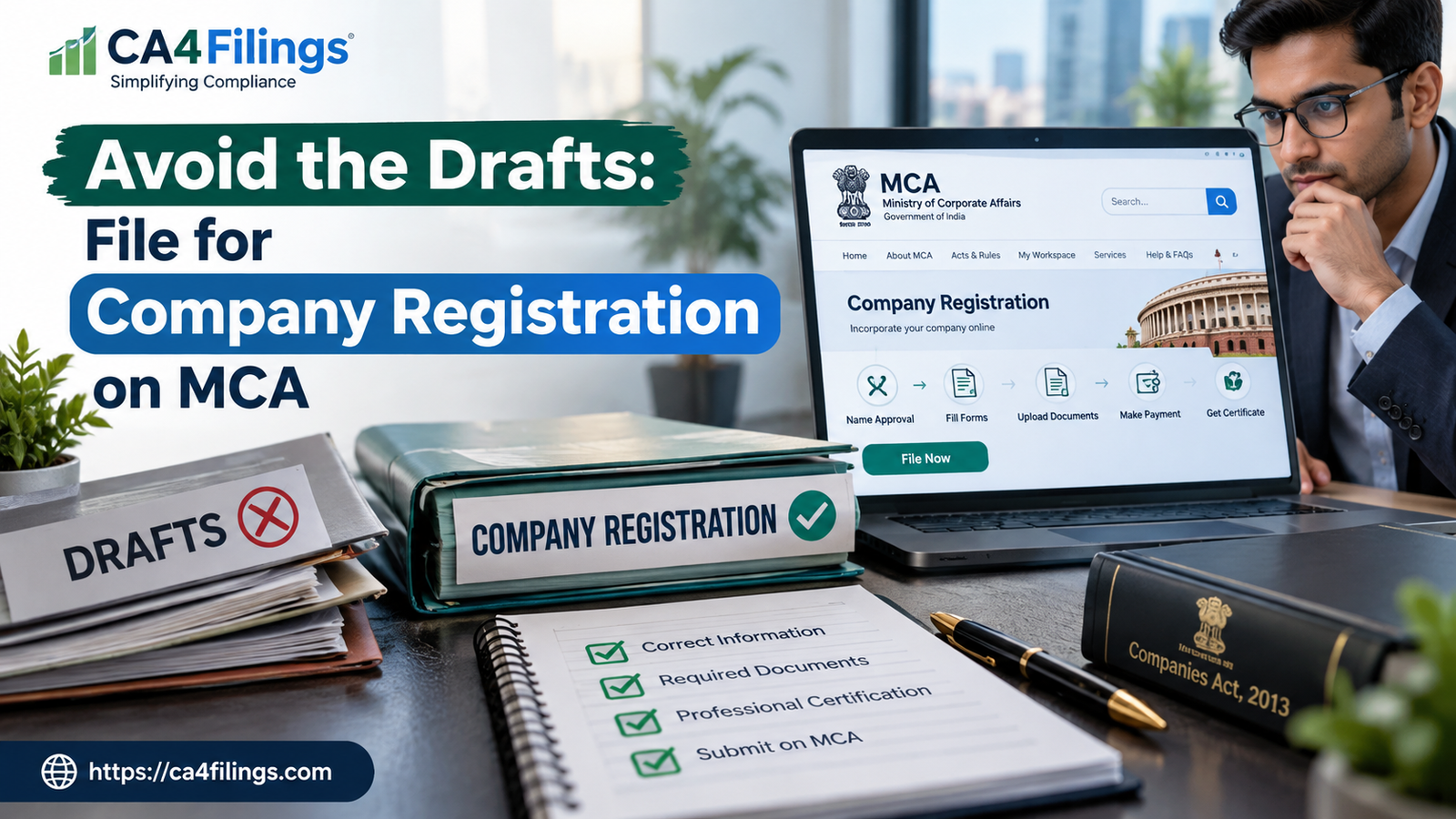
Starting a business is an exciting milestone, but getting the paperwork right is just as important as developing your business idea. In India, company registration is completed through the Ministry of Corporate Affairs (MCA), which requires accurate information, valid documents and appropriate professional certification. Even a small mismatch in a director's name, address or identity details can lead to resubmission requests and unnecessary delays.
At CA4Filings, we regularly guide entrepreneurs through the registration process and understand how confusing MCA forms can be for first-time founders. If you are planning to register a business, our Company Registration service can help you navigate the formalities with greater confidence.
The good news is that most filing mistakes are preventable. With the right preparation and professional guidance, you can avoid common errors and complete your company registration more smoothly.
Why Accurate Company Registration Filing Matters
The MCA follows a structured electronic filing system to ensure that companies are incorporated in accordance with the Companies Act, 2013. Applicants must submit the prescribed forms, supporting documents and declarations through the applicable process.
Incorrect information can result in resubmission, additional professional charges and delays in commencing business operations.
Consider a practical example: two founders plan to launch a technology consultancy. They submit their incorporation application, but one founder's residential address differs between the identity document and the supporting address proof. If the discrepancy cannot be reconciled, the application may require clarification or correction.
This is why company registration should never be treated as a simple form-filling exercise. Accuracy at the beginning can save considerable time later.
Common Mistakes to Avoid During Company Registration
Before submitting your application, pay attention to the following issues.
1. Choosing an unsuitable company name
A proposed name must satisfy MCA naming requirements and should not conflict with existing company names, trademarks or restricted expressions.
Before applying:
Check the MCA database for similar company names.
Search relevant trademark records.
Ensure the proposed name reflects the intended business activity.
Prepare alternative names in case the first choice is unavailable.
A name that sounds attractive to the founders may still be rejected if it is too similar to an existing entity or fails the applicable naming rules.
2. Uploading incorrect or inconsistent documents
Document discrepancies are among the most avoidable filing problems. The details in identity proofs, address proofs, declarations and incorporation forms should be consistent.
Keep the following documents ready, as applicable:
PAN cards and identity proofs of proposed directors and subscribers.
Residential address proofs.
Registered office address proof.
Recent utility bill for the proposed registered office, where required.
No-objection certificate from the property owner, where applicable.
Memorandum of Association (MoA) and Articles of Association (AoA), as prescribed.
Check document validity, legibility, file format and signatures before uploading. For foreign subscribers or directors, additional documentation and authentication requirements may apply.
3. Entering incorrect details in MCA forms
A wrong PIN code, spelling error, incorrect shareholding figure or mismatched director detail can complicate the form processing stage.
Review every field before submission, especially:
Director and subscriber information.
Proposed company name and business activity.
Authorised and subscribed share capital.
Registered office details.
Email addresses and mobile numbers.
Never copy information from an old application without verifying that it remains correct.
4. Overlooking professional certification
Certain incorporation forms require certification by an eligible practising professional, such as a Chartered Accountant, Company Secretary or Cost Accountant, as applicable under MCA rules.
Professional certification is not merely a procedural checkbox. It involves checking whether the information and declarations meet the relevant requirements.
Experienced CA CS services can help identify discrepancies before filing and ensure that the application is prepared with appropriate care.
Step-by-Step Guide to Correct Company Registration on MCA
Follow this practical sequence to reduce the chances of avoidable errors.
Step 1: Decide the appropriate business structure
Evaluate whether a private limited company, one-person company or another eligible structure suits your business objectives.
If you want limited liability, a separate legal identity and a structure suitable for bringing in investors, you may choose to register private limited company status. Consider ownership, compliance costs, funding plans and long-term growth before deciding.
Step 2: Obtain the necessary digital credentials
Proposed directors and subscribers may need Digital Signature Certificates (DSCs) to sign the applicable electronic documents. Director identification requirements must also be satisfied through the prescribed MCA process.
Check that the relevant DSCs are valid and usable before starting the final submission.
Step 3: Reserve the company name
Submit the name application through the applicable MCA service, generally SPICe+ Part A or the integrated incorporation workflow, depending on the filing route.
Provide accurate details about the proposed name and business activity. Keep alternative names ready to minimise delays if the preferred name is unavailable.
Step 4: Prepare and complete the incorporation forms
The SPICe+ incorporation process includes the prescribed company details and linked registrations, where applicable. Depending on the application, supporting forms may cover constitutional documents, registered office information, director declarations and statutory registrations.
Read each declaration carefully. Do not select options simply because they appear to be standard choices.
Step 5: Verify fees and professional requirements
The applicable ROC filing fees depend on factors such as authorised share capital, the forms submitted and the relevant statutory provisions. Stamp duty can also vary by state and other applicable criteria.
Review the MCA fee calculation before payment. Remember that ROC filing fees, stamp duty and professional service charges are different components of the overall incorporation cost.
Step 6: Submit the application and track its status
After checking the complete application, ensure that the required DSCs and professional certifications are in place. Submit the forms through the official MCA portal and retain the acknowledgement and payment records.
Monitor the application for approval or any resubmission request. If the MCA raises an issue, respond within the prescribed timeline with accurate corrections and supporting evidence.
Step 7: Complete the post-incorporation formalities
Once the Certificate of Incorporation is issued, check the company's name, Corporate Identity Number (CIN) and other particulars for accuracy.
Depending on your circumstances, subsequent requirements may include opening a bank account, completing the applicable commencement-of-business declaration, maintaining statutory registers and meeting tax or other registration obligations.
Incorporation is the beginning of your company's compliance journey, not the end.
How CA4Filings Helps You Avoid MCA Filing Errors
At CA4Filings, we believe that a well-prepared application is better than repeatedly correcting an incomplete one. Professional assistance can be particularly valuable for founders unfamiliar with MCA terminology and statutory declarations.
Our support can help with:
Reviewing proposed company names and incorporation documents.
Preparing the applicable MCA forms and declarations.
Checking director, subscriber and registered office details.
Coordinating professional certification.
Explaining government fees and professional charges.
Assisting with resubmission requirements, where applicable.
The objective is to make company registration more straightforward while helping you understand the responsibilities that follow incorporation.
Latest Updates
ca4filings.com Services