PF Registration vs. EPF: What’s the Difference?
PF Registration vs. EPF: What’s the Difference? Understand PF compliance, EPF benefits, registration rules, and employer obligations in India.
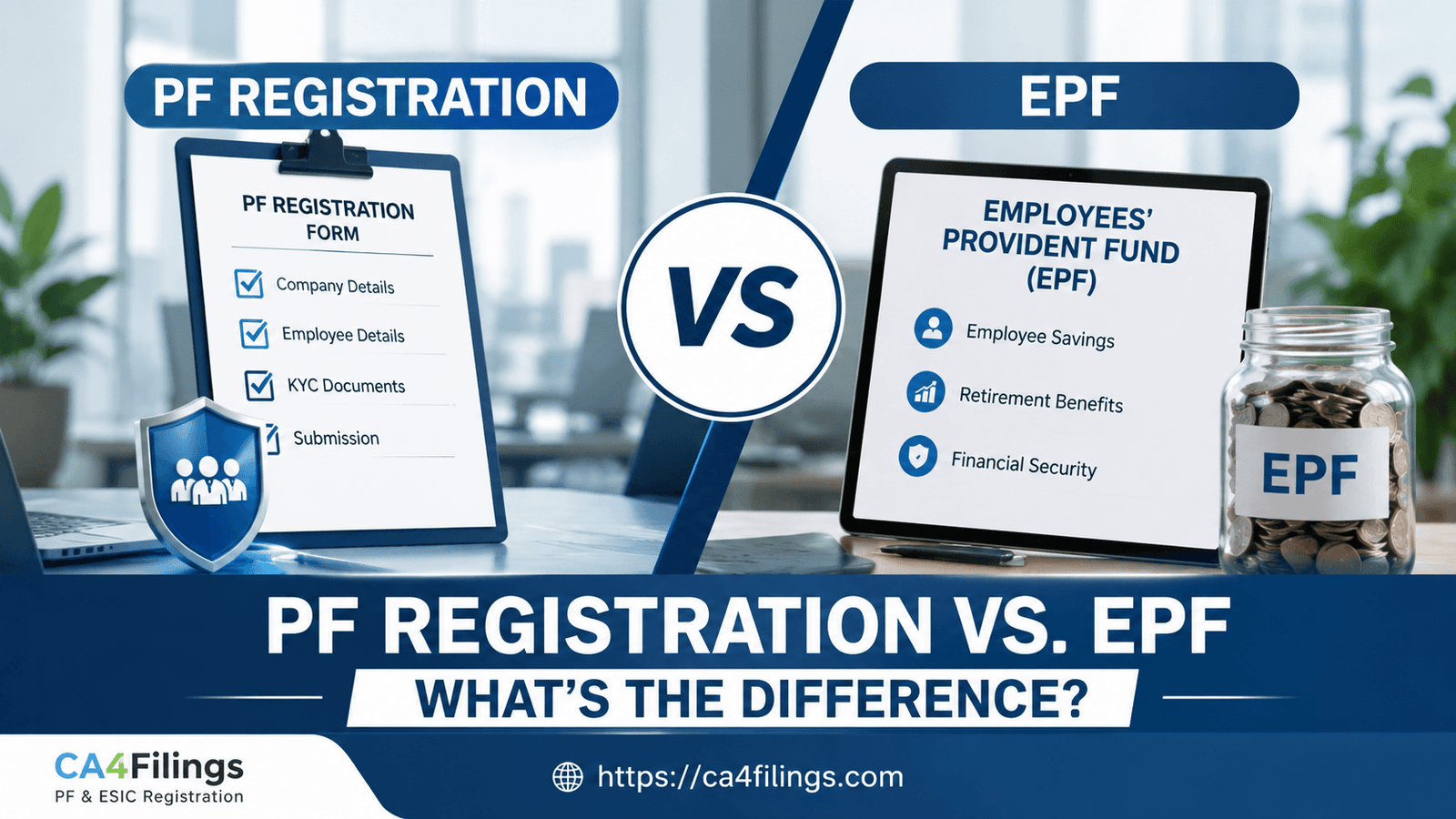
If you are running a business in India or working as an employee, you have probably heard terms like PF Registration and EPF being used interchangeably. However, many people still get confused about “PF Registration vs. EPF: What’s the Difference?” Understanding this distinction is important because both concepts are closely connected to employee benefits, legal compliance, and payroll management.
At CA4Filings, we regularly help startups, SMEs, and growing companies understand labour law compliances, including PF & ESIC Registration. In practical terms, EPF is the employee benefit scheme, while PF Registration is the process an employer must complete to comply with EPF laws.
In this guide, we will explain PF Registration vs. EPF: What’s the Difference? in simple language so that employers and employees can clearly understand their responsibilities and benefits.
Understanding PF and EPF in India
Before discussing PF Registration vs. EPF: What’s the Difference?, let us first understand the basic meaning of these terms.
What is PF?
PF stands for Provident Fund, a retirement savings scheme designed to provide financial security to employees after retirement. Both employer and employee contribute a fixed percentage of salary towards this fund every month.
What is EPF?
EPF stands for Employees’ Provident Fund, which is governed by the Employees’ Provident Funds and Miscellaneous Provisions Act, 1952. It is managed by the Employees’ Provident Fund Organisation (EPFO).
The EPF scheme helps employees build long-term savings while earning interest on their contributions.
PF Registration vs. EPF: What’s the Difference?
One of the most common questions business owners ask is: PF Registration vs. EPF: What’s the Difference?
The answer is simple:
- EPF is the actual provident fund scheme for employees.
- PF Registration is the legal process through which an employer registers with EPFO to provide EPF benefits to employees.
In short:
| Basis | PF Registration | EPF |
|---|---|---|
| Meaning | Employer registration process | Employee savings scheme |
| Purpose | Compliance with labour laws | Retirement and social security benefits |
| Applicable To | Employers | Employees |
| Managed By | EPFO registration system | Employees’ Provident Fund Organisation |
| Requirement | Mandatory for eligible establishments | Benefit received after registration |
So, when discussing PF Registration vs. EPF: What’s the Difference?, remember that one is a compliance procedure while the other is the actual employee welfare scheme.
Who Needs PF Registration?
Understanding PF Registration vs. EPF: What’s the Difference? also requires knowing when PF Registration becomes mandatory.
PF Registration is Mandatory When:
- A business employs 20 or more employees
- Certain notified industries require compulsory registration even with fewer employees
- Businesses voluntarily opt for EPF benefits
Types of Businesses Covered
- Private limited companies
- LLPs
- Partnership firms
- Factories
- Startups with growing teams
- Service-based businesses
Many startups ignore PF compliance initially and later face penalties during inspections. At CA4Filings, we always advise businesses to complete PF registration as soon as eligibility criteria are met.
Benefits of EPF for Employees
To fully understand PF Registration vs. EPF: What’s the Difference?, it is equally important to know why EPF matters to employees.
Retirement Savings
EPF creates a disciplined savings habit for employees and provides financial stability after retirement.
Tax Benefits
EPF contributions qualify for deductions under Section 80C of the Income Tax Act.
Employer Contribution
Employees receive additional contributions from employers, increasing overall savings.
Pension Benefits
A part of the employer contribution goes towards the Employees’ Pension Scheme (EPS).
Emergency Withdrawals
Employees can partially withdraw EPF for:
- Medical emergencies
- Home purchase
- Marriage expenses
- Higher education
PF Registration Process in India
When businesses ask PF Registration vs. EPF: What’s the Difference?, they also want to know how registration works.
Step-by-Step PF Registration Process
Step 1: Gather Required Documents
Documents generally include:
- PAN card of the business
- Certificate of incorporation
- Address proof
- Director/partner details
- Employee details
- Bank account details
Step 2: Register on EPFO Portal
The employer must create an account on the EPFO portal.
Step 3: Submit Application
The online application form is filled with business and employee details.
Step 4: DSC Verification
Digital Signature Certificate (DSC) verification is completed.
Step 5: PF Code Generation
Once approved, EPFO issues a PF Establishment Code Number.
This code allows the employer to deposit monthly EPF contributions.
Employer Responsibilities After PF Registration
Another important aspect of PF Registration vs. EPF: What’s the Difference? is understanding employer obligations after registration.
Monthly Contributions
Both employer and employee typically contribute 12% of basic salary.
Filing Returns
Employers must file monthly and annual PF returns.
Timely Deposits
EPF contributions must be deposited before the due date every month.
Maintaining Records
Payroll and employee records must be maintained properly.
Failure to comply can result in:
- Interest penalties
- Late fees
- Legal notices
- Labour department scrutiny
Common Misconceptions About PF Registration and EPF
PF and EPF Are Different Schemes
This is incorrect. EPF is the official provident fund scheme under EPFO.
Only Large Companies Need PF Registration
Even smaller businesses may require registration depending on industry notifications.
EPF is Optional for Eligible Employers
Once eligibility criteria are met, registration becomes mandatory.
Freelancers Can Get EPF
EPF generally applies to salaried employees working under registered establishments.
PF Registration vs. EPF: What’s the Difference? for Startups
Startups often assume labour compliance can wait until later stages. However, ignoring PF obligations can create compliance issues during funding rounds or due diligence.
Here is a practical example:
A startup with 25 employees delayed PF registration for one year. During a labour inspection, they were asked to pay:
- Pending EPF contributions
- Interest
- Penalties
This significantly increased compliance costs.
At CA4Filings, we recommend startups proactively complete PF registration to avoid future legal complications.
Key Advantages of Timely PF Registration
When understanding PF Registration vs. EPF: What’s the Difference?, businesses should also focus on the long-term benefits of compliance.
Better Employee Trust
Employees feel secure when statutory benefits are properly managed.
Improved Company Reputation
Compliant businesses attract skilled employees and investors.
Avoidance of Penalties
Timely registration helps businesses avoid heavy fines.
Smooth Payroll Management
Integrated payroll and PF systems reduce compliance errors.
FAQs on PF Registration vs. EPF: What’s the Difference?
Is PF Registration mandatory for every business?
No. It generally becomes mandatory once a business employs 20 or more employees.
Can a company voluntarily opt for EPF?
Yes. Even businesses with fewer than 20 employees can voluntarily register under EPF.
What is the contribution percentage under EPF?
Typically, both employer and employee contribute 12% of basic salary.
Is PF deduction compulsory for employees?
For eligible employees working in registered establishments, PF deduction is generally mandatory.
What happens if a company delays PF registration?
The company may face penalties, interest, and legal action from EPFO authorities.
By now, the confusion around PF Registration vs. EPF: What’s the Difference? should be much clearer. EPF is the employee welfare and retirement savings scheme, while PF Registration is the mandatory legal process employers complete to provide those benefits.
For businesses, timely PF compliance is not just a legal formality — it builds employee trust, improves operational credibility, and protects the company from penalties. For employees, EPF acts as a valuable financial safety net for the future.
At CA4Filings, we help businesses across India with seamless PF registration, labour law compliance, and payroll-related support. Whether you are a startup, SME, or established company, our experts ensure your compliance process remains smooth, accurate, and stress-free.
If you need professional assistance with PF registration or labour law compliance, connect with CA4Filings today and let our experts guide you at every step.
Latest Updates
ca4filings.com Services


























-registration.png)