Income Tax ITR Filing 101: Everything a Young Professional Needs to Know
Confused about income tax itr filing? CA4Filings brings you a comprehensive guide to help young professionals master taxes and secure their finances.
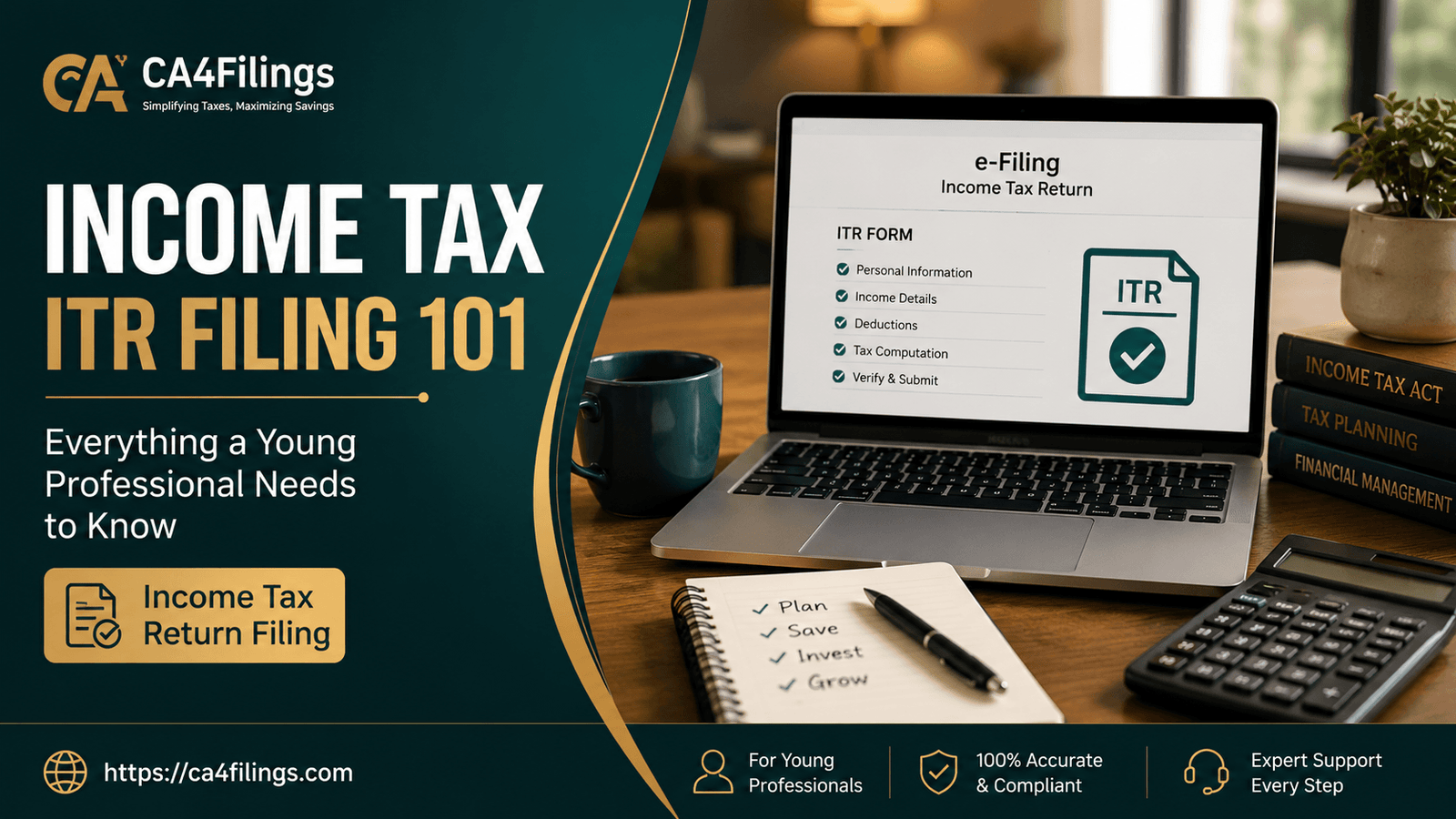
So, you’ve landed your first job, received that exciting first salary, and are finally starting your career journey. It’s a proud moment! But amidst the celebrations, there’s one "adulting" task that often feels daunting: income tax itr filing. As a young professional, navigating the Indian tax landscape might seem complex, but it is a fundamental pillar of financial literacy. At CA4Filings, we understand that your time is valuable, and that is why we offer professional Income Tax Return Filing services to ensure you stay compliant without the stress.
Understanding the basics today saves you from potential legal headaches tomorrow. Let’s break down everything you need to know to get started on the right foot.
Why Should a Young Professional Care About Income Tax ITR Filing?
Many youngsters assume that if their employer deducts TDS (Tax Deducted at Source), their tax obligations are over. This is a common misconception. Income tax itr filing is not just about paying taxes; it is about declaring your financial health to the government.
Beyond compliance, filing your returns is crucial for:
Loan Approvals: Banks and financial institutions treat your ITR as the primary proof of your repayment capacity for home, car, or education loans.
Visa Processing: Many foreign consulates require ITR receipts as proof of your financial stability.
Claiming Refunds: If your TDS exceeds your actual tax liability, the only way to get that money back is by filing your returns.
Carrying Forward Losses: If you dabble in the stock market and face losses, filing an ITR allows you to carry those losses forward to offset future gains.
Decoding the Basics: Taxable Income and Your Paycheck
To master income tax itr filing, you first need to understand how your income is categorized. In India, your income is taxed under five heads: Salary, House Property, Profits and Gains from Business or Profession, Capital Gains, and Income from Other Sources (like interest from savings accounts).
Understanding Gross Total Income vs. Taxable Income
Your gross total income is the sum of all income earned during the financial year before any deductions. However, the government allows various deductions under Chapter VI-A (like Section 80C for PF/PPF/LIC, 80D for health insurance, etc.). Once these deductions are subtracted, you arrive at your taxable income limits.
The government sets specific thresholds for taxable income limits every year. If your income falls below these limits, you might not have to pay tax, but filing an ITR is still recommended to keep your documentation clean.
Taxation for Youth: Old Regime vs. New Regime
A major part of taxation for youth today is choosing the right tax regime. Since the introduction of the "New Tax Regime," many young professionals are confused about which path to take.
The New Regime: Offers lower tax rates but requires you to forgo most common deductions and exemptions (like HRA, LTA, and Section 80C investments). It is often simpler for those who don’t have heavy investments or insurance premiums.
The Old Regime: Higher tax rates, but it allows you to utilize various deductions to reduce your overall tax burden.
We recommend calculating your tax liability under both regimes before filing. At CA4Filings, we often see that for young professionals with limited investments, the New Regime is more convenient, but your specific financial goals determine the best choice.
Step-by-Step: How to Approach Your Income Tax ITR Filing
When you are ready to start your income tax itr filing process, follow these structured steps:
Gather Your Documents: Keep your Form 16 (provided by your employer), Form 26AS (your tax credit statement), Annual Information Statement (AIS), and investment proofs handy.
Choose the Correct Form: For most salaried individuals, ITR-1 (Sahaj) is sufficient. If you have capital gains or income from business, you may need ITR-2 or ITR-3.
Verify Your Data: Always cross-verify the data in your ITR form with your Form 26AS. Any mismatch can trigger a notice from the Income Tax Department.
Submit and Verify: After uploading your return, the process is only complete once you e-Verify your ITR. You can do this via Aadhaar OTP or net banking.
Frequently Asked Questions (FAQs)
Is income tax itr filing mandatory if my income is below the exemption limit?
While it is not mandatory, it is highly recommended. It helps maintain a documented trail of your income, which is helpful for future credit applications and visa processing.
What happens if I miss the ITR filing deadline?
If you miss the due date (usually July 31st for individuals), you can still file a "belated return." However, you will have to pay a late fee under Section 234F, and you lose the option to carry forward certain losses.
How does CA4Filings help a first-time filer?
We simplify the entire process. From helping you choose the right tax regime to ensuring you claim all eligible deductions, we handle the technicalities so you can focus on your growing career.
Do I need to report my interest income from savings accounts?
Yes, interest income from savings accounts and fixed deposits is taxable under "Income from Other Sources" and must be disclosed in your ITR.
Secure Your Financial Future Today
Don’t let the jargon of taxation intimidate you. Income tax itr filing is a gateway to financial maturity and security. By staying organized and seeking professional guidance, you ensure that your hard-earned money is managed efficiently.
Are you ready to handle your taxes like a pro? You don't have to do it alone. Reach out to CA4Filings today. Our team of experienced Chartered Accountants is here to provide personalized advice, optimize your tax liability, and ensure your income tax itr filing is error-free. Let us handle the numbers while you build your future!
Latest Updates
ca4filings.com Services






















-registration.png)