Understanding ITR Return Filing: Which Form (ITR-1 to ITR-7) Is Right for You?
Confused about which ITR form to file? Our expert guide simplifies itr return filing to help you select the right form quickly and avoid tax penalties.
Every year, as the tax season approaches, the most common question I hear from clients is: "Which form do I actually need to submit" Navigating the complexities of itr return filing can feel overwhelming, but it is a critical task for every taxpayer. If you are looking for professional assistance to streamline your Income Tax Return Filing, our team at CA4Filings is here to guide you through the process seamlessly. Selecting the correct document is the foundation of a compliant tax season, as choosing the wrong one can lead to notices or rejection of your return.
Why Understanding the Types of ITR Forms Matters
In India, the Income Tax Department has introduced various types of itr forms designed for specific income sources and taxpayer profiles. When it comes to itr return filing, there is no "one-size-fits-all" solution. The tax department categorizes taxpayers based on their residential status, source of income, and entity type.
Filing the wrong form is a common mistake that often leads to your return being treated as "defective." By understanding your income tax category, you ensure that your financial disclosures match the requirements of the law, saving you time, stress, and potential legal headaches later on.
Breaking Down ITR Eligibility: Which Form Is for You?
Choosing the right tax form depends entirely on your financial profile. Let’s break down the different forms so you know exactly what is expected.
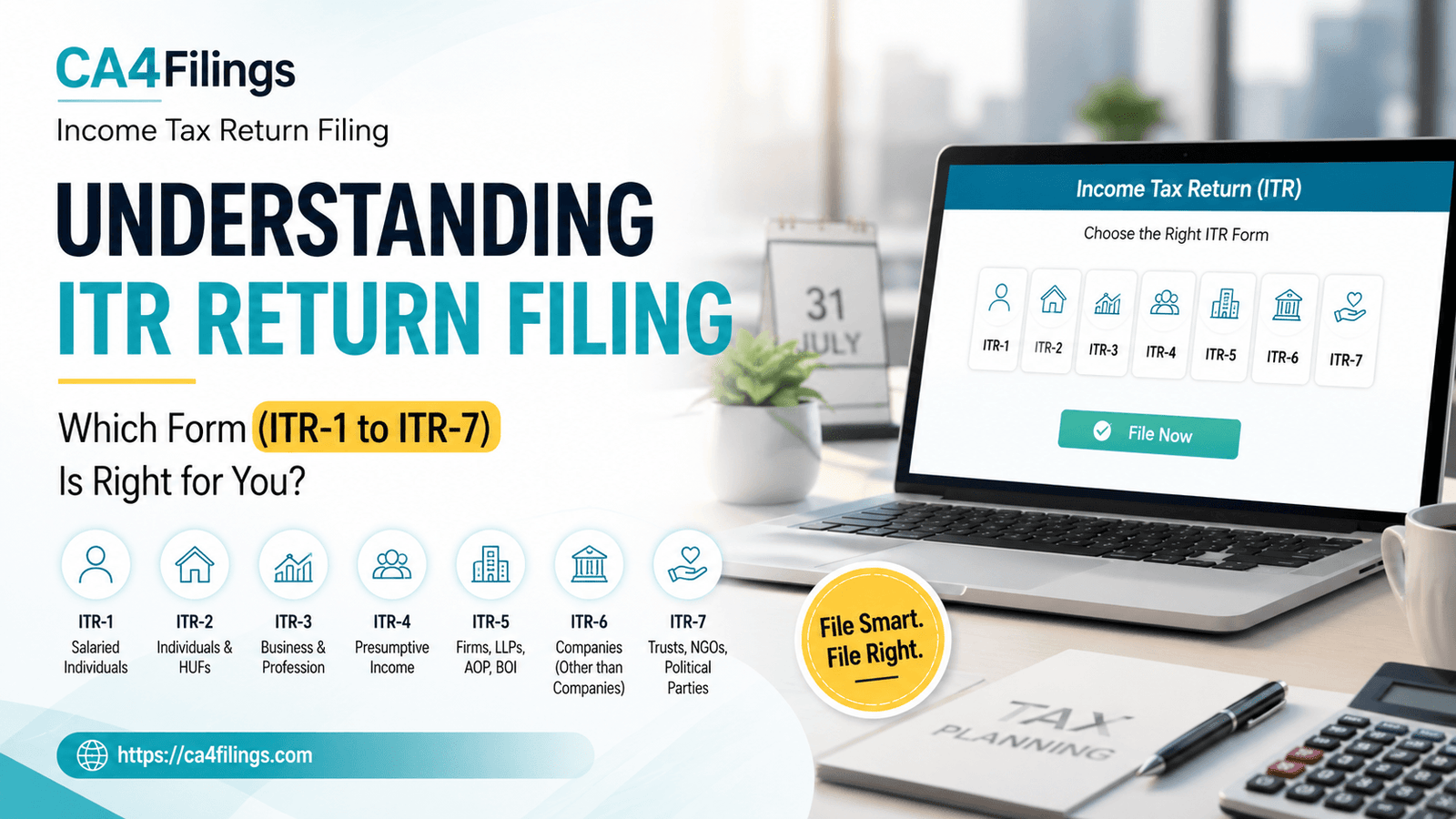
ITR-1 (Sahaj)
This is for resident individuals having total income up to ₹50 lakh. It covers income from salaries, one house property, and other sources like interest. If you have capital gains or income from business, this form is not for you.
ITR-2
Designed for individuals and HUFs who do not have income from a business or profession. You use this if you have capital gains, multiple house properties, or income from foreign assets.
ITR-3
This is the comprehensive form for individuals and HUFs having income from a proprietary business or profession. If you are a freelancer or run a small shop, this is your go-to.
ITR-4 (Sugam)
A simplified version for individuals, HUFs, and firms (other than LLPs) who have opted for the presumptive taxation scheme under sections 44AD, 44ADA, or 44AE.
ITR-5
Specifically for firms, LLPs, AOPs, and BOIs.
ITR-6
Exclusively for companies that are not claiming exemption under section 11.
ITR-7
For persons including companies required to furnish returns under specific sections related to charitable or religious trusts, political parties, or scientific research associations.
Practical Insights for Choosing Tax Form Correctly
When choosing tax form types, my best advice is to look at your "worst-case" income. For example, if you are a salaried employee (which would usually mean ITR-1), but you also made a profit from selling stocks during the year, you have moved into the ITR-2 bracket. Always document your income streams before starting your itr return filing process.
Many taxpayers try to use ITR-1 to save time, even when they have complex income. As a CA, I have seen many clients receive scrutiny notices simply because they didn't disclose their capital gains or dividend income in the correct form. Transparency and accuracy are your best defenses against tax audits.
Common Mistakes During ITR Return Filing
Ignoring Foreign Income: Many people forget that foreign assets or income must be reported, which automatically shifts you to a more complex ITR form.
Incorrect Presumptive Income: If you choose ITR-4, ensure you meet the specific conditions of presumptive taxation. If your business turnover exceeds the limits, you must shift to ITR-3.
Missing TDS Credits: Always verify your Form 26AS. Sometimes, the income reported on your form does not match the TDS reflected by the government.
Frequently Asked Questions
Can I change my ITR form after filing?
No, once submitted, you cannot change the form. However, if you realize you made a mistake, you can file a "Revised Return" using the correct form, provided the original filing window is still open.
What happens if I file the wrong ITR form?
The Income Tax Department will likely mark your return as "defective" and issue a notice. You will then have to file a corrected return within 15 days of receiving the notice.
Is ITR-1 mandatory for all salaried employees?
No. ITR-1 is an option, not a mandate. If a salaried employee has capital gains or house property income, they must use ITR-2 instead.
Do I need to attach bills or proofs with my ITR?
No, the Indian tax system is based on self-assessment. You do not need to attach proofs, but you must keep them safe for six years in case of a future audit.
Secure Your Financial Future with CA4Filings
Itr return filing doesn't have to be a source of anxiety. Whether you are a salaried professional, a freelancer, or a business owner, ensuring you are under the correct income tax category is the first step toward a peaceful tax year. At CA4Filings, we specialize in simplifying these technicalities so you can focus on what you do best—growing your wealth.
Latest Updates
ca4filings.com Services


























-registration.png)