Exporting Goods without Tax: The Step-by-Step Guide to Bond Filing
Master exporting goods without tax! Our expert guide covers the Letter of Undertaking (LUT), goods and services tax filing, and how to stay compliant.
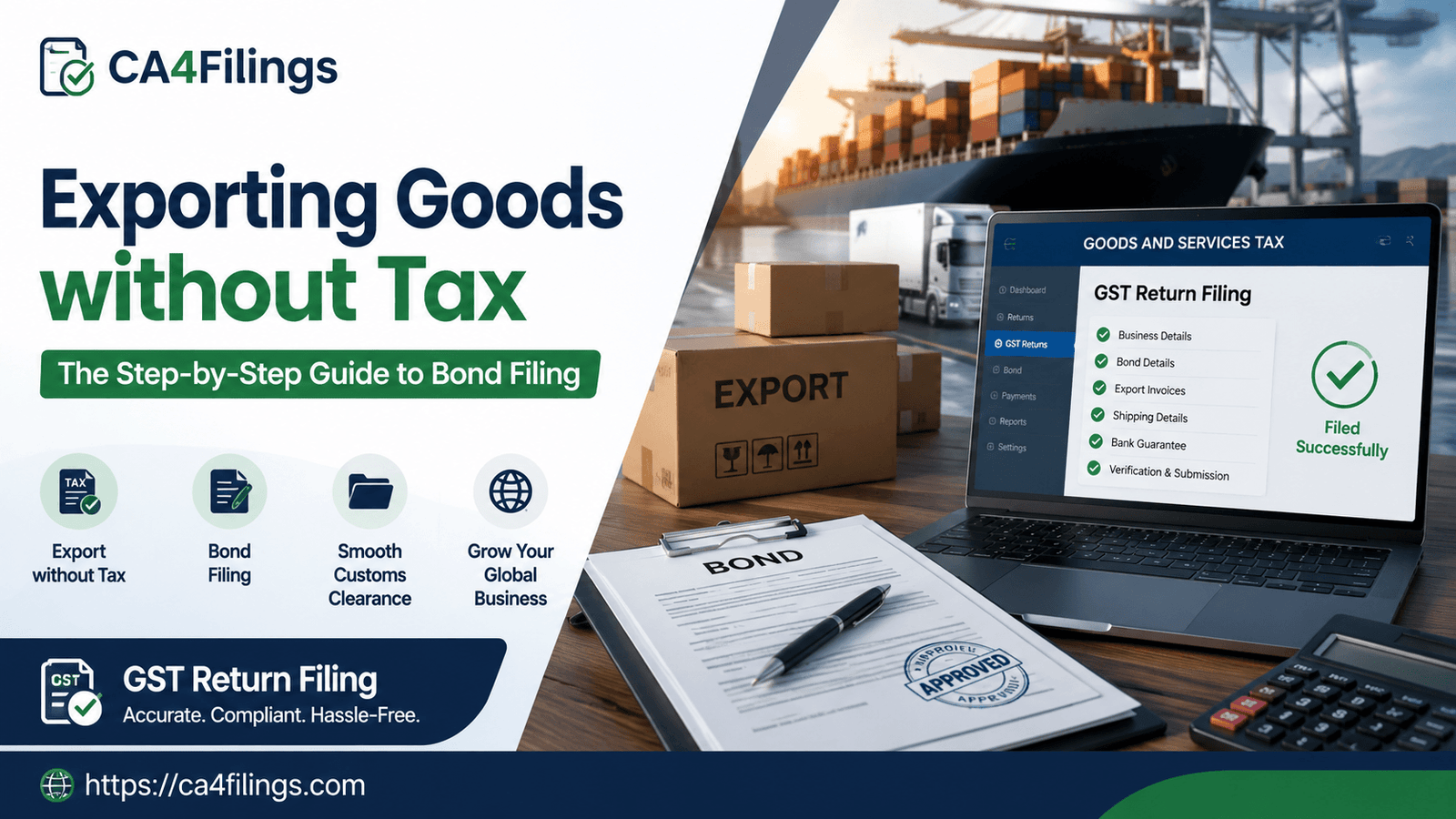
For many Indian exporters, the prospect of navigating complex tax regulations can feel like sailing into uncharted waters. While the government encourages exports through tax incentives, ensuring your goods and services tax filing is handled correctly is the bedrock of a smooth operation. At CA4Filings, we often see businesses struggle to balance these incentives with their routine GST Return Filing requirements. Exporting goods without paying integrated tax is a brilliant way to maintain cash flow, but it requires meticulous adherence to the bond or Letter of Undertaking (LUT) process.
If you are looking to scale your exports while keeping your working capital intact, this guide is for you. Let’s break down the mechanics of exporting under a bond or LUT so you can keep your focus where it belongs—growing your business globally.
Why Export Without Tax? The Power of LUT
When you export goods, the Indian government treats it as a "zero-rated supply." This essentially means you have two primary options:
Pay the IGST upfront and claim a refund later.
Export under a Letter of Undertaking (LUT) and export the goods without paying any tax at all.
Most exporters prefer the second option because it avoids locking up working capital in tax refunds. By using an LUT, you effectively bypass the need for a goods and services tax filing that involves massive cash outflows.
Understanding the LUT Submission Tutorial
An LUT is a self-declaration by the exporter that they will comply with all GST laws and export the goods within the stipulated time frame. Unlike in the old regime, where you had to provide a bank guarantee for almost every transaction, the current system allows most exporters to function with a simple LUT submission.
Eligibility Criteria for LUT
Not everyone qualifies for an LUT. To be eligible, you must:
Hold a valid GST registration.
Have an active IEC (Import Export Code).
Ensure that you have not been prosecuted for tax evasion exceeding ₹2.5 crore under the GST or CGST Acts.
The Step-by-Step LUT Process
Log in to the GST Portal: Access the portal using your credentials.
Navigate to Services: Go to User Services > Furnish Letter of Undertaking (LUT).
Select Financial Year: Choose the relevant year for which you want to file the LUT.
Upload Documents: Attach the previous year's LUT if applicable.
Self-Declaration: Read the terms carefully regarding your commitment to export.
Sign and Submit: Use your Digital Signature Certificate (DSC) or Electronic Verification Code (EVC).
Once submitted, this becomes a critical part of your records for future goods and services tax filing audits.
Navigating Bank Guarantee Exemption
In the past, the bank guarantee exemption was difficult to secure. Today, the GST law is much more streamlined. If you are a regular exporter with a clean track record, you generally do not need to provide a bank guarantee. This is a massive relief for MSMEs, as it frees up credit limits with their banks. If you ever find your application being scrutinized, ensure your documentation—specifically your shipping bills and proof of export—is organized.
Customs Gateway Exchange and Shipping Bill Tracing
Once your goods leave the port, the customs gateway exchange (ICEGATE) takes over. This is where your shipping bill becomes your most important document.
Importance of Shipping Bill Tracing
Shipping bill tracing is how the GST authorities verify that your goods actually crossed the international border. If the electronic data from the Customs port does not match your GSTR-1, your entire tax-free export status could be challenged. Always ensure that the shipping bill number and date are accurately reflected in your system before finalizing your periodic goods and services tax filing.
Refund Route Selection: Choosing the Right Path
Even if you export without tax, you might still have an "Input Tax Credit" (ITC) pile-up because of the inputs you purchased to manufacture your goods. Choosing the right refund route selection is vital. You can claim a refund of unutilized ITC under the export-without-payment-of-tax category. Our advice at CA4Filings is to keep your ITC ledger reconciled monthly. Mismatches here are the most common reason for delayed refunds or notices from the GST department.
Frequently Asked Questions
Do I need a fresh LUT every time I export?
No. An LUT is valid for the entire financial year. You only need to file it once at the start of the fiscal year.
What happens if I fail to export within the time limit?
If you do not export within three months (or the extended period allowed) from the date of the invoice, you will be liable to pay the IGST along with interest at the prescribed rate.
Is LUT applicable for service exporters too?
Yes, the LUT process applies to both goods and services exporters, provided the supply qualifies as an export under GST laws.
How does shipping bill tracing affect my compliance?
It is the primary evidence of export. If this data is missing from the portal, you may be treated as a domestic supplier, which would trigger tax liabilities.
Simplify Your Global Trade Journey with CA4Filings
Managing international trade compliance while handling domestic goods and services tax filing can be daunting. You don’t have to do it alone. At CA4Filings, we specialize in helping exporters streamline their LUT processes, manage ITC refunds, and ensure 100% compliance with the latest regulations.
Latest Updates
ca4filings.com Services
























-registration.png)