Registration of Partnership Firm: Offline vs. Online Methods
Confused between traditional and digital routes? Explore the Registration of Partnership Firm: Offline vs. Online Methods with expert insights from CA4Filings.
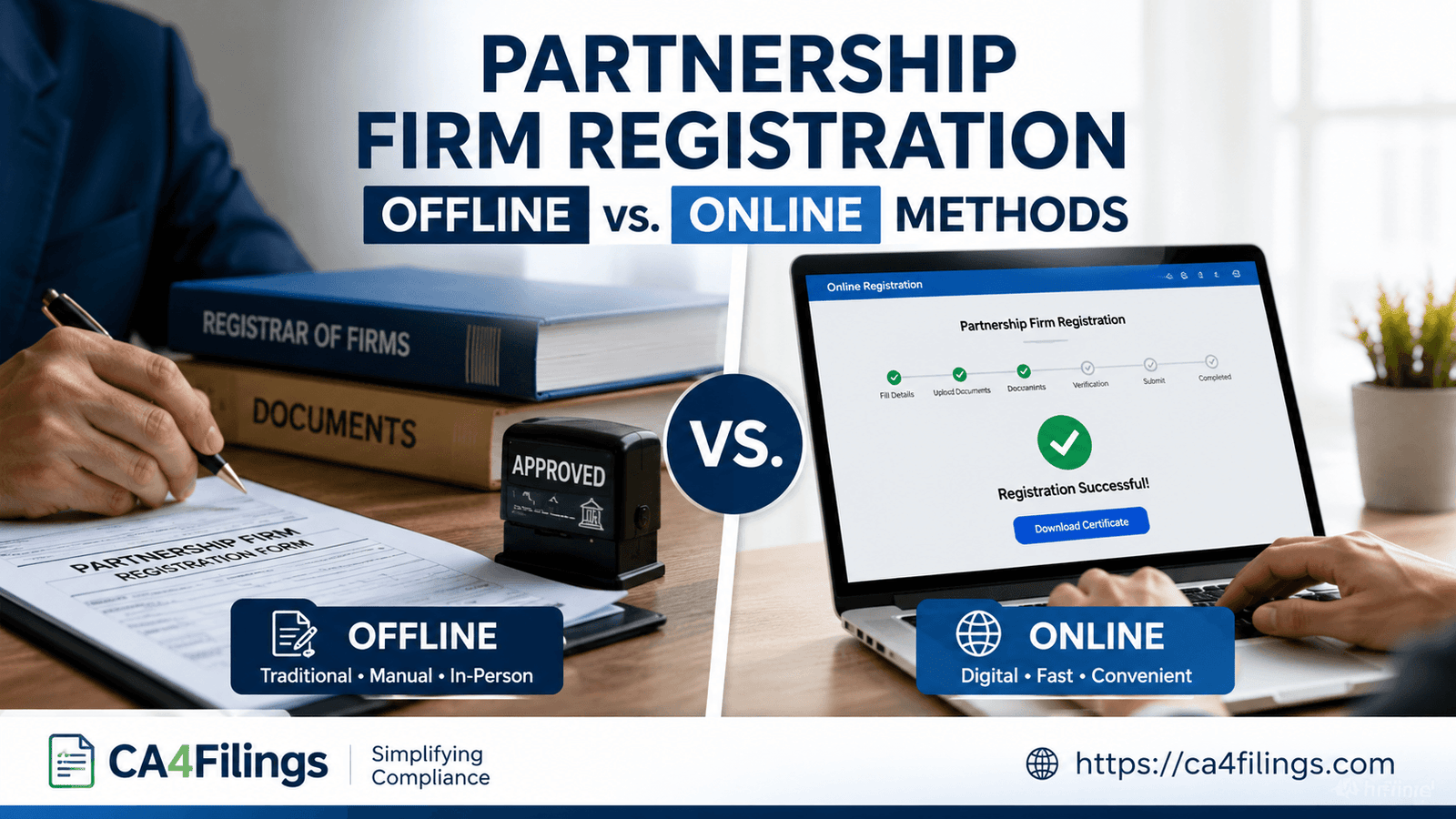
Starting a business with a partner is an exciting milestone, but navigating the legal paperwork can feel like a maze. If you are planning to formalize your business structure, understanding the Registration of Partnership Firm: Offline vs. Online Methods is the first step toward building a secure foundation. Many entrepreneurs ask me, "Is it mandatory to register" While not strictly compulsory under the Indian Partnership Act, 1932, registering provides essential legal safeguards, such as the ability to sue third parties for contractual breaches. At CA4Filings, we often assist clients with Partnership Firm Registration to ensure their business interests are protected from day one. Choosing the right path—whether manual or digital—depends on your comfort with technology and your preference for paperwork.
Why Registration Matters for Your Partnership
Before we dive deep into the Registration of Partnership Firm: Offline vs. Online Methods, let’s briefly touch upon why this matters. An unregistered firm lacks the legal standing to enforce claims against partners or outsiders. It is like driving a car without insurance; you might get by for a while, but if an accident happens, the costs can be devastating. Registration brings transparency, credibility, and ease of operations, especially when dealing with banks and government tenders.
The Traditional Route: Understanding Offline Registration
For many business owners who prefer a physical paper trail, the offline route is the familiar choice. This involves visiting the office of the Registrar of Firms (ROF) in your jurisdiction.
Steps for Offline Registration:
Drafting the Deed: First, you must draft a Partnership Deed on non-judicial stamp paper.
Notarization: Get the deed notarized and signed by all partners.
Submission: Prepare an application in Form A, attach the necessary documents, and visit the local Registrar’s office.
Verification: The Registrar examines your documents. If there are discrepancies, you will be asked to rectify them in person.
Certificate Issuance: Once satisfied, the Registrar issues the Certificate of Registration.
While this method feels "tangible," it is often time-consuming. You may face multiple visits, long queues, and the frustration of manual paperwork errors.
The Modern Shift: Exploring Online Registration
In recent years, many states have digitized their processes, making the Registration of Partnership Firm: Offline vs. Online Methods comparison lean heavily toward the digital side. Online registration is designed for speed and convenience.
Why Opt for Online Registration?
Efficiency: You can initiate the process from your office or home.
Real-time Tracking: Most portals allow you to track the status of your application.
Reduced Human Intervention: Digital filing minimizes the chances of arbitrary rejections based on minor clerical errors.
Faster Processing: Since documents are uploaded and processed through a centralized system, the turnaround time is generally faster.
However, note that India does not have one single national portal for all states. Some states are fully online, while others offer a hybrid model. This is where professional guidance becomes invaluable.
Comparing Registration of Partnership Firm: Offline vs. Online Methods
To help you make an informed decision, let’s break down the core differences.
| Feature | Offline Method | Online Method |
|---|---|---|
| Convenience | Requires physical presence | Accessible from anywhere |
| Speed | Often slow/bureaucratic | Significantly faster |
| Error Handling | Difficult and tedious | Quick updates via portal |
| Transparency | Low (hard to track status) | High (automated notifications) |
Expert Advice: Which Method Should You Choose?
At CA4Filings, we have handled hundreds of cases. My advice? If your state offers a robust online portal, always go digital. However, if your state’s digital infrastructure is in its infancy, or if your partnership deed involves complex clauses that might confuse an automated system, a hybrid approach—where we prepare everything digitally but handle the nuances of the Registrar's specific demands—is often the smartest route.
Don't let the complexity of the Registration of Partnership Firm: Offline vs. Online Methods stall your business growth. Whether you are in a tech-savvy state or one that relies on traditional documentation, our team knows exactly how to get your firm registered with the least amount of friction.
Frequently Asked Questions
Is it mandatory to register a partnership firm?
No, registration is optional under the Indian Partnership Act, 1932. However, it is highly recommended to protect your legal rights and gain credibility.
Which is faster: the offline or online method?
In states with functional digital portals, the online method is almost always faster as it eliminates physical transit and manual processing delays.
Do I need a lawyer or CA to register my firm?
While you can do it yourself, the process involves drafting a legally sound Partnership Deed. Errors in the deed can cause major disputes later. A professional ensures compliance and saves you time.
Can I change my firm's details after registration?
Yes, you can file for an amendment to the partnership deed or update details like the firm's address or partner additions/retirements with the Registrar.
What are the main documents required?
Generally, you need the Partnership Deed, PAN card of the firm, address proof of the business, and identity/address proof of all partners.
Get Started with CA4Filings
Navigating the Registration of Partnership Firm: Offline vs. Online Methods doesn't have to be a headache. You focus on growing your business, and let CA4Filings handle the legalities. We offer end-to-end support, from drafting your deed to receiving your registration certificate.
Latest Updates
ca4filings.com Services




























-registration.png)