Income Tax Return Filing and Its Impact on Your Credit Score
Income Tax Return Filing and Its Impact on Your Credit Score explained simply with expert tips to improve loan approval chances.
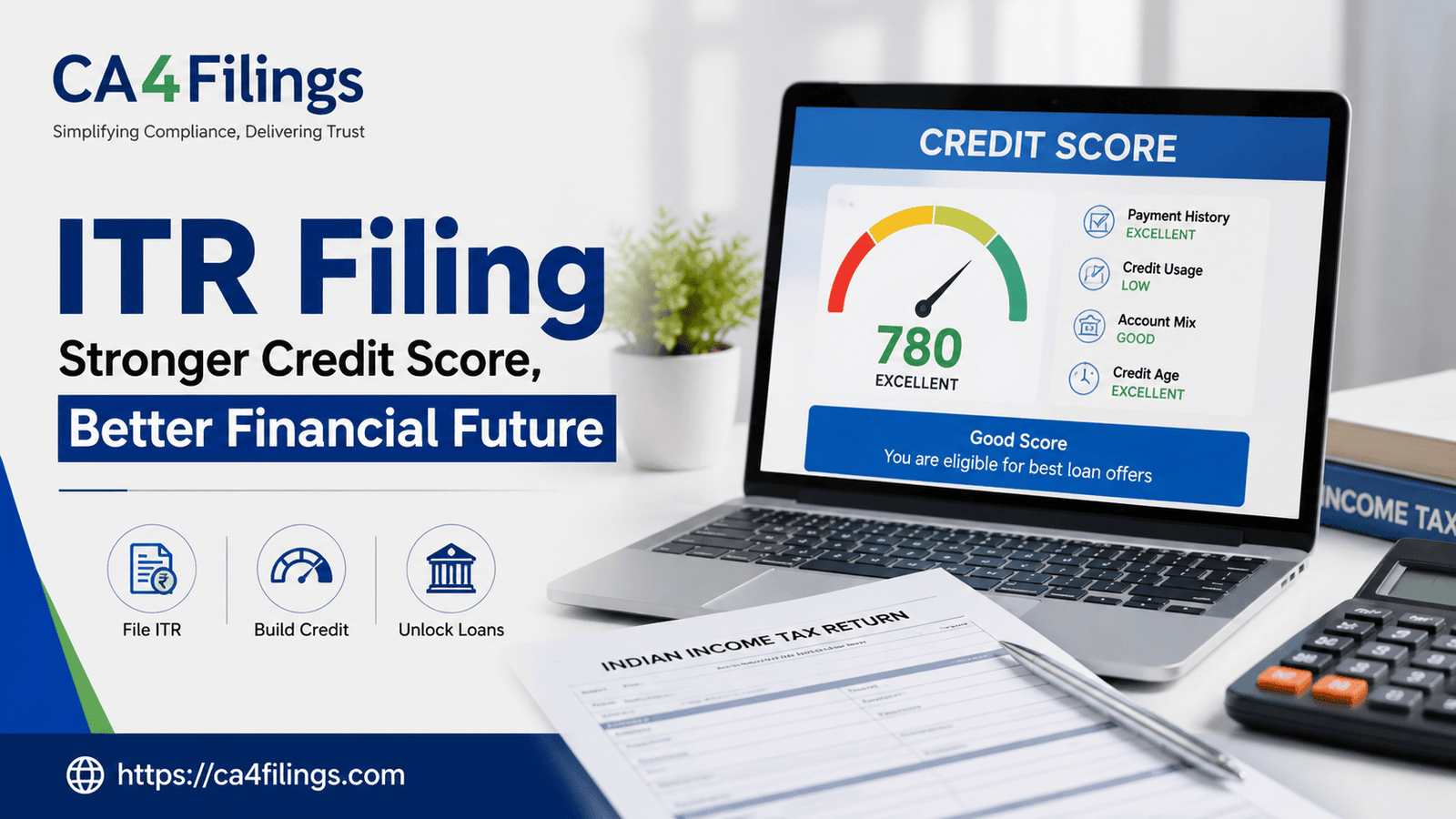
Many people in India believe that credit scores depend only on loan repayments and credit card usage. However, there is another important factor that lenders increasingly consider today — Income Tax Return Filing and Its Impact on Your Credit Score. Whether you are a salaried employee, freelancer, startup founder, or business owner, filing your Income Tax Return (ITR) regularly can significantly influence your financial credibility.
At CA4Filings, we often meet individuals who are surprised when banks ask for their ITRs before approving loans, credit cards, or even higher credit limits. Timely tax filing reflects financial discipline and transparency, which directly affects how financial institutions assess your repayment capacity.
If you are planning to apply for a home loan, personal loan, business loan, or visa, regular Income Tax Return Filing can work strongly in your favour. In this article, we will explain Income Tax Return Filing and Its Impact on Your Credit Score in a simple and practical way.
Understanding Credit Score in India
A credit score is a three-digit number, usually ranging from 300 to 900, that reflects your creditworthiness. Credit bureaus such as CIBIL, Experian, and Equifax generate this score based on your financial behaviour.
Factors That Affect Your Credit Score
Some common factors include:
- Loan repayment history
- Credit card payment behaviour
- Credit utilisation ratio
- Number of active loans
- Loan enquiries
- Financial stability
- Income consistency
Although ITR filing may not directly increase your score instantly, Income Tax Return Filing and Its Impact on Your Credit Score becomes visible when lenders assess your financial profile.
How Income Tax Return Filing Impacts Your Credit Score
Demonstrates Financial Discipline
One of the biggest advantages of regular ITR filing is that it shows financial responsibility. Banks and NBFCs prefer borrowers who maintain proper financial records and comply with tax regulations.
When you file returns consistently:
- Your income becomes officially documented
- Your financial profile appears more reliable
- Lenders gain confidence in your repayment ability
This is where Income Tax Return Filing and Its Impact on Your Credit Score becomes practically important.
Improves Loan Approval Chances
Suppose two individuals apply for a home loan:
- Applicant A has a credit score of 760 but no ITR records.
- Applicant B has a credit score of 730 with three years of regular ITR filing.
In many cases, banks may prefer Applicant B because documented income reduces lending risk.
Regular tax filing acts as additional proof of income, especially for:
- Self-employed professionals
- Freelancers
- Small business owners
- Consultants
- Startup founders
Helps in Getting Higher Loan Amounts
Banks do not approve loans only based on your credit score. They also evaluate your repayment capacity.
Your ITR contains important details such as:
- Annual income
- Business profits
- Salary details
- Investments
- Tax payments
A properly filed ITR helps lenders determine how much loan you can comfortably repay. This clearly highlights Income Tax Return Filing and Its Impact on Your Credit Score and borrowing capacity.
Why Banks Ask for ITRs Before Loan Approval
Verification of Income Stability
Banks want assurance that you have a stable income source. Salary slips alone may not always be sufficient, especially for self-employed individuals.
ITRs provide:
- Verified income history
- Consistency in earnings
- Tax compliance records
Reduces Lending Risk
Financial institutions view non-filers as higher-risk applicants. Even if your repayment history is decent, failure to file ITRs may create doubts regarding financial transparency.
This is another practical example of Income Tax Return Filing and Its Impact on Your Credit Score in the real world.
Impact of Non-Filing of Income Tax Returns
Many individuals avoid filing ITRs because they believe their income is below taxable limits. However, non-filing can create several financial limitations.
Difficulty in Loan Approvals
Without ITRs:
- Loan applications may get delayed
- Banks may approve lower amounts
- Interest rates may be higher
Negative Financial Impression
Frequent non-filing may indicate:
- Unstable income
- Lack of financial planning
- Poor compliance habits
These factors indirectly affect your creditworthiness.
Problems for Self-Employed Individuals
For freelancers and business owners, ITRs are often the primary proof of income. Absence of returns can seriously impact:
- Business loan approvals
- Working capital funding
- Credit card eligibility
This is why understanding Income Tax Return Filing and Its Impact on Your Credit Score is essential for entrepreneurs.
Can Filing ITR Improve a Poor Credit Score?
Direct vs Indirect Impact
ITR filing does not directly add points to your credit score like loan repayments do. However, it creates a stronger financial profile.
For example:
- A lender may overlook a slightly lower credit score if your income records are stable.
- Regular ITR filing may help you qualify for secured loans.
- Banks may offer better repayment terms.
Builds Long-Term Financial Credibility
Consistency matters. Filing returns year after year helps establish trust with:
- Banks
- Financial institutions
- Credit card issuers
- Investors
Over time, this positively supports your overall credit profile.
Importance of ITR Filing for Different Individuals
Salaried Employees
Even salaried individuals benefit from filing returns regularly.
Advantages include:
- Faster loan processing
- Easier visa applications
- Better credit card offers
- Proof of income documentation
Freelancers and Consultants
Freelancers often face challenges proving stable income. Regular ITR filing helps establish legitimacy and financial consistency.
Small Business Owners
For business owners, Income Tax Return Filing and Its Impact on Your Credit Score becomes even more important because lenders rely heavily on tax records to evaluate business health.
Practical Tips to Maintain a Healthy Credit Profile
File ITR Before Due Dates
Timely filing shows discipline and avoids penalties.
Maintain Accurate Financial Records
Ensure all income sources are properly disclosed.
Pay Loan EMIs on Time
Your repayment history remains one of the strongest credit score factors.
Avoid Excessive Credit Usage
Keep credit utilisation below 30% whenever possible.
Monitor Your Credit Report Regularly
Check for errors and incorrect entries that may reduce your score.
Common Myths About ITR Filing and Credit Scores
Myth 1: ITR Filing Directly Increases Credit Score
Reality: It supports your financial profile indirectly rather than directly increasing points.
Myth 2: Only Business Owners Need to File ITRs
Reality: Salaried individuals also benefit from regular filing.
Myth 3: Low Income Means No Need for ITR Filing
Reality: Even lower-income individuals may need ITRs for loans, visas, or financial documentation.
Understanding these realities helps clarify Income Tax Return Filing and Its Impact on Your Credit Score more accurately.
FAQs
Is Income Tax Return Filing mandatory for getting loans?
Not always mandatory, but most banks prefer at least 2–3 years of ITR records, especially for self-employed individuals.
Can non-filing of ITR reduce my credit score?
It may not directly reduce your score, but it can negatively affect loan approvals and financial credibility.
How many years of ITR do banks usually ask for?
Most banks ask for the last 2–3 years of filed returns for major loans.
Does ITR filing help in getting a higher credit card limit?
Yes, regular and higher-income ITRs can support requests for increased credit limits.
Is ITR filing important for freelancers?
Absolutely. Freelancers often use ITRs as official proof of income for loans and financial verification.
Today, financial institutions look beyond just repayment history. Income Tax Return Filing and Its Impact on Your Credit Score has become increasingly relevant in loan approvals, financial assessments, and credit evaluations.
Regular ITR filing reflects financial responsibility, improves credibility, and strengthens your overall financial profile. Whether you are salaried, self-employed, or running a business, maintaining proper tax compliance can open doors to better financial opportunities.
At CA4Filings, we help individuals and businesses file accurate and timely tax returns with complete professional guidance. If you want hassle-free ITR filing and expert support for improving your financial profile, connect with CA4Filings today and stay financially confident for the future.
Latest Updates
ca4filings.com Services
























-registration.png)