The 30-Day Time Limit for E-Invoices: Managing Enterprise Cash Flows
Are you hitting the 30-day limit for e-invoices? Learn how to manage enterprise cash flow, avoid penalties, and simplify your GST filing with expert tips.
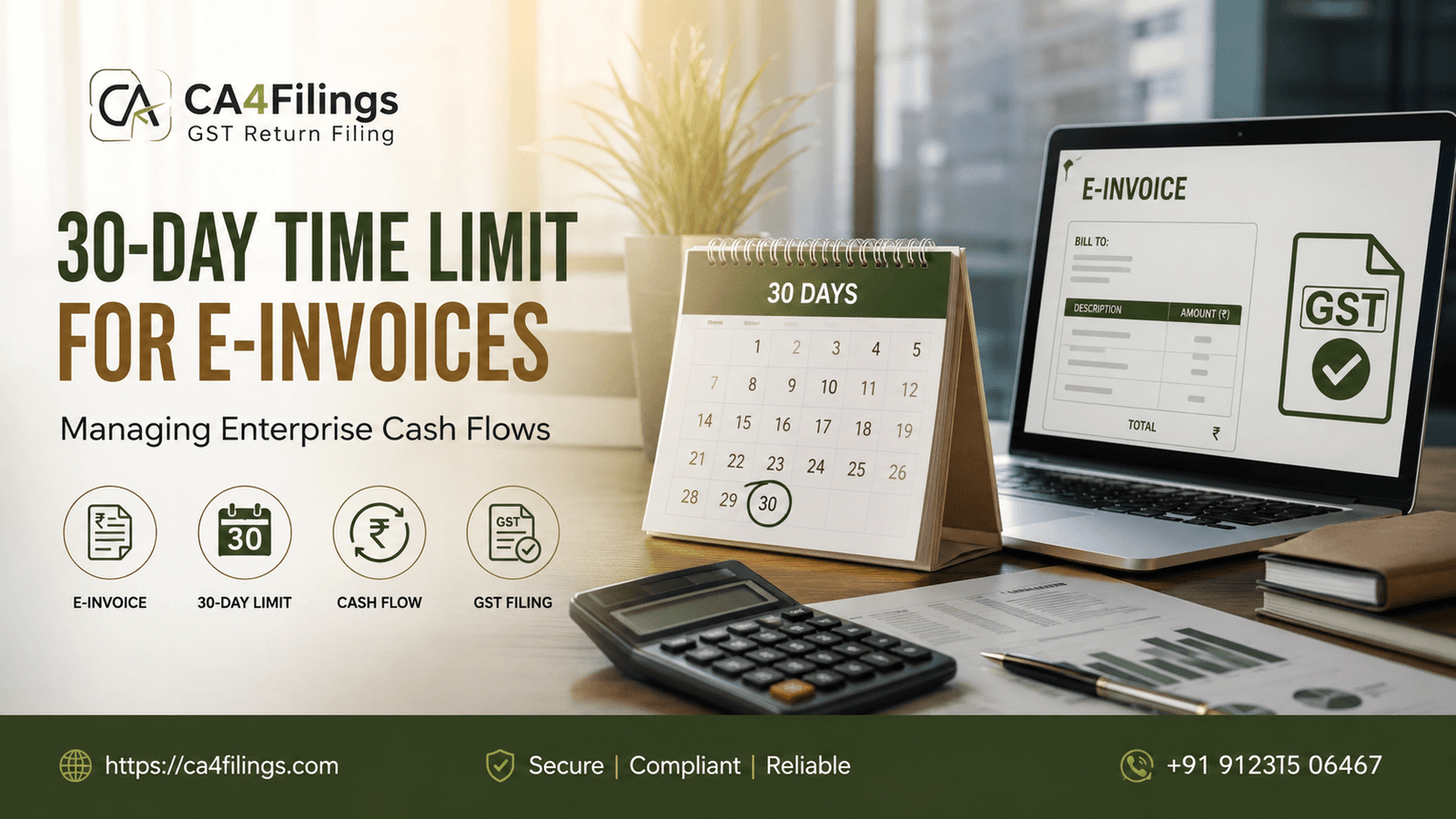
Managing enterprise cash flows in today’s digital tax environment requires more than just good accounting; it requires proactive compliance. At CA4Filings, we often see businesses overlook the technical nuances of the gst filing process, which can lead to avoidable financial bottlenecks. If you are navigating the complexities of modern taxation, our experts can simplify your GST Return Filing to ensure your business stays ahead of regulatory deadlines while maintaining a healthy financial cycle.
One of the most critical updates that every business owner—especially those with an Aggregate Annual Turnover (AATO) exceeding ₹10 Crore—needs to master is the 30-day window for e-invoice reporting. Understanding this timeline is not just about avoiding penalties; it is about protecting your enterprise's cash flow.
The 30-Day Rule: A Hard Deadline for Compliance
The government introduced the 30-day reporting limit on the Invoice Registration Portal (IRP) to curb the practice of backdating invoices. Put simply, if you generate an invoice, you must report it to the IRP within 30 days from the date mentioned on the document.
If you miss this window, the portal will reject the attempt to generate an Invoice Reference Number (IRN). This is a rigid technical barrier; there is currently no provision for "condoning the delay." Once the 30-day mark passes, that specific invoice becomes "orphaned" in the eyes of the GST system.
The Ripple Effect of Delay Reporting Consequences
When you fail to report an invoice within the designated irn portal timeline, you aren't just facing a technical error; you are inviting a cascade of commercial issues:
Invalidation of Invoices: Without an IRN, your tax invoice is legally invalid. It essentially ceases to exist for GST purposes.
Tax Credit Invalidation: The most immediate pain point is for your buyer. If you provide them with an invoice that lacks a valid IRN, they cannot claim Input Tax Credit (ITC). In many B2B contracts, this is a deal-breaker that leads to payment holds or invoice disputes.
Operational Friction: The time spent reconciling these "orphaned" invoices is non-productive administrative work. Your finance team will have to issue credit notes or fresh documents, disrupting your revenue recognition cycle.
Protecting B2B Transaction Safety
The shift toward real-time reporting tech is designed to create transparency across the supply chain. For enterprises, ensuring b2b transaction safety is paramount. By integrating your billing software directly with the IRP, you minimize human intervention, which is often where the error occurs.
At CA4Filings, we always advise our clients to treat e-invoicing as an extension of their sales order process rather than a month-end compliance task. When your system automatically pushes data to the IRP as soon as the invoice is generated, you eliminate the risk of the 30-day deadline sneaking up on you.
How to Audit Your Internal Processes
To avoid the pitfalls of late reporting, your finance team should implement the following steps:
Automated Flagging: Use accounting software that provides a dashboard view of pending IRNs.
Regular Reconciliation: Perform a weekly check between your sales ledger and the IRP data.
Cross-Department Coordination: Ensure your warehouse dispatch team is in sync with the billing team. If goods are dispatched, the invoice must follow immediately—do not wait for the end of the month to "group" your filings.
Frequently Asked Questions
Does the 30-day rule apply to all businesses?
No, the 30-day reporting restriction currently applies specifically to taxpayers with an Aggregate Annual Turnover (AATO) of ₹10 Crore and above.
What is the penalty for missing the 30-day window?
Failure to generate a valid e-invoice is treated as non-issuance of a tax invoice. Penalties can be as high as ₹10,000 per invoice or 100% of the tax amount, whichever is higher.
Can I cancel an e-invoice after 24 hours?
No, the IRP only allows cancellation within 24 hours of generation. After that, you must issue a credit note to nullify the transaction.
How does this affect my overall gst filing?
If invoices are not reported on time, they will not auto-populate in your GSTR-1, leading to significant mismatches during your regular gst filing and making the reconciliation process a nightmare.
Secure Your Business Growth with CA4Filings
Navigating the complexities of GST compliance can be overwhelming, but you don’t have to do it alone. At CA4Filings, we provide comprehensive support for your gst filing and e-invoicing needs. Let our team of experienced chartered accountants handle the technicalities so you can focus on scaling your business.
Latest Updates
ca4filings.com Services






















-registration.png)