How to Convert an Existing Entity via Section 8 Company Registration Paths
Planning a transition to non-profit? Learn the steps for section 8 company registration and how to convert your existing entity effectively with CA4Filings.
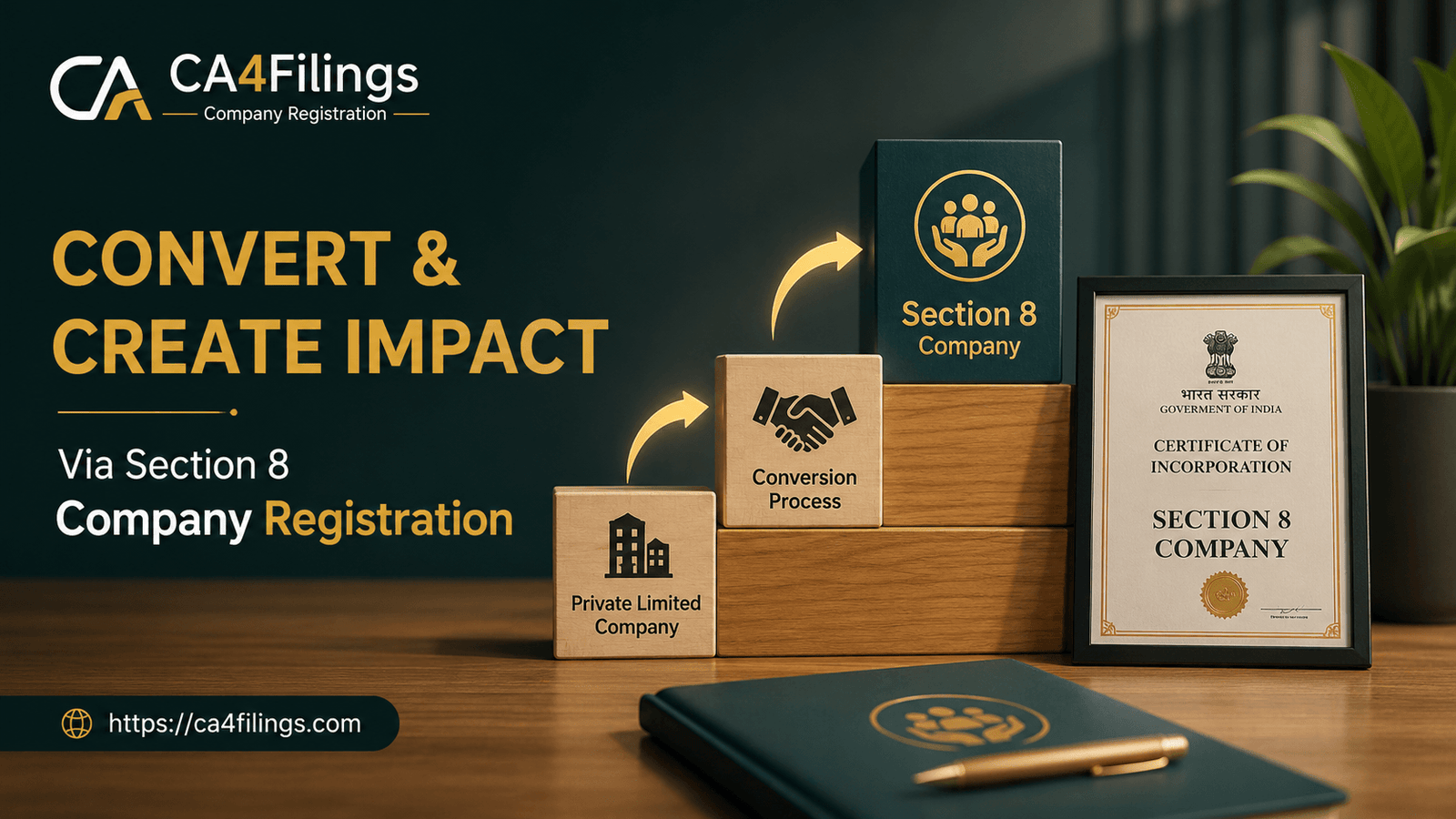
Many entrepreneurs begin their journey with a focus on profit, but as their vision evolves toward social impact, they often seek a private firm transformation. At CA4Filings, we frequently assist business owners who realize their true calling lies in philanthropy or social welfare. If you are ready to pivot, the process of Company Registration as a non-profit is a structured path that requires careful planning and legal precision.
Transitioning from a for-profit model to a non-profit is not just a change in name; it is a fundamental shift in your organizational DNA. Under the Companies Act, 2013, the process for section 8 company registration is designed to ensure that the entity’s resources are strictly dedicated to charitable goals like arts, science, education, or environmental protection.
Understanding the Shift: Why Consider a Non-Profit Model?
When you decide on restructuring to non-profit, you are committing to a transparent, mission-driven operational framework. A Section 8 company does not distribute dividends; instead, all profits are reinvested into the organization’s objectives. This structure carries significant credibility, often making it easier to secure grants and donations.
Shifting business goals towards social welfare is a commendable move, but it requires meeting specific legal criteria:
The primary objective must be the promotion of commerce, art, science, sports, education, or social welfare.
Profits must be utilized solely for these charitable purposes.
Payment of dividends to members is strictly prohibited.
Legal Transition Procedures for Conversion
The conversion of an existing Private Limited Company into a Section 8 entity involves several legal transition procedures. Because you are changing the fundamental character of your entity, the Registrar of Companies (RoC) and the Regional Director (RD) conduct a thorough review.
Step 1: Board and Shareholder Approval
The process begins in the boardroom. You must convene a board meeting to approve the proposal to convert the entity. Following this, you need to conduct an Extraordinary General Meeting (EGM) to pass a Special Resolution, authorizing the change in the Memorandum of Association (MoA) and Articles of Association (AOA) to reflect the new non-profit character.
Step 2: Applying for the License
The most critical part of section 8 company registration is obtaining the license from the Central Government (power delegated to the RoC). You will file Form INC-12, which acts as the formal application for the license.
Step 3: Compliance and Public Notice
Transparency is a core tenet of non-profits. You are required to publish a notice in a leading English newspaper and a regional language newspaper in Form INC-26. This allows the public and interested parties to raise any objections. Simultaneously, you must ensure that asset transfer rules are strictly followed, providing a detailed statement of assets and liabilities to the authorities.
Critical Documentation and Financial Planning
When you approach section 8 company registration, documentation is your strongest ally. As your CA partners, we emphasize the importance of preparing the following:
Detailed Asset/Liability Statement: This must be prepared within 30 days of your application.
Projected Income/Expenditure: A clear three-year financial forecast showing how you intend to sustain the entity’s mission.
Declarations: Form INC-14 (by a professional) and Form INC-15 (by the directors) are mandatory to confirm that the MoA and AOA align with the law.
Frequently Asked Questions
Can I convert any private company to a Section 8 entity?
Yes, provided the company meets the criteria of promoting charitable objectives and adheres to the licensing requirements under the Companies Act, 2013.
How long does the section 8 company registration take?
The timeline varies based on documentation accuracy and the speed of government processing, but it generally takes 3–5 months to complete the conversion process.
Are there any specific tax benefits after conversion?
Yes, once incorporated, the entity can apply for registration under Sections 12A and 80G of the Income Tax Act to receive tax-exempt status on income and offer tax deductions to donors.
Can I change the name of my company during conversion?
Usually, the suffix "Private Limited" or "Limited" is removed, and terms like "Foundation," "Association," or "Council" are adopted to reflect the non-profit nature.
Expert Guidance with CA4Filings
Transitioning to a non-profit is a complex, multi-stage journey that requires expert oversight to ensure you don’t hit compliance roadblocks. Whether it is drafting the new object clauses or managing the communication with the Regional Director, having a knowledgeable team makes all the difference.
At CA4Filings, we specialize in simplifying the section 8 company registration process for businesses across India. We understand that your focus should be on your mission, not on regulatory paperwork. Let our experienced professionals handle the complexities of your legal transition so you can concentrate on making a positive impact.
Latest Updates
ca4filings.com Services




















-registration.png)