Service Accounting Codes (SAC) vs HSN: How to Code Your Billings Perfectly
Struggling with billing? Learn the difference between SAC and HSN, how to use gst and hsn code correctly, and simplify your tax compliance with CA4Filings.
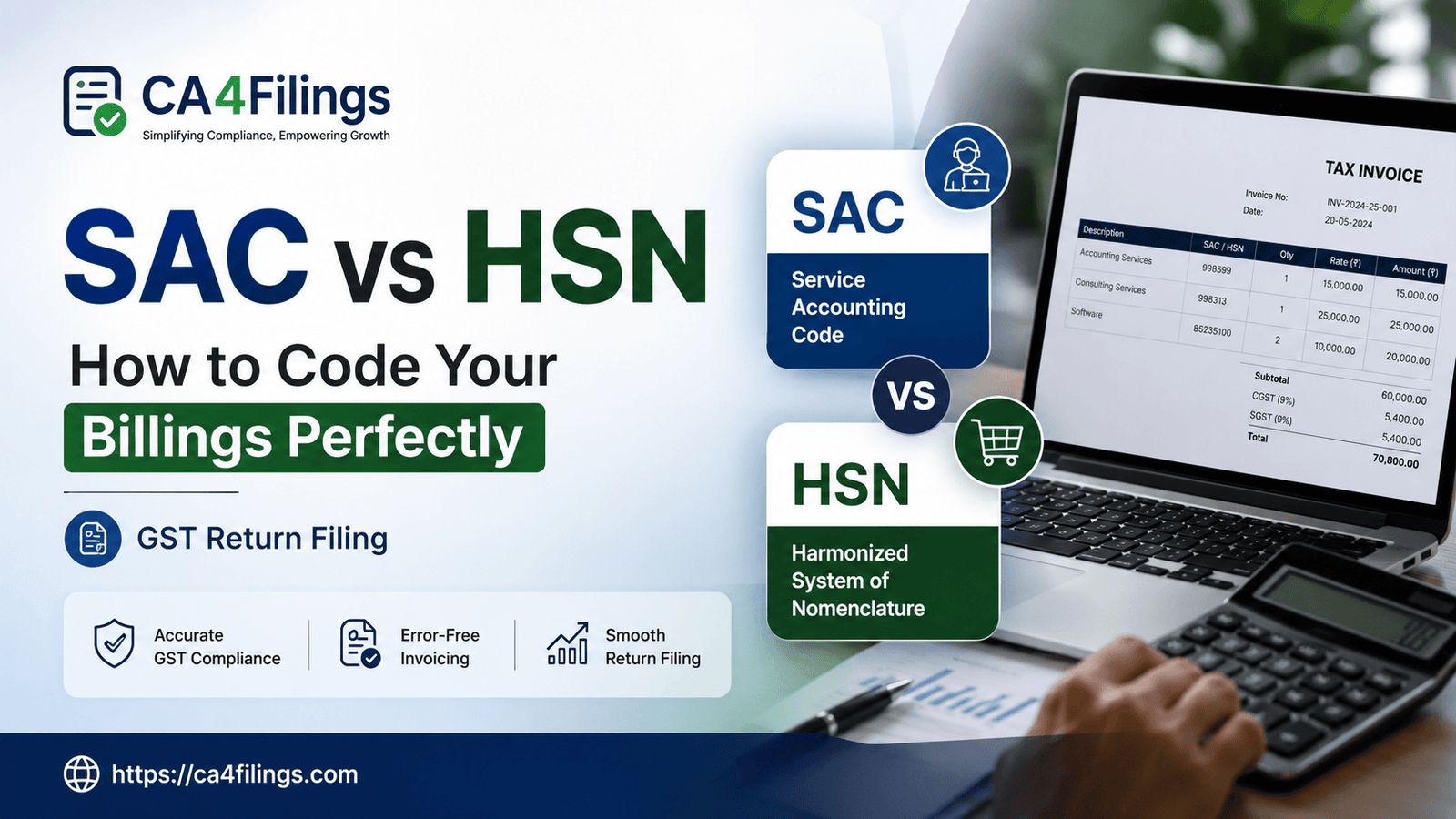
Managing a business in India often feels like navigating a maze, especially when it comes to tax compliance. As a Chartered Accountant, I hear the same confusion from my clients every day: "Do I use a service code or a product code for this invoice" Mastering the basics of gst and hsn code classification is the single best way to avoid scrutiny from the tax authorities. If you are currently struggling with these classifications, it is vital to get your GST Return Filing process sorted to ensure your books are audit-ready and your input tax credits are secure.
Whether you are a freelancer providing consulting services or a trader selling goods, getting your billing right is non-negotiable. Let’s break down the technicalities into simple, actionable steps.
Understanding the Basics: SAC vs. HSN
At the heart of the Indian GST system lies a need for standardization. To ensure taxes are applied uniformly, the government introduced a structured system for classifying goods and services.
HSN (Harmonized System of Nomenclature): This is the global standard for classifying goods. It is a product numbering matrix used by customs and tax authorities worldwide to identify what is being sold.
SAC (Service Accounting Codes): Since services are intangible, they don't have a physical "shape" to be classified by HSN. Instead, India adopted SAC, which is unique to our GST framework.
Think of it this way: If you sell a laptop, you use an HSN code. If you provide a service to repair that laptop, you use an SAC code.
Why GST and HSN Code Accuracy Matters
Misclassifying your items can lead to more than just a clerical error; it can lead to interest, penalties, and blocked input tax credits. Using the correct gst and hsn code ensures that the tax rate—whether it is 5%, 12%, 18%, or 28%—is applied precisely as per the current law.
When you fail to use the correct code, you might end up overcharging or undercharging your clients. Undercharging results in an immediate tax liability for you, while overcharging can lead to frustrated customers and issues with your GST filings.
How to Classify Your Business Offerings
When setting up your bill template design, you need to have a clear lookup table for your products and services. Here is how I advise my clients to handle this:
Map Your Inventory/Services: Create a master list of everything you sell.
Consult the Manuals: Use the official service classification manual for services and the HSN search tool on the GST portal for goods.
Cross-Verify: Perform a cross industry tax lookup if your business involves niche activities, as some codes are surprisingly specific.
Stay Updated: GST rates and codes change periodically. Review your master list every financial year.
Handling Combined Invoices: The Modern Dilemma
Many modern businesses provide "composite supplies." For example, an interior designer might sell furniture (goods) and provide design consulting (services). This results in combined invoices.
In such cases, you must determine if the supply is a "composite supply" (a bundle where one is the principal supply) or a "mixed supply." The classification and rate will depend on which element is the principal supply. If you are unsure, always consult a professional to ensure your billing is legally sound.
Pro-Tips for Perfect Billing
Don't rely on guesswork: Never guess a code. If you aren't sure, check the official GST portal.
Keep it consistent: Once you assign a code to a product or service, stick to it. Consistency is the hallmark of a healthy tax audit.
Update your software: Ensure your accounting software is synced with the latest tax tables.
Frequently Asked Questions (FAQs)
1. Is it mandatory to mention HSN codes on all invoices?
Yes, for most registered taxpayers, HSN or SAC codes are mandatory. The number of digits required (4, 6, or 8) depends on your annual aggregate turnover.
2. Can I use the same code for similar products?
Not necessarily. While products may look similar, they may fall under different sub-headings. Always refer to the specific product numbering matrix provided by the government.
3. What happens if I use an incorrect code?
You may face notices from the department. If the tax rate for the incorrect code is lower than the actual rate, you will be liable to pay the difference plus interest and potential penalties.
4. How often should I review my GST and HSN code list?
I recommend a quarterly review, or at the very least, an annual review during your year-end closing process to account for any government notifications.
Partner with CA4Filings for Stress-Free Compliance
I understand that as a business owner, your primary focus should be on growth, not deciphering complex tax codes. At CA4Filings, we specialize in taking the weight of tax compliance off your shoulders. From accurate classification to seamless filing, we ensure your business remains compliant and efficient.
Latest Updates
ca4filings.com Services





















-registration.png)