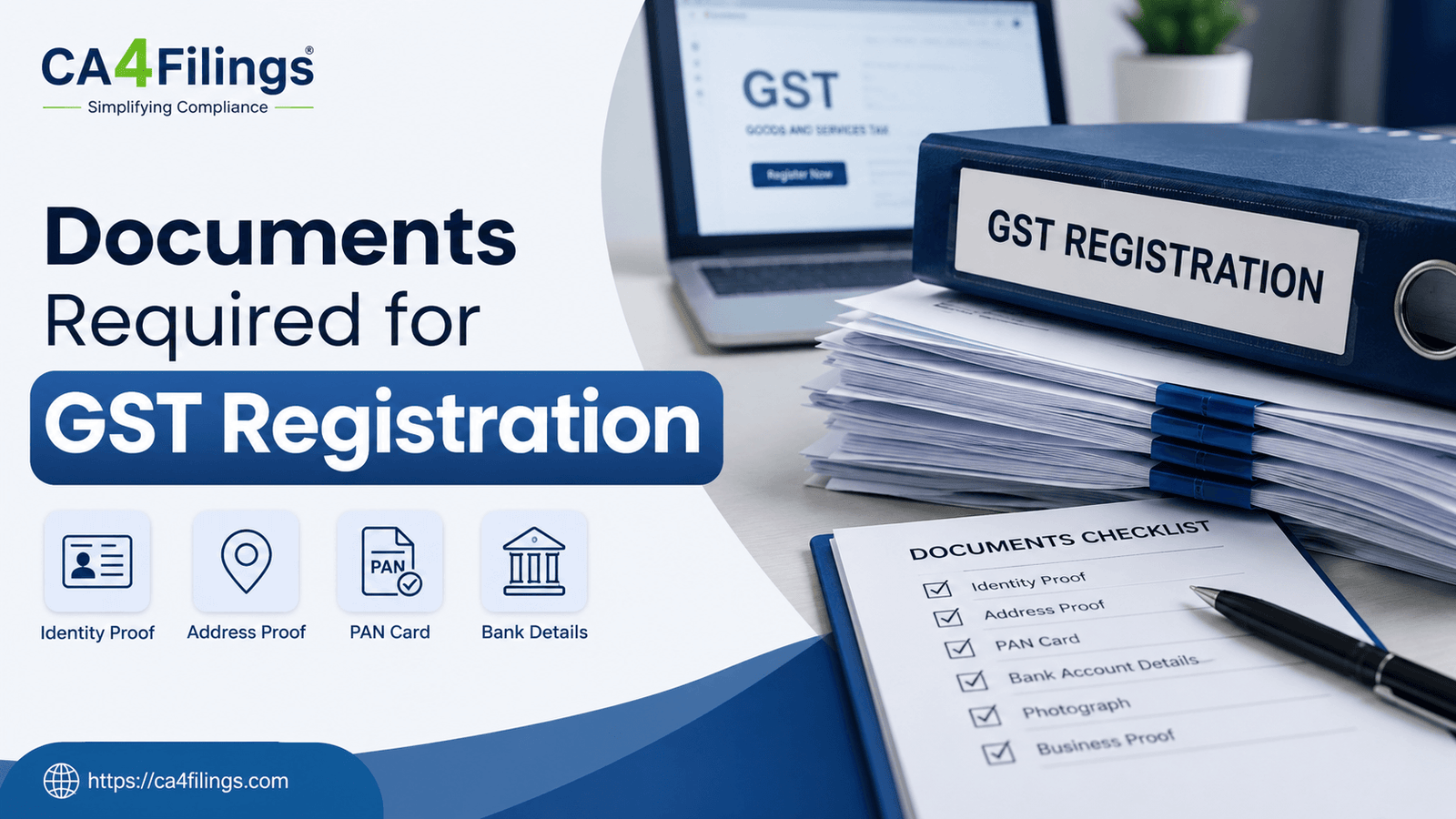
Documents Required for GST Registration
Master the Documents Required for GST Registration in India. Check out our comprehensive GST registration checklist and expert CA tips from CA4Filings.
Starting a new business venture in India is an exhilarating journey. You have got the idea, the passion, and the drive to make it big. But before you can open your doors to customers and start issuing invoices, there is one crucial milestone you need to cross: getting your tax structure in order. For most businesses, this means navigating the Goods and Services Tax network. At CA4Filings, we often see young entrepreneurs completely overwhelmed by the sheer volume of paperwork required to get started. They lose sleep wondering if they have missed a crucial form or if a minor mistake will lead to a painful rejection from the tax department.
The good news is that the process does not have to be a nightmare. If you know exactly what paperwork to gather beforehand, the entire online application moves like clockwork. Whether you are operating as a solo freelancer, running a partnership firm, or launching a full-scale private limited company, having the right Documents Required for GST Registration ready beforehand is half the battle won. In this detailed guide, we will break down the essential GST Registration process and provide you with an absolute, foolproof checklist tailored to different business structures so you can apply with total confidence.
Why Getting Your Paperwork Right Matters
The GST portal is completely digital, but do not let that fool you into thinking it is lenient. The portal uses a mix of automated verification and manual review by tax officers. If your uploaded documents are blurry, expired, or mismatching in names and addresses, the system will immediately issue a system-generated notice (Form GST REG-03) seeking clarification.
When you submit incorrect GST registration papers, it delays your business operations. You cannot legally collect tax from customers, nor can you claim Input Tax Credit (ITC) on your initial business expenses like setting up your office or buying inventory. Getting your GST registration application documents right the first time ensures your business stays compliant right from day one.
The Master GST Registration Checklist: Core Documents
No matter what type of business entity you run, there are certain foundational required documents for GST registration that every applicant must upload. Consider these the absolute non-negotiables.
1. PAN Card of the Business and Stakeholders
Your Permanent Account Number (PAN) is the base of your entire tax identity in India.
For Proprietorships: The individual owner’s PAN card is used.
For Companies/Partnerships/LLPs: A separate, dedicated PAN card issued in the name of the business entity is mandatory.
2. Identity and Address Proof of Promoters
You need to provide clear copies of the identity and address proofs for all directors, partners, or the sole proprietor. The tax department accepts:
Aadhaar Card (Highly recommended as it links to OTP authentication)
Passport
Driving License or Voter ID Card
Passport-sized photographs of all stakeholders
Entity-Specific Documents for GST Registration
Every business structure has a unique legal footprint in India. Because of this, the needed documents for GST registration will vary quite a bit depending on how your business is legally set up. Let us break down exactly what you need to upload based on your specific entity type.
Sole Proprietorship
If you are running the business alone under a trade name, you and the business are considered a single legal entity. Your GST registration essentials include:
Owner’s PAN Card and Aadhaar Card.
Owner’s photograph.
Proof of business constitution (like a Shop & Establishment Act license, Trade License, or any registration document issued by a government authority).
Partnership Firms and LLPs
For businesses run by multiple partners, the tax officer needs to see the official agreements binding the partners together. Ensure you have these GST registration requirements ready:
Partnership Deed or the LLP Incorporation Agreement.
PAN Card of the Partnership Firm or LLP.
Identity and address proofs of all active partners.
Passport-sized photos of all partners.
Copy of the resolution or authorization letter appointing an "Authorized Signatory" to handle the GST portal.
Private Limited Companies and One Person Companies (OPCs)
Companies have the most stringent documentation due to their separate corporate legal identity. Your primary GST registration paperwork consists of:
Certificate of Incorporation (COI) issued by the Ministry of Corporate Affairs (MCA).
Memorandum of Association (MOA) and Articles of Association (AOA).
PAN Card of the Company.
Identity proof, address proof, and photographs of all operating Directors.
Board Resolution authorizing a specific director or employee as the official Authorized Signatory.
Proving Your Place of Business: The Trickiest Part
In our years of practicing as corporate consultants at CA4Filings, we have noticed that the majority of application rejections happen because of faulty proof of principal place of business. The tax department is incredibly strict about verifying where you operate.
The documents you need to upload depend entirely on your ownership or lease status:
If the Property is Owned
If you own the office, shop, or warehouse space, you must provide:
A copy of the latest Municipal Property Tax Receipt, or
The Registered Deeds of the property (Ownership Deed), or
A recent Electricity Bill or Water Bill clearly displaying the owner's name and the exact address.
If the Property is Rented or Leased
If you are operating out of a rented space, you will need to upload:
A valid, legally unexpired Rent Agreement or Lease Agreement.
A recent utility bill (like an electricity bill) in the name of the landlord.
If You Are Operating from Home or a Shared Space
Many early-stage startups operate from a founder’s home or a relative's property to save on costs. If this applies to you, you can still register easily. You just need to provide:
A recent utility bill in the name of the property owner.
A formal No Objection Certificate (NOC) signed by the property owner, stating they have no issues with you using their premises for business operations.
Bank Account Proof: What Is Acceptable?
While the government previously required an active bank account at the exact time of submitting your initial application, the rules have since been relaxed to make starting up a business smoother. You can now provide your bank details within 45 days of your registration being granted.
However, if you already have an operational account or are a sole proprietor using your savings account initially, you must upload:
A cancelled cheque clearly displaying the name of the business entity or proprietor, or
The first page of your bank passbook, or
A recent bank statement that clearly shows your account number, bank IFSC code, address, and recent transactions.
Top Tips from a CA to Avoid Application Rejections
To ensure your application sails through the verification process without any unexpected speed bumps, keep these practical expert tips in mind:
Check for Name and Address Mismatches: Ensure that the address written on your electricity bill matches the address on your rent agreement word-for-word. Even a minor spelling discrepancy or a missing floor number can trigger a clarification notice from an eagle-eyed tax officer.
Ensure High-Quality Scans: Avoid uploading blurry photos taken on a phone in low light. Use a proper scanner app and save the files in PDF or JPEG format, keeping the file sizes strictly under the portal's 100 KB to 2 MB limits.
Keep Your Linked Mobile Number Handy: The entire verification system relies heavily on Aadhaar authentication. Make sure the mobile number linked to your Aadhaar card is active and near you so you can enter the required OTPs instantly during submission.
Frequently Asked Questions
Can I get a GST registration using my home address?
Yes, absolutely. You can easily register your home address as your principal place of business. You will simply need to upload a utility bill under the owner's name along with a signed No Objection Certificate (NOC) from the homeowner.
What happens if I upload expired documents?
If you upload expired lease agreements or old utility bills, the tax officer will reject your application or issue a deficiency memo. Always ensure your utility bills are less than two months old.
Is a separate bank account mandatory before applying for GST?
For companies and partnerships, you can apply for the registration first using the entity's core documents and then open a corporate current bank account once the registration certificate is issued. You must update your bank details on the portal within 45 days.
Let CA4Filings Handle the Hard Work for You
Gathering the essential documents for GST registration is the first step toward building a legally compliant, highly scalable business in India. While the online portal is accessible to everyone, interpreting specific tax clauses, drafting error-free NOCs, and handling sudden clarification notices from tax officials requires specialized professional expertise.
At CA4Filings, we take the tedious paperwork off your shoulders completely. Our team of experienced Chartered Accountants manages the entire process from start to finish—analyzing your business structure, verifying your documents, and submitting a flawless application so you can focus entirely on what you do best: growing your brand. Reach out to us today, and let's get your business officially registered and ready to fly!
Latest Updates
ca4filings.com Services























-registration.png)