The Consequences of Filing DIR-3 KYC After the Deadline
The Consequences of Filing DIR-3 KYC After the Deadline can include DIN deactivation, penalties, and compliance issues for directors.
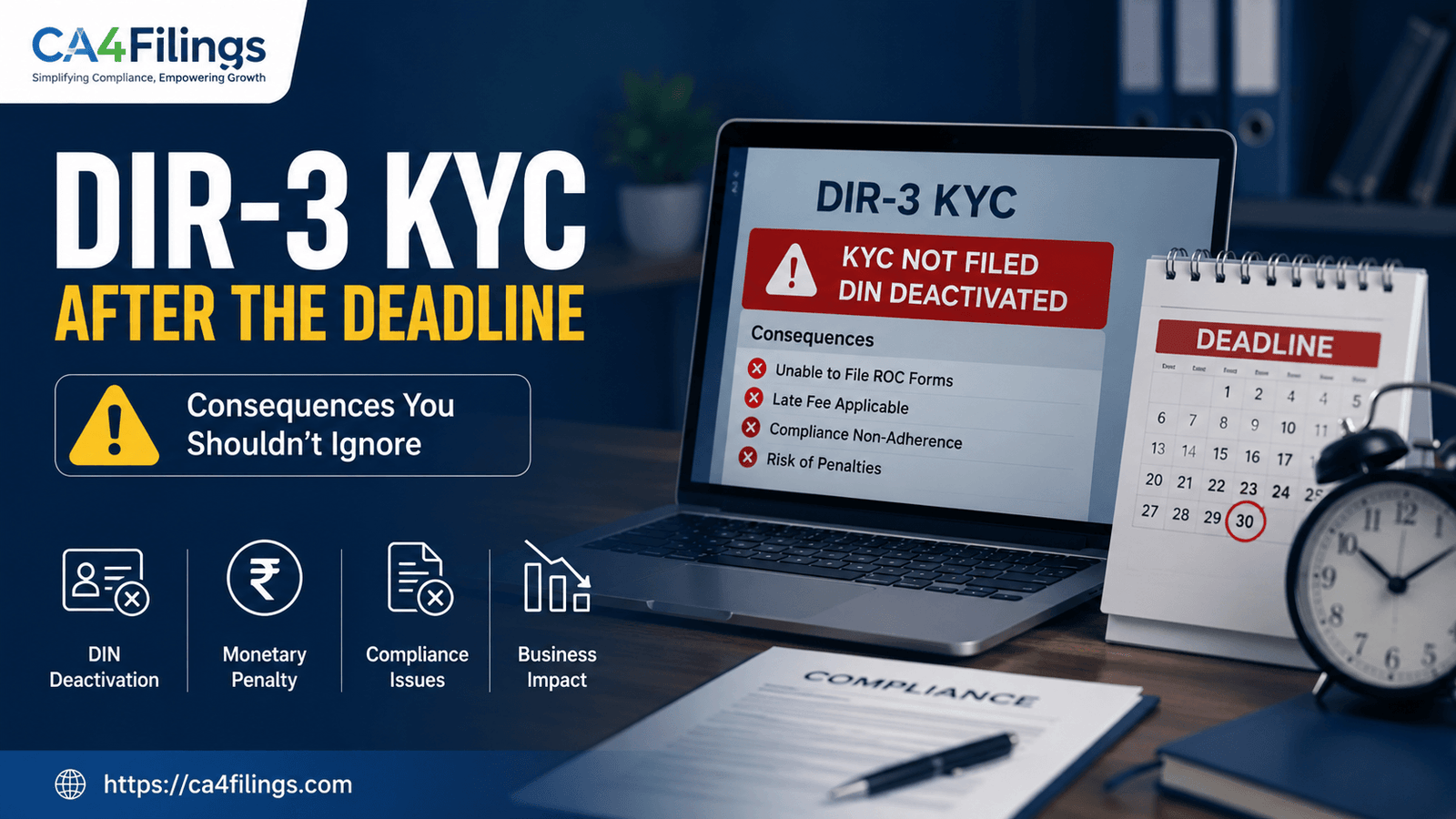
For every director holding a Director Identification Number (DIN), annual DIR-3 KYC compliance is not just a routine formality—it is a mandatory legal requirement under the Companies Act, 2013. Many directors tend to ignore or delay this filing until the last moment, often assuming that a small delay will not create serious issues. However, The Consequences of Filing DIR-3 KYC After the Deadline can be far more serious than most people realize.
At CA4Filings, we regularly assist directors and companies facing DIN deactivation, MCA penalties, and compliance disruptions due to delayed filings. Completing your DIR-3 KYC filing on time helps directors maintain active DIN status and avoid unnecessary legal complications.
In this article, we will explain The Consequences of Filing DIR-3 KYC After the Deadline, penalties involved, practical business impact, and how directors can avoid future compliance problems.
Understanding DIR-3 KYC
DIR-3 KYC is an annual compliance form filed with the Ministry of Corporate Affairs (MCA). Every individual who has been allotted a DIN must complete this KYC verification every financial year.
The purpose of this filing is to:
- Verify director details
- Update mobile number and email ID
- Maintain accurate MCA records
- Prevent misuse of inactive DINs
The filing generally includes:
- PAN details
- Aadhaar details
- Mobile OTP verification
- Email verification
- Address proof
Even directors who are not actively involved in business operations must complete the filing if they hold a DIN.
Why Timely Filing Matters
Many directors underestimate the importance of timely compliance. However, The Consequences of Filing DIR-3 KYC After the Deadline can directly affect both the individual director and the company.
MCA strictly monitors DIN compliance, and delayed filing automatically triggers system-based deactivation. Once the DIN becomes inactive, the director may face multiple operational and legal challenges.
For businesses already handling ROC filings, GST compliance, and income tax obligations, an inactive DIN can create unnecessary stress and delays.
The Consequences of Filing DIR-3 KYC After the Deadline
DIN Gets Deactivated Automatically
One of the biggest consequences is DIN deactivation.
If a director fails to file DIR-3 KYC within the prescribed due date, the MCA marks the DIN as:
- “Deactivated due to non-filing of DIR-3 KYC”
This happens automatically through the MCA system.
Once deactivated:
- The director cannot sign MCA forms
- ROC filings may get delayed
- Company compliance gets affected
- New company incorporation becomes difficult
For example, if a company needs to file annual returns urgently and one director’s DIN is inactive, the entire filing process may get delayed until reactivation is completed.
Heavy Late Filing Penalty
Another major aspect of The Consequences of Filing DIR-3 KYC After the Deadline is the financial penalty.
The MCA currently imposes a late fee of ₹5,000 for delayed DIR-3 KYC filing.
This penalty applies regardless of:
- Length of delay
- Company turnover
- Director activity status
Even if the delay is just a few days, the late fee becomes mandatory.
For many small business owners and startup directors, this unnecessary penalty becomes an avoidable financial burden.
Disruption in Company Compliance
When a director’s DIN becomes inactive, company compliance activities can come to a standstill.
This may impact:
- Annual ROC filings
- Appointment or resignation of directors
- Incorporation of new companies
- Change in company structure
- Bank-related documentation
In practical terms, a simple missed KYC deadline can create operational delays for the entire organization.
We have seen cases where investors postponed funding discussions because ROC filings could not be completed on time due to DIN deactivation.
Risk of Non-Compliance Notices
The MCA has become increasingly strict regarding compliance monitoring.
One of The Consequences of Filing DIR-3 KYC After the Deadline is the possibility of receiving compliance notices or scrutiny from regulatory authorities.
Although delayed filing itself may not immediately trigger prosecution, repeated non-compliance can attract closer examination from regulators.
For directors associated with multiple companies, this becomes even more important.
Difficulty in Future Corporate Transactions
Inactive DIN status may create hurdles in future business activities such as:
- Becoming director in another company
- Participating in mergers
- Opening corporate bank accounts
- Signing official documents
- Applying for loans or tenders
Many financial institutions and investors conduct compliance checks before approving transactions. An inactive DIN can negatively affect credibility.
How to Reactivate a Deactivated DIN
Fortunately, reactivation is possible.
Step-by-Step Process
Step 1: Prepare Required Documents
Keep the following ready:
- PAN card
- Aadhaar card
- Address proof
- Mobile number
- Email ID
Step 2: File DIR-3 KYC Form
The director must submit the DIR-3 KYC form through the MCA portal.
Step 3: Pay Late Fees
The mandatory penalty of ₹5,000 must be paid during filing.
Step 4: Verification and Approval
Once approved, the DIN status becomes active again.
In most cases, reactivation happens relatively quickly if documentation is accurate.
Common Reasons for Missing the Deadline
At CA4Filings, we often notice recurring reasons behind delayed filing.
Lack of Awareness
Many directors are unaware that annual KYC filing is mandatory even if:
- The company is inactive
- They are not actively managing operations
- The DIN was obtained years ago
Last-Minute Filing Rush
Some directors wait until the deadline day, which creates technical issues like:
- OTP delays
- MCA portal slowdown
- DSC problems
Incorrect Contact Information
If the registered mobile number or email ID is inactive, OTP verification becomes difficult.
Dependence on Internal Staff
Companies sometimes rely entirely on internal staff without proper follow-up, leading to missed compliance timelines.
Practical Tips to Avoid DIR-3 KYC Delays
To avoid The Consequences of Filing DIR-3 KYC After the Deadline, directors should adopt a proactive approach.
Maintain a Compliance Calendar
Keep track of:
- ROC filing dates
- DIR-3 KYC deadlines
- Income tax due dates
Update Contact Details Regularly
Ensure your:
- Mobile number is active
- Email ID is accessible
- PAN details are correct
Avoid Last-Day Filing
Complete the filing at least 10–15 days before the deadline.
Work With Compliance Experts
Professional assistance helps avoid errors, delays, and unnecessary penalties.
At CA4Filings, we help directors complete DIR-3 KYC filings smoothly with proper documentation support and timely reminders.
The Consequences of Filing DIR-3 KYC After the Deadline for Startups
Startup founders often ignore small compliance requirements during the early growth phase. However, The Consequences of Filing DIR-3 KYC After the Deadline can create funding and governance issues later.
Investors usually conduct due diligence before investment.
An inactive DIN may indicate:
- Poor compliance management
- Governance weaknesses
- Regulatory negligence
This can affect investor confidence.
For startups aiming for rapid expansion, maintaining clean MCA records is extremely important.
FAQs
Is DIR-3 KYC mandatory for all directors?
Yes. Every director holding a DIN must complete DIR-3 KYC annually unless exempted by MCA.
What happens if DIR-3 KYC is not filed on time?
The DIN becomes deactivated, and a penalty of ₹5,000 is imposed.
Can a deactivated DIN be reactivated?
Yes. The director can reactivate the DIN by filing DIR-3 KYC with the applicable late fee.
Is the penalty fixed for all directors?
Yes. MCA currently charges a fixed late fee of ₹5,000 for delayed filing.
Can a company continue ROC filing with inactive DIN?
In many cases, filings may get delayed or rejected if the required director’s DIN is inactive.
By now, it is clear that The Consequences of Filing DIR-3 KYC After the Deadline go beyond just a simple late fee. From DIN deactivation and business disruption to regulatory complications and loss of professional credibility, delayed compliance can create unnecessary challenges for directors and companies alike.
Timely filing helps directors maintain smooth business operations, avoid penalties, and stay compliant with MCA regulations. A small delay today can become a larger compliance issue tomorrow.
At CA4Filings, we help directors and businesses complete DIR-3 KYC filings accurately and on time with end-to-end professional support. If you want hassle-free compliance and expert guidance, connect with CA4Filings today and keep your DIN active without stress.
Latest Updates
ca4filings.com Services






















-registration.png)