The Role of DIN in Preventing Corporate Fraud
Discover The Role of DIN in Preventing Corporate Fraud. Learn how a Director Identification Number ensures accountability, compliance, and transparency.
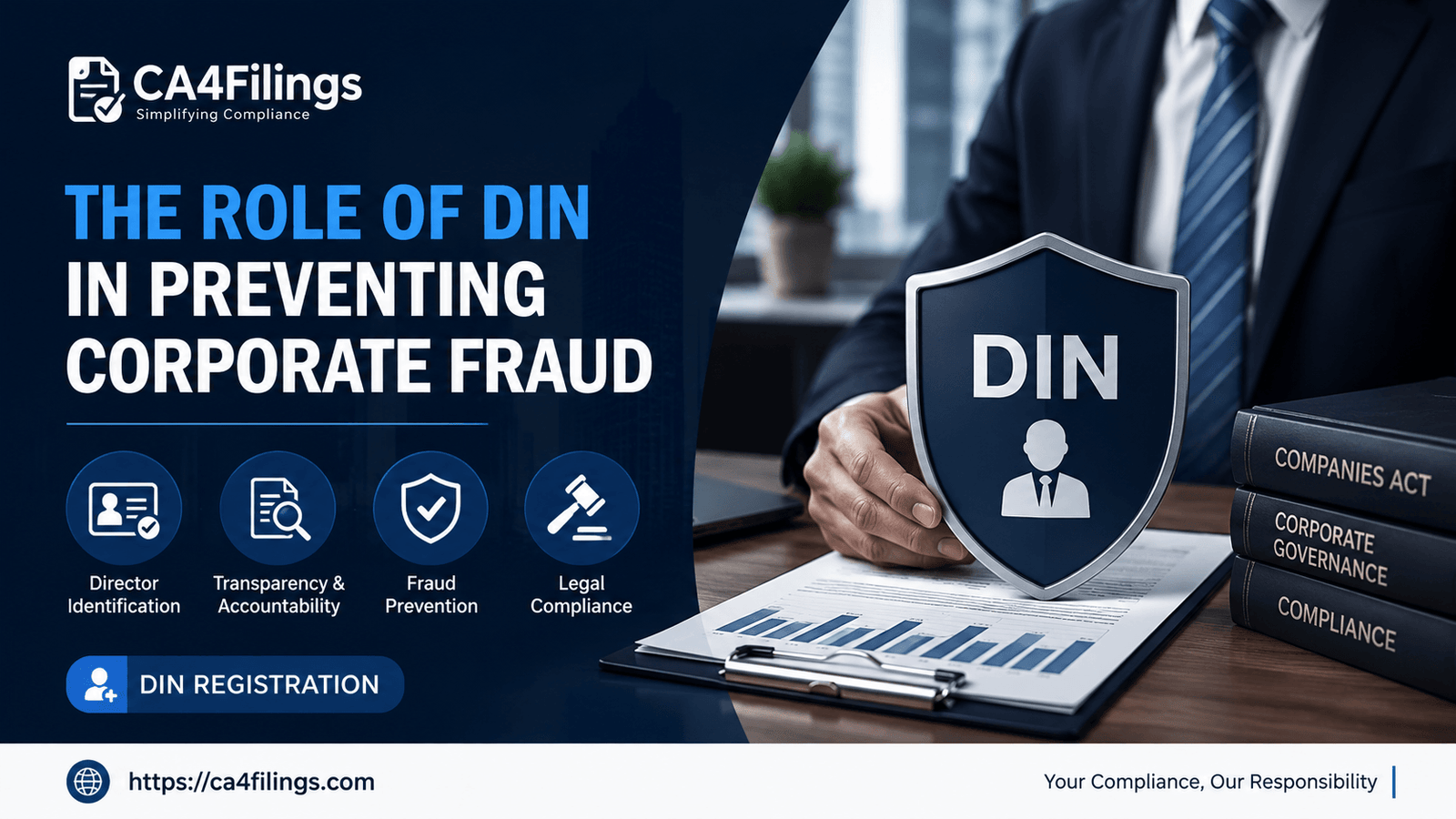
Imagine waking up one morning to find out that your name has been listed as a director of a company you have never heard of, and that the company is now under investigation for a multi-crore financial scam. A decade or two ago, this nightmare was a harsh reality for many unsuspecting citizens in India. Fraudsters routinely created "shell companies" using fictitious names, forged signatures, and stolen identities to siphon off public funds. Once the scam was exposed, the culprits vanished into thin air, leaving no paper trail behind.
To put an end to this corporate wild-west, the Ministry of Corporate Affairs (MCA) introduced a game-changing regulatory tool: the Director Identification Number. Today, we will break down The Role of DIN in Preventing Corporate Fraud and look at how this unique eight-digit identifier has transformed the landscape of Indian corporate governance standards. If you are planning to launch a new business venture or join a board, securing this number is your very first step. You can easily initiate your DIN Registration through CA4Filings to ensure full regulatory compliance right from day one.
Understanding the Basics: What is a DIN?
A Director Identification Number is a unique, lifetime identification number allotted by the Central Government to any individual intending to be appointed as a director of a company. Think of it as a permanent account number, but specifically tailored for corporate leadership.
Introduced through the Companies (Amendment) Act, 2006, it serves as a digital DNA for corporate bosses. Whether a person is a director in one company or twenty, they will hold only one unique identifier. This concept forms the bedrock of modern corporate governance, linking an individual's verified identity directly to their corporate actions and business operations.
The Role of DIN in Preventing Corporate Fraud
The introduction of this mandatory identification system completely shifted the paradigm of fraud detection and prevention in India. Let us look at the specific ways it protects the economic ecosystem:
1. Eliminating Fake and Dummy Directors
Before this system was implemented, corporate fraud prevention was incredibly difficult because investigators often chased ghosts. Fraudsters used to appoint fictitious people or uneducated workers as dummy directors by falsifying paper documents. Because the MCA now validates every application against biometric-linked databases like PAN and Aadhaar, creating a "paper director" is virtually impossible.
2. Tracking the History of Serial Offenders
If a director mismanages a company, defaults on bank loans, or siphons off money, they cannot simply walk away, set up a brand-new company, and start over. The MCA database tracks every single entity tied to that specific individual. If one company gets blacklisted, the individual's profile is flagged across the entire network, signaling an immediate red flag to investors, banks, and auditors.
3. Boosting Transparency and Accountability
Every financial statement, annual return, and official resolution filed by a company must carry the signatures and identification numbers of its directors. This establishes absolute accountability. A director can no longer claim ignorance or state that a fraudulent balance sheet was approved without their knowledge. Their digital fingerprint is permanently stamped onto the company's compliance trail.
How the MCA Uses This Identifier for Fraud Detection
The Ministry of Corporate Affairs has integrated advanced data analytics into its portal. By monitoring active identifiers, regulatory bodies can easily spot anomalies that indicate potential malpractice.
Sifting Through Shell Companies: If a single identification number is attached to dozens of inactive companies with no real business operations, regulatory systems immediately flag it for investigation.
Preventing Insider Trading: It allows market regulators like SEBI to track whether individuals holding key managerial positions are executing suspicious stock trades through interconnected entities.
Strict Disqualification Measures: Under Section 164(2) of the Companies Act, 2013, if a company fails to file financial statements or annual returns for three consecutive years, its directors face automatic disqualification. Their unique numbers are deactivated, blocking them from joining any other board for five years.
The Broader Impact on Corporate Governance Standards
Beyond stopping bad actors, this framework has elevated Indian business operations on the global stage. When international investors see robust corporate governance standards backed by ironclad identity verification, their confidence climbs.
It promotes secure business practices by ensuring that whenever a vendor, client, or lender enters into a contract with an enterprise, they can verify exactly who is steering the ship. A quick search on the MCA portal using a director's identification details reveals their entire corporate footprint, past track record, and current compliance status.
Steps to Ensure Your Business Stays Compliant
As an entrepreneur or corporate leader, maintaining clean regulatory compliance is non-negotiable. Here is a quick roadmap to keep your leadership status flawless:
Complete the Annual KYC: Every individual holding an active identifier must file Form DIR-3 KYC annually. Failing to do so results in the number being marked as "deactivated," attracting heavy financial penalties.
Report Personal Changes Promptly: If you change your residential address, nationality, or name, you must update the central database within 30 days using Form DIR-6.
Avoid Multiple Allocations: Holding more than one unique corporate identifier is a serious legal offense. If you accidentally receive a duplicate number, it must be surrendered immediately.
Frequently Asked Questions
Can a person hold more than one Director Identification Number?
No. Holding more than one identifier is strictly prohibited under law. If an individual is found holding multiple numbers, they face severe financial penalties and potential legal prosecution.
Does a DIN expire if a person leaves their directorship?
No, it is a lifetime identification number. Even if you resign from all companies and no longer serve on any board, your number remains valid and stays mapped to your identity permanently.
What happens if I forget to file my annual DIR-3 KYC?
If you miss the annual KYC deadline, the MCA will deactivate your identification number and change its status to "Deactivated due to non-filing of KYC." To reactivate it, you will have to file the form along with a late fee of ₹5,000.
How does this framework protect honest business owners?
It prevents identity theft. Because the registration process requires strict PAN, Aadhaar, and video verification, it ensures that unauthorized individuals cannot fraudulently use your name or credentials to establish illegal businesses.
How CA4Filings Can Assist Your Business
Navigating the web of corporate compliances, MCA filings, and director updates can easily feel overwhelming when you are focused on scaling your daily business operations. At CA4Filings, our team of experienced Chartered Accountants and corporate law experts handles your regulatory journey from start to finish.
Whether you need to secure fresh credentials for an incoming board member, file your annual corporate KYC, or resolve complex compliance flags on the MCA portal, we deliver precise, swift, and hassle-free solutions. Reach out to CA4Filings today to fortify your corporate structure and champion secure business practices.
Latest Updates
ca4filings.com Services



























-registration.png)