When to Choose Limited Liability Partnership Over Pvt Ltd Company Registration
Compare LLP and pvt ltd company registration in India to understand compliance costs, taxation, ownership flexibility, and the right structure for your business.
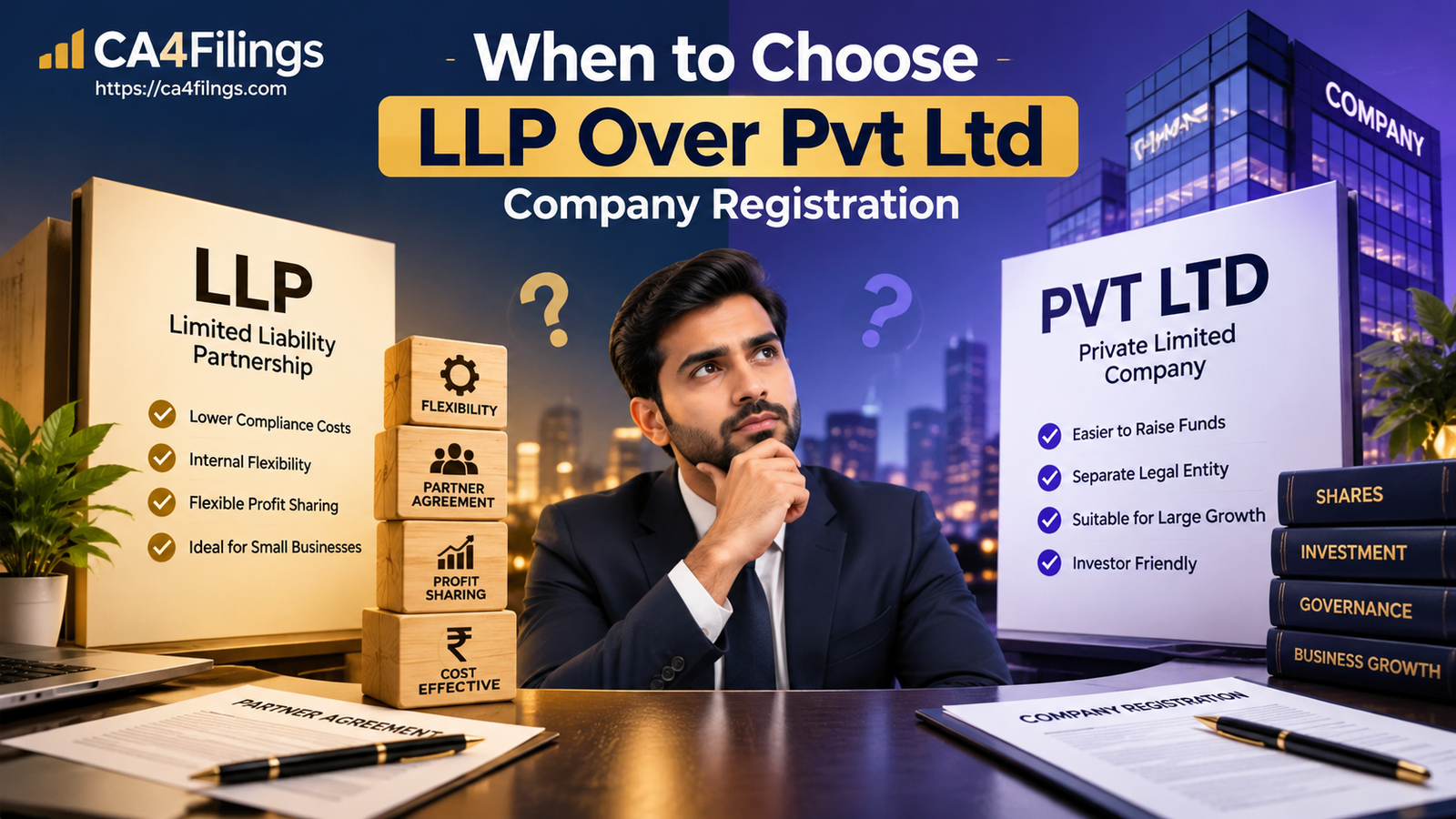
Understanding LLP vs Pvt Ltd Company Registration
Choosing the right business structure is one of the first important decisions an entrepreneur makes. While a Limited Liability Partnership (LLP) offers flexibility and relatively simple compliance, a Private Limited Company is often preferred by businesses planning to raise funds, expand operations, or build a scalable organisation. Before proceeding with pvt ltd company registration, it is essential to understand whether a company structure actually suits your business goals.
At CA4Filings, we regularly help entrepreneurs evaluate both options before making a decision. Our Company Registration services help business owners understand the legal requirements, documentation, and responsibilities involved in establishing a business in India.
The right choice depends on factors such as the number of founders, investment plans, annual turnover, management preferences, and long-term objectives. Let us explore when an LLP may be a better option than a Private Limited Company and when choosing a company structure makes more sense.
What Is a Limited Liability Partnership (LLP)?
A Limited Liability Partnership is a business structure governed by the Limited Liability Partnership Act, 2008. It combines the operational flexibility of a traditional partnership with the benefit of limited liability.
An LLP is a separate legal entity, which means it can own property, enter into contracts, and continue operating independently of changes in its partners.
Its key features include:
Limited liability: Partners are generally not personally responsible for the LLP's obligations beyond their agreed contribution, subject to applicable legal exceptions.
Internal flexibility: Partners can decide how the business will be managed through an LLP agreement.
Flexible profit sharing ratios: Profits can be distributed according to mutually agreed terms.
Lower compliance costs: LLPs generally have fewer recurring statutory compliance requirements than Private Limited Companies.
No mandatory board structure: An LLP does not require a board of directors or company-style shareholder meetings.
For professionals, consultants, small service businesses, and closely held ventures, these advantages can make an LLP an attractive choice.
When Should You Choose an LLP Over Pvt Ltd Company Registration?
Although pvt ltd company registration offers several advantages, it is not automatically the best option for every business. An LLP may be more suitable in the following situations.
1. When You Want Lower Compliance Costs
One of the biggest reasons entrepreneurs choose an LLP is the comparatively lighter compliance burden.
A Private Limited Company generally needs to maintain statutory registers, conduct board and shareholder meetings as applicable, file annual financial statements and annual returns, and comply with other provisions of the Companies Act, 2013.
LLPs also have important annual obligations, including filing their Statement of Account and Solvency and annual return, as well as maintaining proper accounts and meeting applicable tax requirements. However, their overall administrative requirements are often simpler.
For example, a two-partner digital marketing agency with modest revenue may not need the additional governance structure of a Private Limited Company during its early years.
CA4Filings advice: Compare the expected annual compliance expenses, accounting requirements, and professional fees before deciding. Lower compliance costs should not come at the expense of future business requirements.
2. When Partners Want Greater Internal Flexibility
An LLP is particularly useful when the founders want to customise their working arrangements.
The LLP agreement can specify:
Each partner's capital contribution.
Profit sharing ratios.
Responsibilities and decision-making powers.
Rules for admitting new partners.
Procedures for resolving disputes.
Retirement, resignation, and exit arrangements.
For instance, suppose two consultants start a business. One contributes most of the capital, while the other manages daily operations and brings clients. They can agree on suitable profit sharing ratios and responsibilities rather than relying on a standard ownership arrangement.
In comparison, a company operates through a more formal structure involving shareholders, directors, and the applicable corporate governance framework.
3. When You Do Not Plan to Raise Equity Funding
If your business will operate using founders' contributions, business revenue, or conventional borrowing, an LLP may be sufficient.
A Private Limited Company is generally better suited to raising equity investment because it can issue shares and establish ownership through shareholding arrangements. This structure is familiar to angel investors, venture capital firms, and many institutional investors.
An LLP does not have share capital in the same way as a company. Bringing investors into an LLP may require changes to the agreement and the investor's legal and commercial role.
If you intend to approach venture capital firms in the next few years, consider your fundraising strategy before choosing between an LLP and pvt ltd company registration.
4. When Your Business Is Service-Oriented
LLPs often work well for businesses that rely primarily on professional expertise rather than large-scale capital investment.
Suitable examples include:
Management and business consultants.
Marketing and creative agencies.
IT service providers.
Design and development firms.
Professional service partnerships, subject to the applicable professional regulations.
For these businesses, an LLP can provide legal separation, defined partner responsibilities, and flexibility without introducing unnecessary administrative complexity.
However, eligibility and regulatory requirements should be checked for regulated professions and activities.
5. When You Want a Simple Long-Term Partnership
An LLP can be appropriate when a small group of founders plans to retain control of the business and does not anticipate frequent ownership changes.
A carefully drafted partner agreement can establish clear expectations and reduce disagreements over financial contributions, workload, and profit distribution.
Nevertheless, an LLP is not entirely free from formalities. Changes in partners, agreement terms, registered office details, and other particulars may require prescribed filings with the Ministry of Corporate Affairs (MCA).
When Is Pvt Ltd Company Registration a Better Choice?
While an LLP suits many small businesses, a Private Limited Company may be the stronger option when growth, investment, or ownership expansion is a priority.
Consider pvt ltd company registration if:
You plan to raise investment: Equity shares make it easier to establish ownership and structure investments.
You want to scale rapidly: A company structure can support formal governance and expansion.
You expect frequent ownership changes: Shares can be transferred subject to the Companies Act, the company's articles, and applicable restrictions.
You want to build an investor-ready business: Many investors prefer companies because their ownership and governance structures are familiar.
You intend to offer employee equity: A company can implement employee stock option arrangements where the applicable legal requirements are met.
For example, a technology startup developing a software product and planning to raise seed funding may benefit from pvt ltd company registration from the beginning. Converting an LLP into a company later can involve additional legal, tax, and procedural considerations.
LLP vs Pvt Ltd Company: Key Differences
| Basis | LLP | Private Limited Company |
|---|---|---|
| Governing law | LLP Act, 2008 | Companies Act, 2013 |
| Owners | Partners | Shareholders |
| Management | Partners and designated partners | Directors and officers |
| Ownership structure | Partnership interests under the LLP agreement | Shareholding |
| Profit distribution | As agreed under the LLP agreement | Dividends, subject to applicable law |
| Equity fundraising | Less suitable for conventional equity investment | Generally more suitable |
| Compliance | Generally simpler | Generally more extensive |
| Annual filings | Mandatory | Mandatory |
| Statutory audit | Based on applicable LLP rules and thresholds | Generally mandatory irrespective of turnover |
Important: Both structures offer limited liability, but neither protects individuals from every type of liability. Personal guarantees, fraud, statutory violations, and other legal exceptions can create personal exposure. Audit and tax obligations must also be evaluated under the rules applicable to the particular entity.
How to Choose the Right Business Structure: A Step-by-Step Guide
Before finalising your registration, follow these practical steps.
Step 1: Define your business goals. Decide whether you intend to run a stable partnership or build a business designed for rapid expansion.
Step 2: Evaluate your funding requirements. If external equity investment is likely, a company may be more appropriate.
Step 3: Compare compliance expenses. Estimate annual accounting, filing, audit, and professional service costs for both structures.
Step 4: Discuss ownership and responsibilities. Determine how contributions, profit sharing ratios, decision-making powers, and exits will be handled.
Step 5: Review taxation. LLPs and companies follow different tax rules. An LLP is generally taxed at the applicable firm rate, while domestic companies may qualify for different corporate tax regimes subject to eligibility and conditions. Compare the total tax impact rather than looking only at the headline rate.
Step 6: Consult a professional. A qualified CA can assess your business model, funding plans, and compliance requirements before you make a final decision.
Latest Updates
ca4filings.com Services