The Annual Compliance Calendar Post Pvt Ltd Company Registration
Understand the annual compliance calendar after pvt ltd company registration, including ROC filings, AGM deadlines, director KYC, and tax compliance.
Completing your pvt ltd company registration is an important milestone for any entrepreneur. However, incorporation is only the beginning of your responsibilities as a company director. Once your company is registered, you must follow a structured annual compliance calendar to meet statutory deadlines, maintain accurate financial records, and avoid unnecessary penalties.
At CA4Filings, we often advise business owners to plan their compliance activities well in advance instead of rushing to complete filings at the last minute. Whether you operate a startup, a family-owned business, or a growing enterprise, understanding your obligations after Company Registration can help you manage your business with greater confidence.
The Companies Act, 2013, along with applicable tax and other regulations, establishes several ongoing requirements for private limited companies in India. These include board meetings, annual general meetings, financial statement filings, annual returns, and director KYC. Let us understand how to organise these responsibilities throughout the financial year.
Why Is an Annual Compliance Calendar Important After Pvt Ltd Company Registration?
An annual compliance calendar provides a clear schedule of the filings, meetings, and records your company must maintain. It helps directors stay organised and reduces the risk of missing statutory deadlines.
Even if your company has not started operations, generated revenue, or issued invoices, several compliance obligations may still apply.
A well-planned calendar helps you:
Avoid additional fees and penalties for delayed statutory filings.
Maintain transparent financial and corporate records.
Keep directors informed about their legal responsibilities.
Build credibility with banks, investors, and potential business partners.
Prepare financial statements and tax returns on time.
For example, suppose a startup completes its pvt ltd company registration in August but does not begin trading until December. The absence of business activity does not automatically exempt it from applicable annual ROC filings, financial reporting, or other statutory requirements.
Monthly and Quarterly Compliance Calendar
Some compliance activities depend on your company's transactions, employee strength, and applicable tax registrations. Therefore, your calendar should cover more than annual ROC filings.
Monthly Compliance Activities
During each month, the company should review the following activities, wherever applicable:
Record sales, purchases, expenses, and bank transactions.
Reconcile bank accounts and accounting records.
Deduct and deposit TDS within the applicable statutory timelines.
Deposit GST and file GST returns according to the company's filing frequency.
Maintain payroll records and deposit applicable employee-related statutory contributions.
Update invoices, expense vouchers, and supporting documents.
The exact due dates depend on the relevant tax provision, return type, registration status, and applicable extensions.
Quarterly Compliance Activities
At the end of every quarter, review your company's financial and tax position.
Important activities may include:
Filing quarterly TDS returns, where applicable.
Reviewing advance tax liabilities and instalments.
Reconciling GST returns with books of accounts.
Reviewing outstanding customer payments and vendor balances.
Checking compliance with applicable labour laws.
CA4Filings recommends maintaining a digital compliance tracker with the responsible person's name, due date, document status, and filing acknowledgement.
Annual Compliance Calendar After Pvt Ltd Company Registration
Annual compliance is particularly important because several key ROC filings are linked to the financial year-end and the AGM.
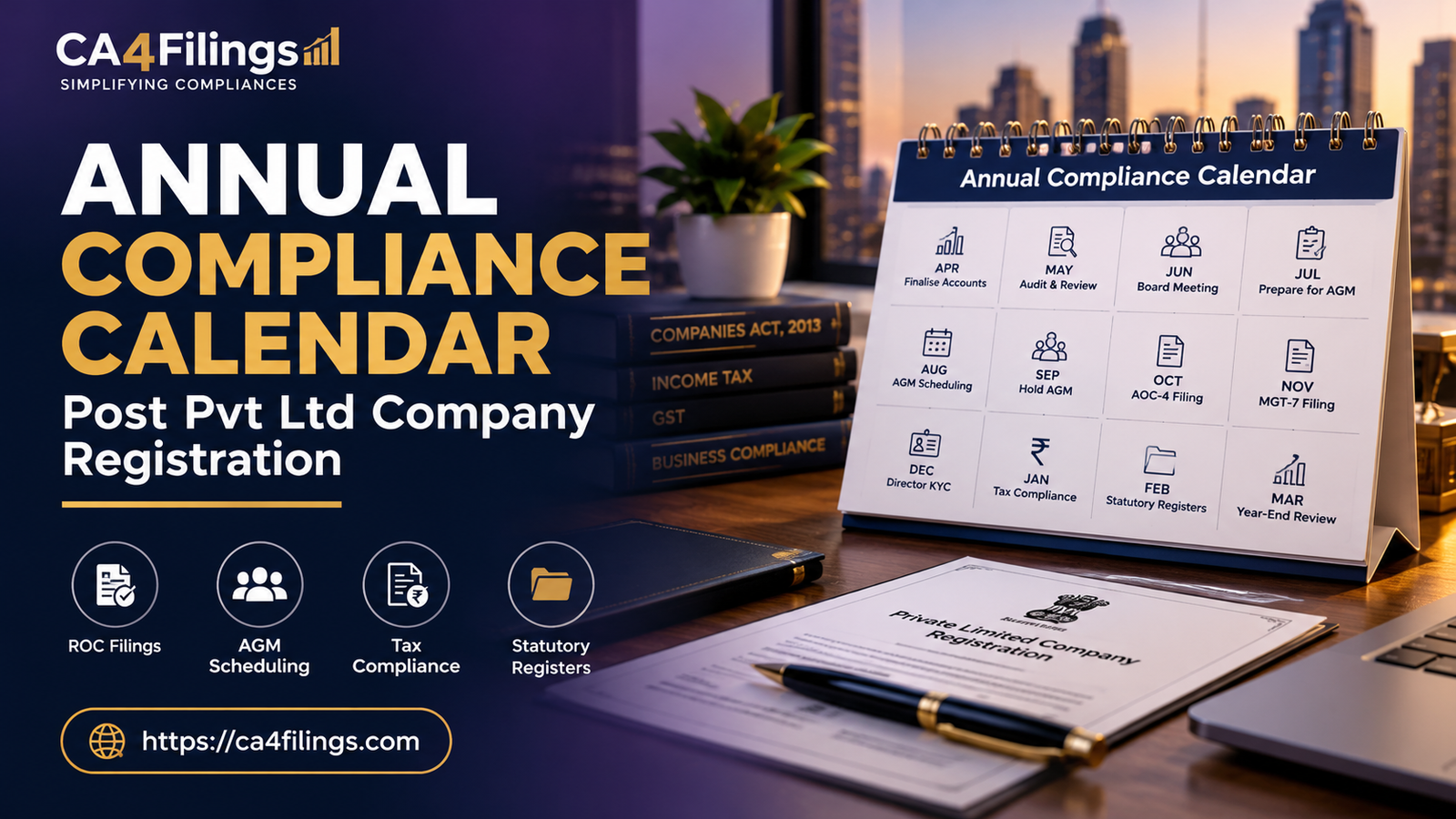
April to June: Close the Financial Year
The financial year in India generally ends on 31 March. During the first quarter of the new financial year, focus on closing the previous year's accounts.
Key activities include:
Finalising sales, expenses, assets, and liabilities.
Reconciling bank statements and statutory tax records.
Identifying outstanding receivables and payables.
Preparing schedules required for financial statements.
Reviewing the applicability of a statutory audit and coordinating with the auditor.
Directors should also check whether any changes in the company's registered office, shareholding, directorship, or capital require separate statutory filings.
July to August: Audit and Board Review
Once the books are finalised, the company should coordinate with its auditor to complete the statutory audit, where required.
The board should review the financial statements and take the necessary steps for their approval. Companies must also plan their AGM scheduling, allowing sufficient time for the audit, board approvals, preparation of the annual report where applicable, and circulation of documents.
For most companies following a 31 March year-end, the first AGM is generally required within nine months of the close of the first financial year. Subsequent AGMs are generally required within six months of the financial year-end, subject to the Companies Act and applicable exceptions.
September: Hold the Annual General Meeting
The AGM is an essential annual event for a private limited company.
During the meeting, shareholders ordinarily consider matters such as:
Adoption of the audited financial statements.
Consideration of the directors' report and auditor's report.
Appointment or reappointment of auditors, where applicable.
Other business included in the meeting notice.
For most companies, the AGM must be held by 30 September when the financial year ends on 31 March, subject to applicable legal provisions.
The company should maintain the AGM notice, attendance records, minutes, and supporting documents as required by law.
October: Complete AOC-4 Submission
Following the AGM, the company must prepare and file its financial statements with the Registrar of Companies.
AOC-4 submission is generally due within 30 days of the AGM. If the AGM is not held, the statutory framework provides a deadline linked to the date on which the AGM should have been held.
The applicable form and attachments depend on the company's circumstances and the MCA's filing requirements.
Before filing, verify that the financial statements, audit report, board's report, and relevant certifications are accurate and complete.
November: Complete MGT-7 Filing
The annual return provides information about the company's registered office, shareholding, directors, members, and other prescribed particulars.
The company generally needs to file its annual return within 60 days of the AGM. Depending on the company's eligibility and applicable rules, the relevant form may be MGT-7 or the simplified MGT-7A.
MGT-7 filing should be coordinated with the company's statutory records to ensure that the information reported to the ROC matches the underlying registers and corporate documents.
For a typical company whose AGM takes place on 30 September, the usual annual return deadline falls in late November.
Throughout the Year: Complete Director KYC
Directors holding a Director Identification Number (DIN) must comply with applicable KYC requirements.
DIR-3 KYC or the applicable web-based KYC process is generally required by 30 September for directors to whom the annual filing requirement applies, subject to current MCA rules.
A company should verify each director's KYC status, registered email address, mobile number, and other required details well before the deadline.
Important Compliance Deadlines at a Glance
| Compliance activity | General deadline |
|---|---|
| First AGM | Within 9 months of the first financial year-end |
| Subsequent AGM | Within 6 months of the financial year-end |
| AOC-4 | Within 30 days of the AGM |
| MGT-7 or MGT-7A | Within 60 days of the AGM |
| Director KYC | Generally 30 September, where applicable |
| Income tax return | As prescribed for the applicable taxpayer and audit category |
| GST and TDS filings | According to the applicable return and payment schedule |
These are general timelines, not a substitute for checking the current statutory requirements. Extensions, special circumstances, company classification, and changes in law may affect particular deadlines.
Other Essential Compliance Requirements
Statutory Register Maintenance
Maintaining statutory registers is an ongoing responsibility, not merely a year-end activity. Depending on applicability, a company must maintain records relating to members, directors, charges, share transfers, and other prescribed matters.
Any change in shareholding or directorship should be documented properly and reflected in the relevant records and filings.
Board Meetings and Minutes
Private limited companies must follow applicable requirements for board meetings, including the prescribed frequency, intervals, notices, and minutes.
Certain companies qualify for exemptions or modified requirements under the Companies Act and applicable rules. Your compliance calendar should reflect the provisions relevant to your company.
Income Tax and Other Regulatory Filings
ROC compliance does not replace income tax compliance. Companies should prepare their income tax returns, tax audit reports where applicable, TDS statements, and GST returns according to the relevant provisions.
Companies operating in regulated industries may also have additional licensing, reporting, or renewal obligations.
Common Compliance Mistakes to Avoid
After pvt ltd company registration, business owners often make avoidable mistakes, including:
Assuming that a company with no revenue has no compliance obligations.
Waiting until September to begin preparing financial statements.
Confusing the AGM deadline with the AOC-4 or MGT-7 filing deadline.
Ignoring director KYC requirements.
Failing to maintain statutory registers and meeting minutes.
Assuming that an accountant's tax filings automatically cover MCA requirements.
The practical solution is to assign a responsible person to each compliance item and review the calendar monthly.
Latest Updates
ca4filings.com Services