The Real Cost of Ignoring Post-Pvt Limited Company Registration Rules
Discover the real cost of ignoring pvt limited company registration compliance, including late fees, penalties, director risks and MCA action.
Starting a private limited company is an exciting milestone for any entrepreneur. It creates a separate legal identity, improves business credibility, and can make it easier to attract investors. However, pvt limited company registration is only the beginning of your compliance responsibilities. Once your company is registered, you must follow the rules prescribed under the Companies Act, 2013, and meet the filing requirements of the Ministry of Corporate Affairs (MCA).
Many business owners assume that compliance can wait until their company starts generating revenue. This is a costly misconception. Even if a company has no transactions, no employees, or no active business operations, several statutory obligations may still apply.
At CA4Filings, we often advise entrepreneurs to treat compliance as an essential part of running a company, rather than an administrative burden. Just as professional Company Registration services help establish your business correctly, timely annual filings and statutory record maintenance help protect it from avoidable legal and financial trouble.
Let us understand the real cost of ignoring post-registration rules and how your business can stay compliant.
Why Compliance Matters After Pvt Limited Company Registration
After completing pvt limited company registration, a company becomes a separate legal entity. This brings certain responsibilities for its directors and management.
The Companies Act requires companies to maintain records, prepare financial statements, conduct applicable meetings, and submit prescribed documents to the MCA.
Some important compliance requirements include:
Annual financial statements: Filing Form AOC-4, as applicable, with the MCA.
Annual return: Filing Form MGT-7 or MGT-7A, depending on eligibility.
Income tax return: Filing the company's income tax return within the applicable deadline.
Statutory audit: Arranging an audit by a qualified chartered accountant, subject to applicable law.
Board meetings: Holding and documenting meetings as required under the Companies Act.
Director KYC: Completing DIR-3 KYC requirements for directors holding a DIN, where applicable.
Statutory registers: Maintaining prescribed company records and registers.
The exact requirements and deadlines depend on the company's circumstances. Missing even one applicable filing can lead to additional costs and complications.
1. Financial Penalties and Late Fees Per Day
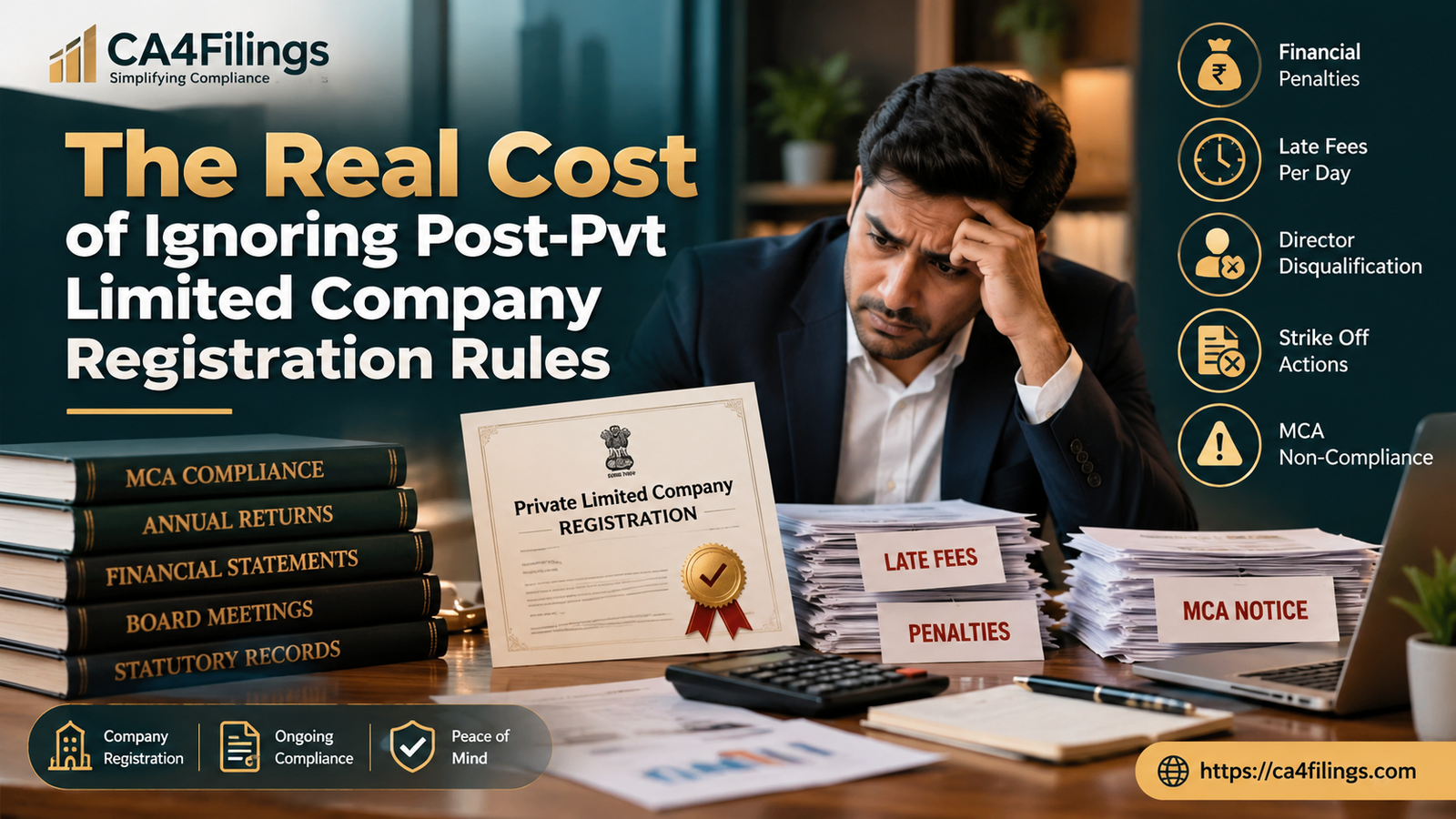
One of the most immediate consequences of MCA non-compliance is the accumulation of additional filing fees and statutory penalties.
For example, when a company fails to file its annual financial statements or annual return within the prescribed period, additional fees generally apply at ₹100 per day of delay for the relevant forms under the MCA filing framework, subject to the applicable rules and any specific exemptions or reliefs.
Consider a company that delays filing its annual return by 90 days. At ₹100 per day, the additional filing fee alone could reach ₹9,000 for that delayed filing. If multiple forms remain outstanding, the cost can increase substantially.
It is important to distinguish additional filing fees from other statutory penalties. Depending on the nature of the default, the Companies Act may prescribe separate penalties for the company and its officers.
The real cost may include:
Additional MCA filing fees.
Statutory penalties for specific defaults.
Professional fees for correcting overdue filings.
Interest or other charges where applicable.
Time spent responding to notices and resolving compliance issues.
The lesson is simple: paying for compliance on time is generally more economical than correcting years of neglect.
2. Director Disqualification: A Serious Business Risk
Many entrepreneurs underestimate the personal consequences of company-level non-compliance.
Under Section 164(2) of the Companies Act, 2013, directors of a company that fails to file financial statements or annual returns for a continuous period of three financial years may become disqualified, subject to the statutory conditions.
Director disqualification can affect a person's ability to continue as a director or accept appointments in other companies during the applicable period.
Imagine a founder who operates two businesses. One company becomes inactive, and the founder stops filing its annual returns. After repeated defaults, the founder may face disqualification-related consequences that affect their involvement in other companies as well.
This is why pvt limited company registration should always be followed by a clear compliance calendar. Founders should not assume that an inactive company carries no responsibilities.
3. Strike Off Actions and Loss of Corporate Status
If a company stops operating and fails to maintain its statutory obligations, the situation can become more complicated over time.
The Registrar of Companies may initiate strike-off proceedings under Section 248 of the Companies Act in circumstances permitted by law. Companies can also apply for voluntary removal of their names if they satisfy the applicable conditions.
However, strike off is not a shortcut for avoiding pending compliance obligations.
Before seeking closure, the company may need to address outstanding filings, settle liabilities, comply with tax requirements, and complete the prescribed closure procedure.
Consider a small startup that has not conducted business for two years. Its founders assume that the company will automatically disappear. Later, they discover that formal closure requires additional paperwork, professional assistance, and attention to outstanding statutory matters.
Proper planning after pvt limited company registration can prevent such situations. If the company is no longer needed, explore the appropriate closure route instead of simply abandoning it.
4. Missed Filings Can Damage Business Credibility
Compliance problems do not always result in immediate penalties. Sometimes, the damage appears when a company tries to grow.
Banks, investors, lenders, and potential business partners may request financial statements, annual returns, and other corporate documents during due diligence.
If these records are missing or outdated, the company may face:
Delays in securing business loans.
Difficulties during investor due diligence.
Delayed transactions involving shares or ownership changes.
Additional professional costs to regularise records.
Reduced confidence among prospective business partners.
For example, a startup seeking investment may have an attractive product and strong revenue potential. However, if its statutory filings are incomplete, investors may postpone the transaction until the company resolves its compliance issues.
A properly maintained compliance history can help demonstrate that the business is managed responsibly.
5. Other Hidden Costs of MCA Non-Compliance
Financial penalties are only one part of the problem. Neglecting company law requirements can create administrative and operational difficulties.
Other potential consequences include:
Difficulty obtaining updated corporate records when required.
Delays in completing corporate restructuring or ownership changes.
Complications when appointing or changing directors.
Increased legal and professional expenses for rectification.
Possible enforcement action for applicable statutory defaults.
The precise consequences depend on the default, the company's circumstances, and the relevant legal provisions.
The biggest mistake is waiting until an MCA notice arrives. Early identification of overdue filings usually gives the company a clearer path towards regularisation.
How to Avoid Compliance Problems After Pvt Limited Company Registration
The good news is that most routine compliance issues can be prevented with a structured process.
Follow these practical steps:
Step 1: Prepare a compliance calendar
Record annual return, financial statement, income tax, audit, and other applicable filing deadlines. Include reminders well before each due date.
Step 2: Maintain proper books of accounts
Record income, expenses, assets, liabilities, and business transactions throughout the year. Good bookkeeping makes year-end reporting easier.
Step 3: Complete annual filings on time
Track AOC-4, MGT-7 or MGT-7A, and other applicable forms. Verify the correct form and deadline for your company's circumstances.
Step 4: Maintain statutory records
Keep board minutes, resolutions, registers, and other prescribed records updated.
Step 5: Review compliance even if the company is inactive
An inactive company may still have statutory filing obligations. Review these responsibilities before deciding to suspend operations or close the company.
Step 6: Seek professional assistance
A qualified CA or experienced compliance professional can help identify overdue filings, determine applicable penalties, and prepare a suitable regularisation plan.
Latest Updates
ca4filings.com Services