Section 8 vs. Regular Pvt Ltd: The Nuances of Non-Profit Company Registration
Compare Section 8 and regular Pvt Ltd company registration in India. Understand legal requirements, taxation, compliance, and the right structure for your goals.
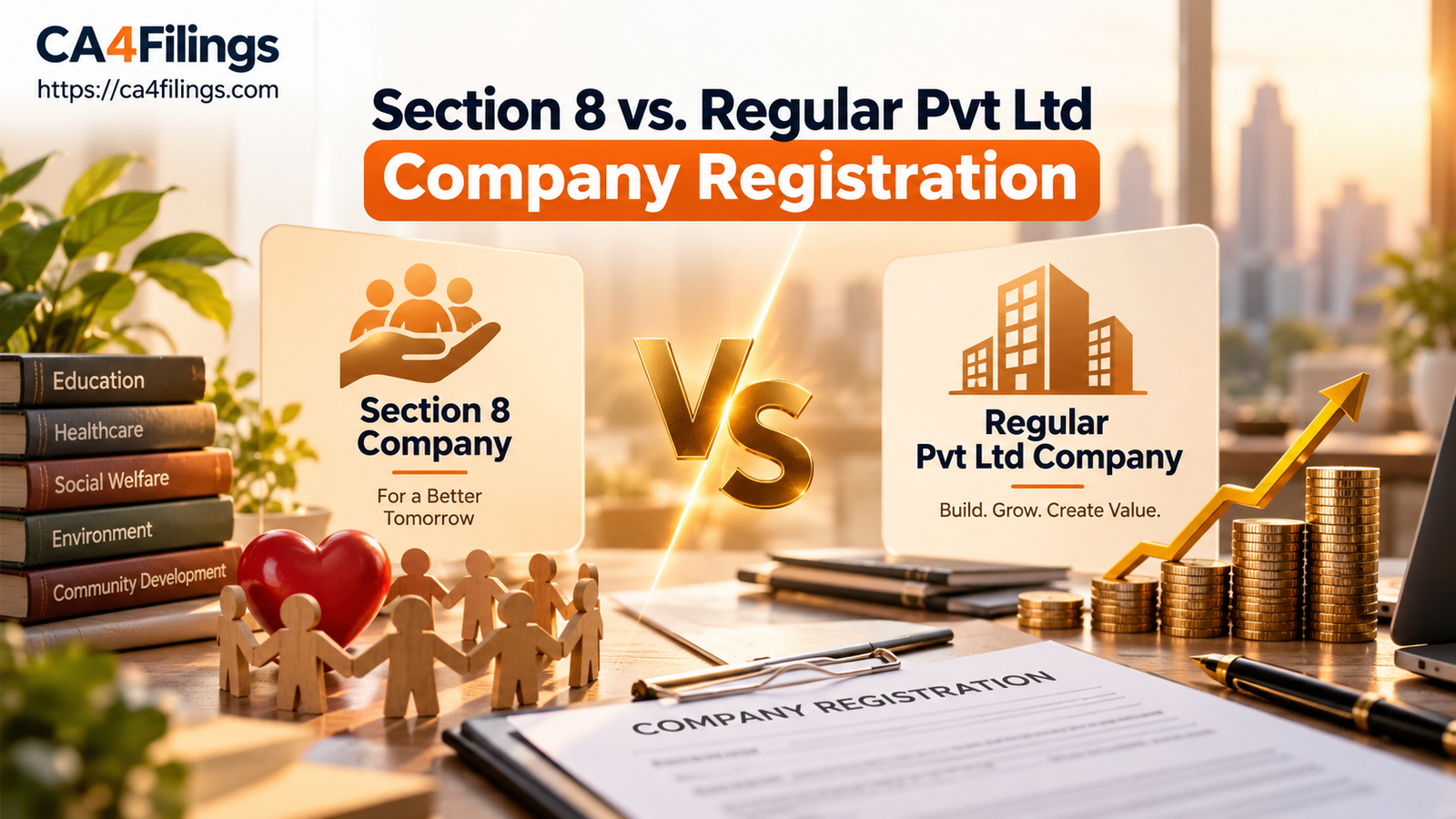
Starting an organisation in India involves more than selecting a name and filing documents. The right company registration structure determines how your organisation operates, manages funds, attracts investments, and fulfils its legal obligations. If your objective is to support education, healthcare, environmental protection, or community development, you may be considering a Section 8 company instead of a regular Private Limited Company.
At CA4Filings, we often help entrepreneurs and social impact founders understand this distinction before they commit to a legal structure. Our Company Registration services help business owners evaluate their options and navigate the incorporation process with greater clarity.
Although both structures are registered under the Companies Act, 2013, their purposes, profit distribution rules, and operational flexibility differ significantly. Let us explore these differences and understand which option makes sense for your plans.
What Is a Section 8 Company?
A Section 8 company is a legal entity established to promote charitable, social, educational, scientific, environmental, cultural, or other permitted public-benefit objectives. It operates under Section 8 of the Companies Act, 2013.
Unlike a conventional business, its primary purpose is not to generate profits for distribution among its members. Instead, its income must be applied towards achieving its stated objectives.
For example, suppose a group of professionals wants to establish an organisation that provides affordable vocational training to underprivileged students. A Section 8 company may be suitable because its activities focus on education and social development rather than distributing profits to shareholders.
Key Features of a Section 8 Company
Charitable objective: Its principal purpose must fall within the objectives permitted under Section 8.
License under Section 8: It must obtain the required licence from the Registrar of Companies as part of the incorporation process.
Dividend restriction: Profits cannot be distributed to members as dividends.
Separate legal identity: The company can own property, enter contracts, and operate in its own name.
Limited liability: Members generally have liability limited according to the company's legal structure.
Reinvestment of income: Surpluses must be used to advance the company's permitted objectives.
A Section 8 company can earn revenue through eligible activities. The important distinction is that commercial income must support its objectives rather than serve as a source of dividends for members.
What Is a Regular Private Limited Company?
A regular Private Limited Company is commonly chosen by entrepreneurs who want to establish a scalable business, bring in investors, and earn profits for shareholders.
It is governed primarily by the Companies Act, 2013, and offers a structured framework for ownership, management, fundraising, and business expansion.
Consider a founder planning to launch a software development company. The business may generate revenue from subscriptions, consulting, and technology services. If the founder intends to distribute profits to shareholders or raise equity capital, a regular Private Limited Company is generally the more appropriate option.
Key Features of a Regular Pvt Ltd Company
Commercial objectives: It can conduct lawful commercial activities to generate profits.
Dividend distribution: Dividends may be declared and paid to shareholders in accordance with applicable law.
Investment opportunities: It can issue shares and bring in eligible investors, subject to legal requirements.
Ownership flexibility: Shareholding can change through permitted share transfers and new issuances.
Limited liability: Shareholders generally have liability limited to their unpaid share capital.
Business expansion: It is suitable for startups, service providers, manufacturers, and technology businesses.
A regular company must also follow applicable accounting, taxation, filing, and governance requirements. Its commercial flexibility does not exempt it from MCA rules or statutory compliance.
Section 8 vs Regular Pvt Ltd: Key Differences
Before proceeding with company registration, compare both structures based on your objectives, financial plans, and compliance responsibilities.
| Basis of Comparison | Section 8 Company | Regular Pvt Ltd Company |
|---|---|---|
| Primary purpose | Charitable or public-benefit activities | Commercial business activities |
| Profit utilisation | Applied towards permitted objectives | May be retained or distributed lawfully |
| Dividend restriction | Dividends to members are prohibited | Dividends may be declared under applicable law |
| Section 8 licence | Required | Not applicable |
| Share capital | Can be structured with or without share capital, as permitted | Share capital is generally used |
| Fundraising | Donations, grants, eligible revenue, and other permitted sources | Equity investment, business revenue, and other permitted sources |
| Tax benefits | Not automatic; separate eligibility conditions apply | Governed by applicable business taxation provisions |
| Suitable for | NGOs, educational initiatives, and social enterprises | Startups, agencies, and commercial businesses |
The key point is that a Section 8 company is not simply a cheaper alternative to a regular company. Its legal purpose and restrictions must align with the organisation's actual activities.
Company Registration Requirements for Both Structures
Although the broad incorporation process is similar, Section 8 companies have additional requirements relating to their objectives and licence.
1. Requirements for a Section 8 Company
Founders should generally prepare the following:
Proposed company name and registered office details.
Identity and address proofs of directors and subscribers.
Memorandum of Association (MOA) specifying the charitable objective.
Articles of Association (AOA) defining governance and operating rules.
Digital Signature Certificates (DSCs) for the relevant signatories.
Declarations and supporting documents required for incorporation and licensing.
A Section 8 company must satisfy the statutory requirements applicable to its proposed activities and governance structure. The precise documentation depends on the facts of the case and current MCA procedures.
2. Requirements for a Regular Pvt Ltd Company
For a regular Private Limited Company, the usual preparation includes:
At least two members and two directors, subject to applicable eligibility requirements.
A proposed name that complies with naming rules.
MOA and AOA.
DSCs and identity documents for the relevant individuals.
Registered office documentation and required declarations.
Details of authorised and subscribed share capital.
At least one director must satisfy the applicable Indian residency requirement under the Companies Act, 2013.
3. Step-by-Step Company Registration Process
The general incorporation process involves the following stages:
Choose the structure: Decide whether your objective is charitable or commercial.
Finalise the name: Check name availability and compliance with MCA naming requirements.
Prepare incorporation documents: Draft the MOA, AOA, declarations, and supporting records.
File the application: Submit the applicable incorporation forms through the MCA portal.
Obtain the required approvals: A Section 8 company must meet the applicable licensing requirements alongside incorporation formalities.
Receive the Certificate of Incorporation: Once approved, the company receives its legal identity and relevant registration details.
Complete post-incorporation compliance: Address bank account formalities, accounting records, statutory registers, and applicable tax registrations.
For Section 8 incorporation, the licence and incorporation process must be handled in accordance with the current MCA framework. Approval is not guaranteed merely because the proposed organisation describes itself as charitable.
Taxation and Compliance: What Should Founders Know?
Tax treatment is one of the most misunderstood aspects of non profit incorporation in India.
A Section 8 company does not automatically become tax-exempt merely by receiving a licence. Eligibility for income-tax exemptions generally depends on separate requirements under the Income-tax Act, 1961, including registration under Section 12AB where applicable. Donations eligible for donor deductions may also require separate approval under Section 80G.
Founders should therefore distinguish between corporate registration and tax exemption.
A regular Private Limited Company is taxed according to the applicable corporate income-tax provisions and its chosen tax regime, subject to eligibility and prevailing law.
Both structures may have obligations involving:
Maintenance of proper books of accounts.
Annual financial statements and statutory filings.
Income-tax returns and tax-related compliance.
Applicable GST registration and returns.
Statutory audit and other governance requirements.
A Section 8 company must also ensure that its funds are used consistently with its approved objectives and applicable restrictions.
Expert tip from CA4Filings: Prepare a compliance calendar immediately after incorporation. Missing annual filings or overlooking tax registrations can create penalties and unnecessary administrative difficulties, even when an organisation has limited transactions.
Which Structure Should You Choose?
The right company registration option depends on how you intend to operate the organisation over the long term.
Choose a Section 8 company if:
Your primary purpose is charitable, educational, scientific, environmental, or social welfare.
You want to reinvest surplus income into public-benefit activities.
You plan to seek eligible grants, donations, or institutional support.
You do not intend to distribute profits as dividends.
Choose a regular Private Limited Company if:
Your main objective is commercial growth and profitability.
You want to distribute dividends to shareholders, subject to applicable law.
You intend to raise equity investment or develop a conventional ownership structure.
You want flexibility to expand into different lawful business activities.
For example, a founder operating a paid coaching business for commercial returns would generally consider a regular Private Limited Company. A group establishing a vocational training initiative for disadvantaged communities, with all surplus directed towards its mission, may find a Section 8 company more suitable.
However, the organisation's actual activities, funding model, and governing documents should guide the final decision.
Latest Updates
ca4filings.com Services