OPC Registration Requirements: Director Age, Residency, and Status Criteria
Understand OPC registration requirements in India, including director age, residency, nominee rules, eligibility criteria, and compliance requirements for entrepreneurs.
OPC Registration: Why Eligibility Matters
Starting a business alone does not mean you have to operate as a sole proprietor. An OPC registration allows a single individual to establish a company with a separate legal identity and limited liability. For entrepreneurs who want greater credibility while retaining individual control, a One Person Company can be a practical structure.
If you are comparing business structures, understanding Company Registration options can help you choose the right legal framework before investing time and money in incorporation. At CA4Filings, we regularly advise entrepreneurs to check eligibility first because a small issue with residency, age, or nominee details can delay incorporation.
The good news is that the basic eligibility conditions for OPC registration are relatively straightforward. However, there are specific requirements relating to the proposed director, nominee, residential status, and documentation.
What Is an OPC?
A One Person Company, commonly called an OPC, is a company structure designed for a single member. Unlike a traditional private limited company, an OPC can have only one member at a time.
The company is legally separate from its owner. This means that, subject to applicable law, the business has its own rights and obligations, while the owner's liability is generally limited to the amount invested in the company.
An OPC can be particularly useful for:
- Individual entrepreneurs starting a formal business.
- Consultants and professionals wanting a corporate structure.
- Small businesses seeking limited liability.
- Founders who want complete ownership and control.
- Entrepreneurs planning to establish a stronger business identity.
The structure is also relevant when considering micro-business laws, although an OPC should not be confused with every form of small-business registration.
OPC Registration Requirements for the Director
One of the most important aspects of OPC registration is the eligibility of the proposed director and member.
Minimum Age Requirement
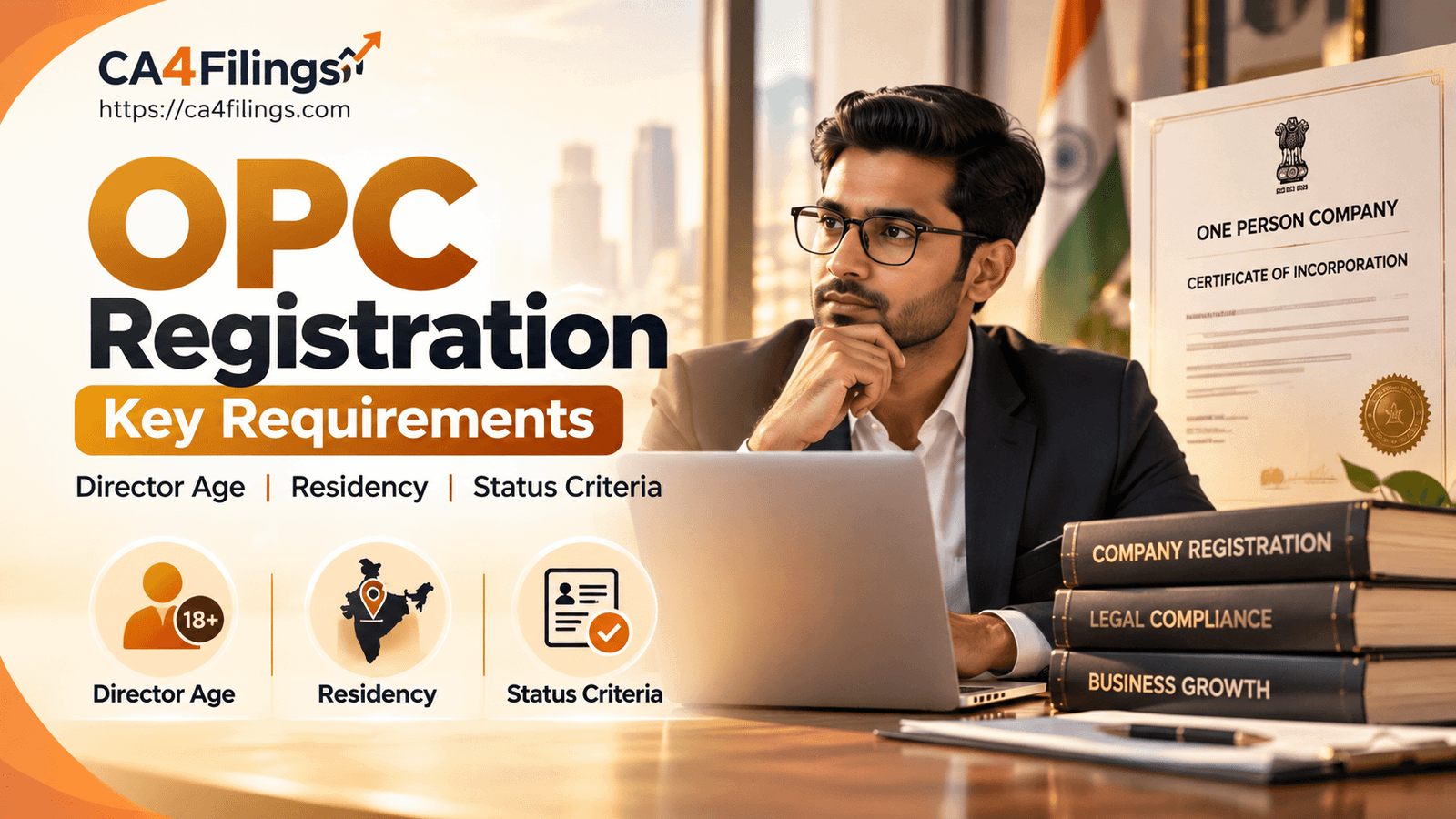
The person forming an OPC must be an adult. In practical terms, the proposed member and director should be at least 18 years old.
This requirement is important because incorporation involves entering into legal contracts, submitting declarations, and taking responsibility for the company's statutory obligations.
For example, if a 17-year-old wants to establish a technology venture, the individual cannot simply proceed with OPC incorporation in their own name. The eligibility requirements must first be satisfied.
Age is therefore one of the basic legal qualification benchmarks that should be checked before starting the incorporation process.
The Individual Must Be a Natural Person
An OPC can be incorporated by a natural person. A company or another artificial legal entity cannot simply become the sole member of an OPC in the same manner as an individual.
This makes the structure particularly suitable for entrepreneurs who personally want to own and operate a business through a corporate entity.
Director Identification and DIN Requirements
The proposed director must have the appropriate identification and statutory credentials required under company law.
The Director Identification Number (DIN) is an important part of the incorporation process. Where applicable, the DIN can be obtained through the prescribed incorporation process.
Entrepreneurs sometimes refer to these as director identification thresholds, but there is no separate age-based DIN threshold beyond the legal eligibility requirements for becoming a director.
The key point is to ensure that the proposed director's identity and documents are correctly submitted.
OPC Registration and Residency Requirements
Residency is another important consideration.
Under the current framework, an Indian citizen who wants to incorporate an OPC needs to satisfy the applicable residency condition prescribed under the Companies Act and related rules.
Who Can Incorporate an OPC?
An eligible Indian citizen who satisfies the applicable residency requirement can generally incorporate an OPC.
The residency requirement should not be confused with citizenship. A person may be an Indian citizen but still need to verify whether they satisfy the prescribed residential condition for OPC incorporation.
This is particularly relevant for people who have recently moved abroad or spend substantial periods outside India.
What About NRIs?
The rules concerning NRIs have evolved over time. Therefore, anyone considering opc registration while living outside India should check the rules applicable on the actual date of incorporation.
The non-resident indian rules should be examined carefully rather than relying on older articles or informal advice found online.
For example, an Indian entrepreneur living in Dubai, Singapore, London, or the United States may have a different compliance position depending on their citizenship and residential status.
At CA4Filings, we recommend verifying this point before preparing incorporation documents because residency-related errors can result in unnecessary rework.
Nominee Requirement in OPC Registration
An OPC must have a nominee. This is one of its distinctive requirements.
The nominee is the person who can become the member of the company in the event of the original member's death or incapacity, subject to the applicable legal provisions.
Who Can Be a Nominee?
The nominee should satisfy the eligibility requirements prescribed under company law.
Before selecting a nominee, the proposed member should discuss the arrangement with the person and obtain the required consent.
A practical approach is to select someone:
- You trust personally.
- Who understands the nature of the business.
- Who is willing to accept the nomination.
- Whose identity and address documents are readily available.
- Who can fulfil the applicable legal requirements.
The nominee is not necessarily involved in the daily management of the company. Their role becomes relevant if the statutory circumstances triggering succession arise.
Documents Required for OPC Registration
Having the correct documentation ready can make the incorporation process much smoother.
Commonly required documents include:
- PAN card of the proposed member/director.
- Identity proof.
- Address proof.
- Passport-size photograph, where applicable.
- Registered office address proof.
- Utility bill or other prescribed address evidence.
- Consent of the nominee.
- Nominee's identity and address documents.
- Digital Signature Certificate (DSC), where required.
- Director-related declarations and incorporation forms.
The exact documents can vary depending on the applicant's circumstances and the registered office arrangement.
A frequent practical issue is a mismatch between the name or address appearing on different documents. It is better to resolve such inconsistencies before filing rather than after receiving an incorporation-related query.
OPC Registration: Step-by-Step Process
The broad opc registration process involves several stages.
Step 1: Check Eligibility
Confirm:
- Age eligibility.
- Citizenship and residency status.
- Director eligibility.
- Nominee eligibility.
- Proposed business activity.
- Registered office details.
Step 2: Obtain Digital Signature
The required DSC is arranged for the relevant person so that electronic incorporation documents can be authenticated.
Step 3: Select the Company Name
Choose a suitable name that complies with applicable naming requirements and does not create confusion with an existing company or trademark.
Step 4: Prepare Incorporation Documents
Prepare the required declarations, nominee consent, identity documents, address proof and other incorporation information.
Step 5: File Incorporation Forms
The prescribed incorporation forms are submitted through the Ministry of Corporate Affairs' online system along with the applicable documents and fees.
Step 6: Receive the Certificate of Incorporation
Once the Registrar of Companies approves the application, the company receives its Certificate of Incorporation and becomes a separate legal entity.
Common Mistakes to Avoid
Entrepreneurs often focus only on submitting the form and overlook the supporting details.
Avoid these common mistakes:
- Choosing a company name without checking availability.
- Providing outdated address proof.
- Ignoring residency requirements.
- Selecting a nominee without obtaining proper consent.
- Assuming every NRI automatically qualifies.
- Entering inconsistent information across documents.
- Starting operations without understanding post-incorporation compliance.
- Treating OPC rules as identical to those applicable to sole proprietorships.
A professional review before filing can prevent many of these issues.
OPC Registration FAQs
1. Can a minor become the director of an OPC?
No. A minor cannot act as a director in an OPC. The proposed director must satisfy the applicable legal requirements, including the minimum age requirement.
2. Is a nominee compulsory for an OPC?
Yes. Nominee appointment is an important requirement of the OPC structure and provides a mechanism for succession in specified circumstances.
3. Can an NRI register an OPC in India?
Eligibility depends on the person's citizenship and residential status and the rules applicable at the time of incorporation. NRIs should verify the current non-resident indian rules before proceeding.
4. Does an OPC provide limited liability?
Generally, an OPC provides a separate legal identity and limited liability to its member, subject to applicable law and circumstances where personal liability may arise.
5. Is OPC suitable for every small business?
Not necessarily. The appropriate structure depends on factors such as ownership, funding plans, number of participants, business activity, compliance requirements, and future expansion.
Get Your OPC Registration Right
Understanding the eligibility conditions before starting opc registration can save entrepreneurs considerable time and avoid unnecessary filing complications. Age, residency, director eligibility, nominee requirements and documentation are all important parts of the process.
If you are planning to establish an OPC and want professional assistance with documentation, incorporation and compliance, CA4Filings can help you approach the process systematically. Speak with the CA4Filings team today and take the next step toward setting up your business with the appropriate legal structure.
Latest Updates
ca4filings.com Services




























-registration.png)