Essential Milestones in the Complete Online OPC Registration Workflow
Understand OPC registration milestones, documents, MCA filing steps, verification, incorporation and post-registration compliance with CA4Filings.
Why Understanding OPC Registration Milestones Matters
Starting a business alone does not mean you have to compromise on having a proper corporate structure. A One Person Company (OPC) allows a single entrepreneur to operate through a separate legal entity while enjoying several benefits of corporate status. However, successful opc registration is not simply about submitting an online form. It involves a sequence of decisions, documents, digital approvals, and compliance checks.
If you are exploring different business structures, understanding the broader Company Registration process can also help you compare OPC with other available options. At CA4Filings, we believe that knowing each milestone in advance makes the entire opc registration journey more predictable and avoids unnecessary delays.
What Is OPC Registration?
OPC registration is the process of legally incorporating a One Person Company under the Companies Act, 2013. It is particularly useful for entrepreneurs who want to run a business independently while maintaining a corporate identity.
An OPC generally has:
- One member or shareholder
- One nominee
- A separate legal identity
- Limited liability protection, subject to applicable law
- Perpetual succession
- Greater credibility for certain business and financial transactions
For example, imagine a freelance technology consultant who has started receiving larger corporate projects. Operating as an individual may work initially, but an OPC can provide a more structured business framework as the venture grows.
Key Milestones in the OPC Registration Workflow
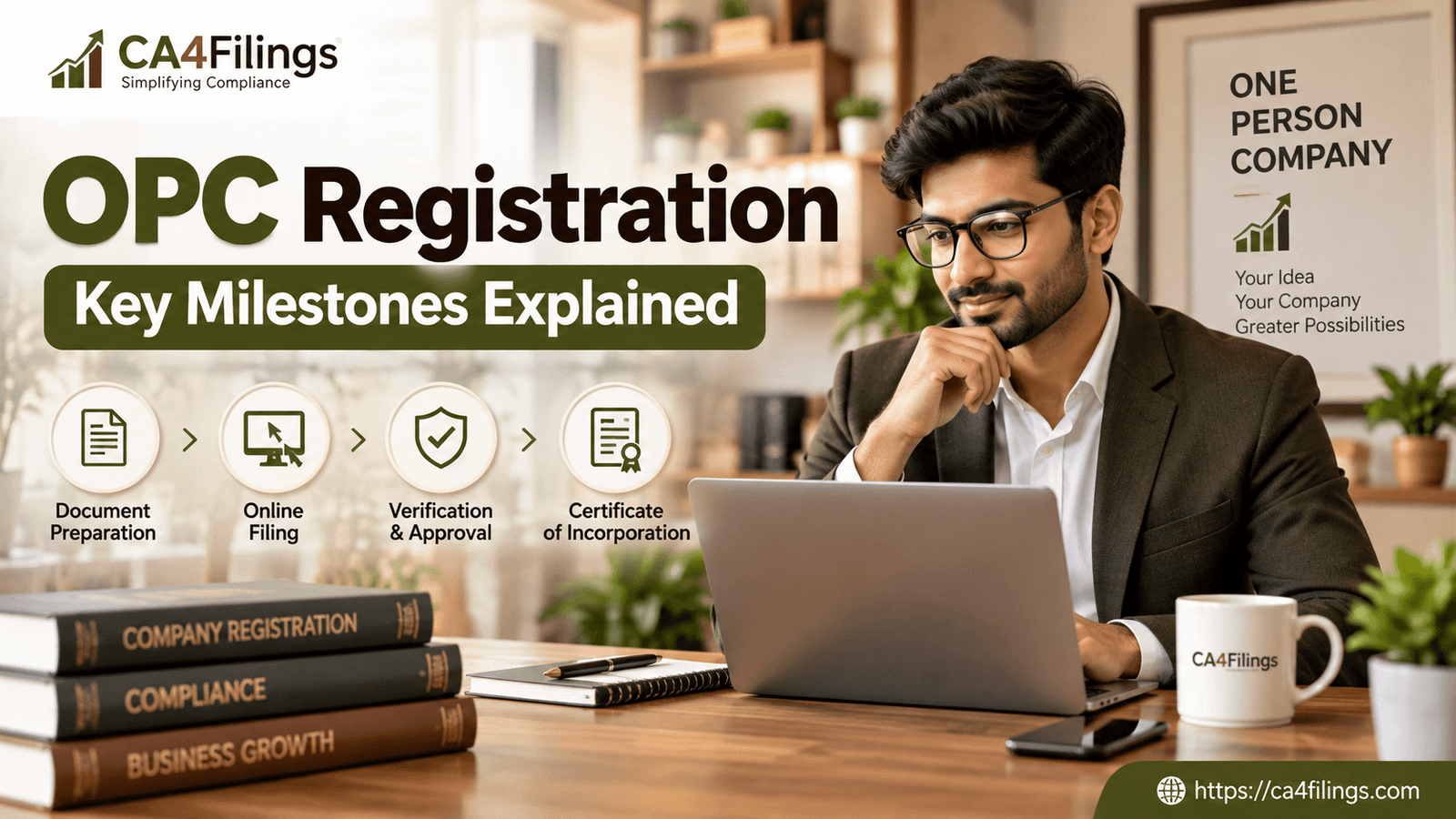
A smooth opc registration process starts well before the incorporation application is submitted. Here are the important milestones an entrepreneur should understand.
1. Check Eligibility and Decide the Business Structure
The first step is confirming whether an OPC is suitable for your circumstances.
The proposed member should generally be an individual who is an Indian citizen and resident in India, subject to the applicable rules at the time of incorporation. The proposed business activity should also be reviewed before proceeding.
At this stage, consider:
- Proposed business activity
- Capital requirements
- Expected turnover
- Future funding plans
- Whether additional shareholders may be required later
- Registered office availability
This initial assessment can prevent structural changes after incorporation.
2. Obtain and Verify Digital Signatures
Since the incorporation process is primarily online, digital signatures are an important part of opc registration.
The proposed director needs a valid Digital Signature Certificate (DSC) for signing electronic forms. The information provided while obtaining the DSC should match the identity documents submitted during incorporation.
This is where our practical document validation benchmarks become useful. Names, addresses, dates of birth and identification details should be checked carefully before submission.
3. Plan the Digital Integration Timeline
The incorporation process involves several interconnected digital steps. Entrepreneurs should therefore create a realistic digital integration timeline rather than expecting everything to happen instantly.
A typical sequence may involve:
- DSC preparation
- Director-related documentation
- Name selection
- Preparation of incorporation forms
- Submission through the MCA system
- Review by the Registrar of Companies
- Clarification or resubmission, if required
- Certificate of Incorporation
- PAN and TAN-related formalities
- Post-incorporation registrations and banking setup
Having these milestones mapped out makes the opc registration process easier to monitor.
4. Select and Reserve the Company Name
Choosing a suitable name is another important milestone.
The proposed name should be distinctive and should comply with applicable naming rules. It should not create confusion with an existing company, registered trademark or another protected name.
A practical tip from CA4Filings: keep alternative names ready. If your first choice is unavailable or rejected, having another suitable option can save time.
5. Prepare the Incorporation Documents
Documentation is one of the areas where applicants frequently make avoidable mistakes.
Common documents may include:
- PAN and identity proof of the subscriber/director
- Address proof
- Passport-size photograph
- Registered office address proof
- Utility bill, where applicable
- No-objection certificate from the owner, where required
- Nominee-related documents and consent
- Digital signature details
The exact documentation can vary depending on the circumstances of the applicant and registered office.
For opc registration, consistency is critical. A minor mismatch between the application and supporting documents can result in clarification requirements.
6. Complete the Online Incorporation Application
Once the documents are ready, the incorporation application is submitted through the MCA's electronic incorporation system.
This stage connects several incorporation requirements into one digital workflow. Applicants should carefully review:
- Company name
- Registered office details
- Director information
- Nominee details
- Business activity
- Share capital
- Subscriber information
- Supporting documents
While some applicants look for spice portal shortcuts, there is no substitute for accurately completing the required information. Shortcuts that involve skipping verification can create problems later.
7. Understand the Verification and Resubmission Stage
Submission does not automatically mean approval.
The Registrar of Companies may examine the application and supporting information. If clarification or correction is required, the applicant may need to respond within the prescribed timeframe.
Common issues can include:
- Incorrect address details
- Incomplete documents
- Name-related concerns
- Improper declarations
- Mismatched information
- Issues with proof of registered office
This is why professional review can be useful. During opc registration, identifying errors before submission is usually easier than correcting them after receiving an objection.
8. Receive the Certificate of Incorporation
Once the application is approved, the company receives its Certificate of Incorporation.
This is a major milestone because it confirms that the OPC has been incorporated as a separate legal entity.
The certificate generally contains important information such as:
- Corporate Identity Number (CIN)
- Company name
- Date of incorporation
- PAN and TAN details, as applicable
Entrepreneurs should preserve these documents carefully because they are likely to be required for banking, taxation and other business formalities.
9. Complete the Post-Incorporation Setup
The opc registration process does not end with receiving the incorporation certificate.
The newly incorporated company may still need to complete several operational steps depending on its activities.
These may include:
- Opening a current bank account
- Bringing in subscribed capital
- Obtaining GST registration, where applicable
- Obtaining other business-specific licences
- Setting up accounting records
- Appointing professionals where necessary
- Understanding annual filing obligations
Think of this as the complete setup walk-through: incorporation creates the company, while post-incorporation activities make it operational.
10. Start Compliance From Day One
A common misconception is that compliance starts months after incorporation. In reality, entrepreneurs should understand their obligations from the beginning.
An OPC has statutory and financial reporting requirements. Maintaining proper books, invoices, resolutions, tax records and other documents can make future compliance considerably easier.
CA4Filings recommends maintaining a simple compliance calendar covering:
- Income-tax requirements
- GST returns, where applicable
- MCA filings
- Accounting deadlines
- Bank and financial documentation
- Director-related statutory requirements
The exact obligations depend on the company's activities and applicable laws.
Practical Tips for Faster OPC Registration
If you want a smoother opc registration experience, keep these points in mind:
- Verify every name and address before submission.
- Keep nominee documents ready in advance.
- Use clear and valid supporting documents.
- Check that the registered office proof meets applicable requirements.
- Keep alternative company names available.
- Respond promptly if clarification is requested.
- Do not treat incorporation as the end of compliance.
- Maintain a digital folder containing all incorporation records.
The biggest time-saving measure is preparation. Most avoidable delays occur because documents or information are incomplete, inconsistent or submitted without proper review.
Frequently Asked Questions About OPC Registration
How long does OPC registration take?
The timeline can vary depending on document readiness, name availability, government processing and whether clarification or resubmission is required. A properly prepared application generally has fewer avoidable delays.
Can a single person start an OPC?
Yes. An OPC is specifically designed to allow a single eligible individual to incorporate a company, subject to the requirements under applicable company law.
Is a nominee mandatory for an OPC?
Yes. An OPC structure requires nomination of another individual who can become a member in specified circumstances, subject to applicable legal requirements.
Can an OPC obtain GST registration?
An OPC can obtain GST registration when it meets the applicable GST registration requirements. GST registration is not automatically required merely because a company is incorporated.
Does OPC registration end after receiving the Certificate of Incorporation?
No. Incorporation is only the beginning of the company's lifecycle. Banking, taxation, accounting and ongoing MCA compliance may still need attention.
Build Your OPC on the Right Foundation
A successful opc registration is best viewed as a structured workflow rather than a single online application. From eligibility checks and DSC preparation to name approval, document verification, incorporation and post-registration compliance, every milestone has a role to play.
At CA4Filings, we help entrepreneurs approach incorporation with proper documentation, practical guidance and a clear understanding of the process. If you are planning to establish your own company, professional assistance can help you navigate the opc registration workflow with greater clarity.
Choose CA4Filings for practical guidance from incorporation planning through the next stages of your business journey, and take the first step toward establishing your OPC on a properly structured foundation.
Latest Updates
ca4filings.com Services



























-registration.png)