How to Registration Company Tax Status: LLC vs. S-Corp vs. C-Corp
Learn how to registration company tax status by comparing LLC, S-Corp and C-Corp taxation, filings, tax brackets and practical compliance needs.
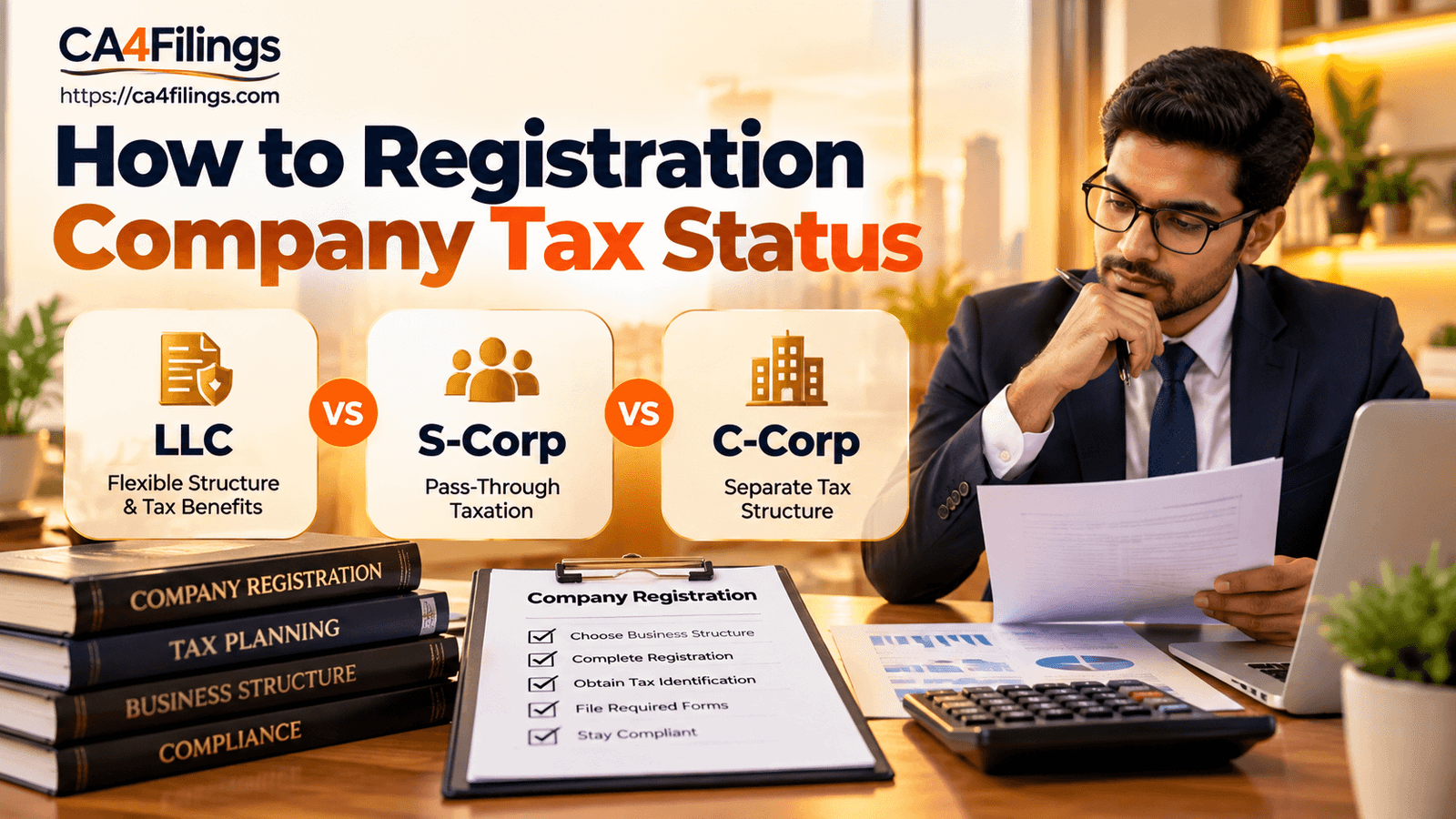
How to Registration Company Tax Status: Understanding Your Options
If you are planning to start a business in the United States, understanding how to registration company structures work for tax purposes is just as important as registering the business itself. Choosing between an LLC, S-Corp, and C-Corp can affect your tax liability, compliance requirements, ownership structure, and how you take money out of the business.
At CA4Filings, we regularly see business owners focus only on registration and overlook the tax consequences of their chosen structure. If you are at the initial stage, completing your Company Registration correctly can help establish a proper foundation for future compliance.
The important point is that an LLC, S-Corp, and C-Corp are not simply three interchangeable business names. They have different tax treatments, filing requirements, and eligibility rules. So, before deciding how to registration company, you should understand what each option means.
How to Registration Company: LLC Tax Treatment
An LLC, or Limited Liability Company, is popular among small business owners because it offers liability protection with relatively flexible tax treatment.
For federal income tax purposes, an LLC may generally be treated as:
- A disregarded entity if it has one owner and does not elect corporate taxation.
- A partnership if it has multiple owners.
- An S-Corporation or C-Corporation if the LLC makes an appropriate tax election and meets the applicable requirements.
This flexibility makes an LLC particularly interesting for small business taxation.
LLC as a Pass-Through Entity
One of the major advantages of an LLC is its potential pass-through entity treatment. Instead of the business itself generally paying federal income tax on its operating profits, taxable income can pass through to the owners.
For example, suppose two members operate an LLC and the business generates $100,000 of taxable income. Depending on the tax classification, that income may be reported by the owners on their individual tax returns.
However, pass-through taxation does not mean that the income is tax-free. The owners may still owe federal and state taxes, and self-employment tax can also be relevant.
This is why how to registration company should not be approached only from a registration perspective. The tax classification selected for the business can have a significant financial impact.
How to Registration Company as an S-Corp
An S-Corporation is a tax election available to eligible corporations and certain LLCs. It is often considered by profitable small businesses that want pass-through taxation while potentially managing employment-tax exposure in a compliant manner.
A business that wants to elect S-Corporation status generally needs to file IRS Form 2553 within the applicable deadline.
How S-Corp Taxation Works
An S-Corp generally passes its income, deductions, and certain other tax items through to shareholders. The corporation generally does not pay federal corporate income tax in the same way as a C-Corporation.
However, there is an important compliance requirement when an owner actively works in the business.
The owner-employee generally needs to receive reasonable compensation through payroll before taking certain distributions. Simply taking all business profits as distributions can create tax and compliance problems.
For example, imagine an owner actively works in a consulting company and the company earns substantial profits. Treating the owner as receiving no salary merely to reduce payroll taxes may attract scrutiny. Proper payroll processing and reasonable compensation are therefore essential.
When considering how to registration company with an S-Corp strategy, business owners should look beyond the headline tax benefit and consider payroll costs, accounting, state rules, and annual compliance.
How to Registration Company as a C-Corp
A C-Corporation is a separate taxable entity. Unlike a typical pass-through structure, the corporation itself generally pays federal corporate income tax on its taxable income.
The corporation must also file its own corporate tax returns, generally using Form 1120 for a domestic C-Corporation.
Understanding Double Taxation
One commonly discussed issue with C-Corporations is double taxation.
Suppose a corporation earns $200,000 of taxable profit. The corporation may first pay corporate income tax. If the remaining after-tax profit is later distributed to shareholders as dividends, the shareholders may also have individual tax consequences on those dividends.
That does not automatically make a C-Corp unsuitable. C-Corporations can be useful for businesses planning to reinvest profits, raise outside capital, issue different classes of stock, or build a structure suitable for institutional investment.
Therefore, the right answer to how to registration company depends heavily on the business model and long-term plans.
LLC vs. S-Corp vs. C-Corp: Key Differences
Before deciding how to registration company, compare the structures based on your actual business requirements.
| Factor | LLC | S-Corp | C-Corp |
|---|---|---|---|
| Tax treatment | Flexible | Generally pass-through | Separate corporate taxation |
| Pass-through taxation | Often available | Yes | Generally no |
| Payroll requirement | Depends on tax treatment | Important for owner-employees | Employees generally on payroll |
| Form 2553 | Not always applicable | Generally required for S election | Not applicable |
| Corporate tax return | Depends on classification | Generally corporate return plus shareholder reporting | Form 1120 generally applies |
| Outside investors | Flexible but varies | More restrictions | Generally more flexible |
| Double taxation | Usually avoidable under pass-through treatment | Generally avoided at federal income-tax level | Possible on dividends |
| Typical consideration | Flexibility | Eligible small businesses | Growth and investment |
Tax rules can vary based on ownership, elections, state law, income level, and individual circumstances. So, a structure that works well for one business may not be appropriate for another.
How to Registration Company: Step-by-Step Approach
If you are still deciding how to registration company, follow a structured approach rather than selecting a tax structure based only on a friend's recommendation.
Step 1: Define Your Business Activity
Start by identifying what the company will actually do. A consultancy, online store, technology startup, professional practice, and real-estate business may have very different tax and compliance considerations.
Step 2: Identify the Owners
Consider the number of owners and where they are located. Ownership structure can influence eligibility for certain tax elections and determine how income is reported.
Step 3: Estimate Your Profit
Prepare a realistic projection of revenue, operating expenses, owner compensation, and expected taxable profit.
This is particularly important when comparing an LLC with an S-Corp election. The potential benefits of an S-Corp can depend significantly on the company's profitability and payroll requirements.
Step 4: Compare Tax Brackets and Total Costs
Do not compare structures using only one tax rate. Consider applicable federal and state taxes, payroll taxes, self-employment taxes, deductions, accounting fees, filing costs, and compliance requirements.
Individual tax brackets can also affect the owner's final tax position.
Step 5: Review Future Plans
Ask yourself:
- Will you need outside investors?
- Do you plan to reinvest most profits?
- Could the business eventually seek venture capital?
- Will there be multiple shareholders?
- Do you expect to sell the company?
- Will owners actively work in the business?
These questions can materially affect how how to registration company should be evaluated.
Common Mistakes Business Owners Should Avoid
Many entrepreneurs make the same mistakes during business formation.
Choosing a Structure Only for Lower Taxes
A lower potential tax bill should not be the only consideration. Administrative costs, payroll compliance, state taxes, and future financing can be equally important.
Missing the S-Corp Election Deadline
Eligible businesses choosing S-Corporation taxation generally need to pay attention to the IRS Form 2553 filing deadline. Missing an election deadline can create unnecessary complications.
Ignoring State-Level Rules
Federal tax treatment is only one part of the picture. State registration, franchise taxes, annual reports, and state income-tax rules can differ substantially.
Mixing Personal and Business Finances
Even where a business structure provides liability protection, maintaining separate business and personal bank accounts is a fundamental accounting practice.
Taking Distributions Without Proper Records
Owners should maintain proper books, payroll records, financial statements, and documentation supporting payments and distributions.
How to Registration Company: When Should You Get Professional Help?
Business formation is not simply a form-filling exercise. Your initial choice can influence tax reporting for years.
Professional advice can be particularly useful if:
- Your business expects significant profits.
- You are considering an S-Corp election.
- There are multiple owners.
- You expect foreign or non-resident ownership issues.
- You plan to raise investment.
- You operate across multiple states.
- You are unsure about payroll and distributions.
- You want to compare long-term tax costs.
At CA4Filings, our approach is to first understand the business and then evaluate the available tax structures rather than recommending a structure based on a generic formula.
FAQs About How to Registration Company
1. Is an LLC automatically taxed as an LLC?
Not necessarily. For federal tax purposes, an LLC can have different tax classifications depending on its ownership and elections. A single-member LLC is generally disregarded by default, while a multi-member LLC is generally treated as a partnership unless another election applies.
2. Can an LLC choose S-Corp taxation?
Yes, an eligible LLC can generally elect to be taxed as an S-Corporation by making the appropriate election, including filing IRS Form 2553 where applicable.
3. Is a C-Corp always more expensive from a tax perspective?
Not necessarily. The answer depends on profitability, distributions, deductions, state taxes, shareholder circumstances, and whether profits are retained or distributed.
4. What is double taxation in a C-Corp?
Double taxation generally refers to corporate profits being taxed at the corporate level and dividends distributed to shareholders subsequently being subject to individual-level tax.
5. Which structure is best for small businesses?
There is no universal structure that suits every small business. The appropriate choice depends on ownership, profitability, operations, investment plans, payroll, and long-term objectives.
How to Registration Company the Right Way
Understanding how to registration company tax status is an important part of starting a business in the United States. LLCs can provide flexibility, S-Corps can offer pass-through taxation for eligible businesses, and C-Corps can provide a structure suited to businesses seeking certain forms of investment and growth.
The right decision should be based on your actual business circumstances rather than simply choosing the structure with the lowest advertised tax rate. Consider tax brackets, payroll obligations, corporate tax returns, potential double taxation, state compliance, and future investment requirements before making the election.
If you are unsure about how to registration company and which tax structure fits your business, CA4Filings can help you evaluate the available options and understand the compliance responsibilities involved.
Ready to get your business structure right from the beginning? Connect with CA4Filings for professional guidance on company registration and US business tax compliance.
Latest Updates
ca4filings.com Services


























-registration.png)