Why OPC Registration is the Perfect Gateway Structure for Bootstrapped Startups
OPC registration helps bootstrapped founders gain limited liability and corporate identity. Learn its benefits, process, costs and suitability for startups.
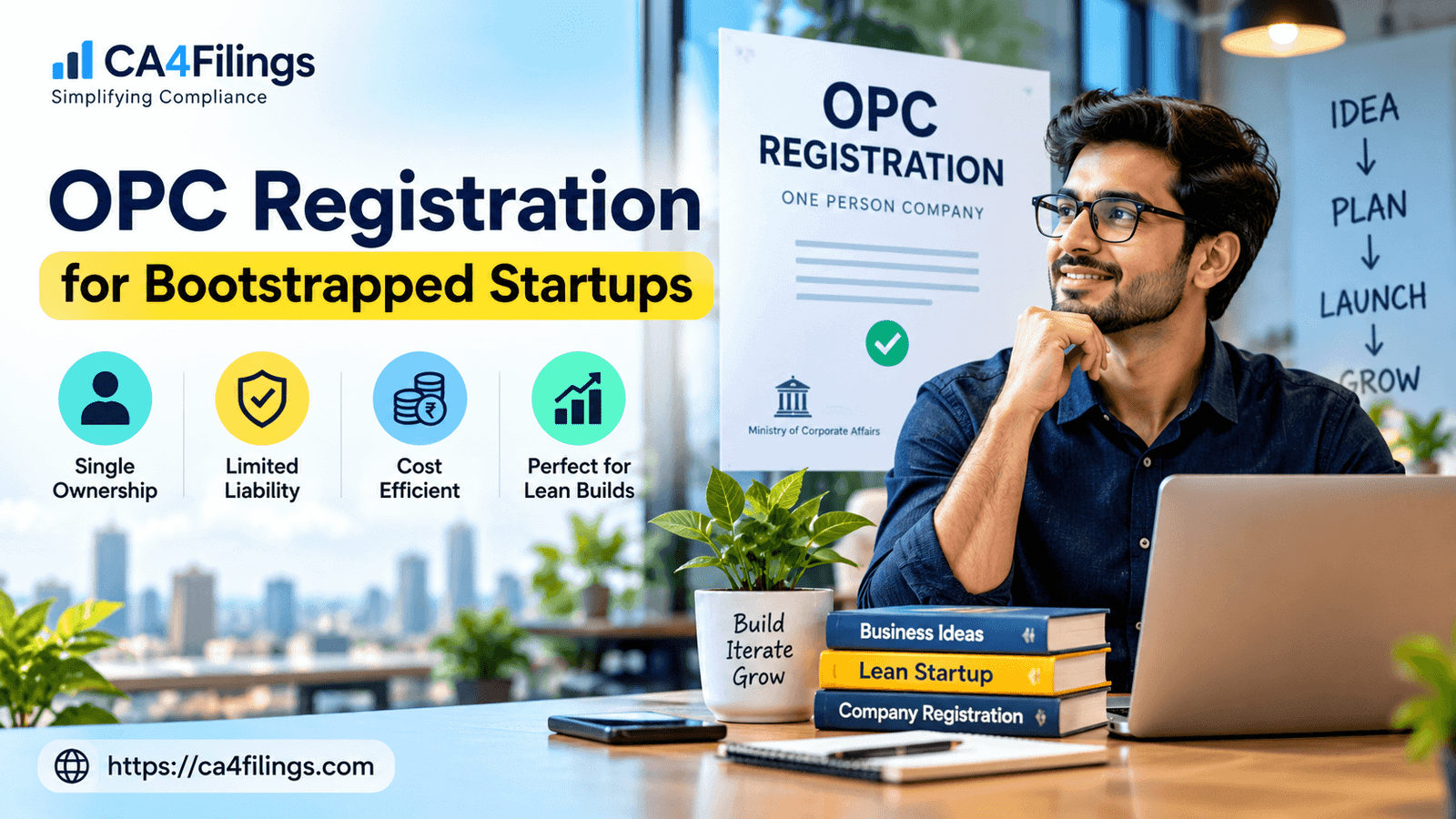
Starting a business with your own savings is exciting, but it also comes with a practical challenge: how do you create a proper legal structure without making the business unnecessarily expensive or complicated? For many solo founders, opc registration can be an effective starting point. A One Person Company (OPC) gives a single entrepreneur a separate legal identity while keeping ownership and control largely with one person. If you are exploring formal business structures, understanding Company Registration can help you compare OPC with other options before making a decision.
For founders working with zero funding lean builds, limited resources and an untested business idea, OPC can offer a useful middle ground between operating as an individual and immediately building a larger corporate structure. At CA4Filings, we often see entrepreneurs choosing structures based not just on today's requirements, but on where they expect the business to go over the next few years.
What is OPC Registration?
OPC registration is the process of incorporating a One Person Company under the Companies Act, 2013. Unlike a traditional private limited company, an OPC can have a single member.
This structure is particularly relevant for entrepreneurs who:
- Want to start a business independently
- Prefer complete ownership and decision-making control
- Want limited liability protection
- Need a separate legal identity for their business
- Are testing a business model before bringing in investors or partners
In simple terms, OPC allows a solo entrepreneur to operate through a company rather than conducting the business entirely in their personal capacity.
Why OPC Registration Works for Bootstrapped Startups
Bootstrapped founders usually think differently from funded startups. Every rupee matters, unnecessary compliance is a concern, and the founder may want to validate the idea before expanding.
This is where opc registration can become useful.
1. Complete Control for the Founder
One of the biggest advantages is ownership. Since there is only one member, the founder does not have to divide ownership with co-founders or outside shareholders.
For a founder building a software product, consulting practice, digital agency or niche e-commerce business, this can make decision-making considerably simpler.
The founder can determine:
- Business strategy
- Pricing
- Hiring decisions
- Investment priorities
- Expansion plans
This makes OPC suitable for entrepreneurs who want to retain control during the early stage.
2. Limited Liability Protection
Running a business as an individual can sometimes expose the proprietor's personal assets to business-related liabilities, subject to the nature of the obligation.
An OPC, being a separate legal entity, generally provides limited liability protection to its member.
For example, suppose a founder starts a technology services business and signs a commercial contract with a client. If the company faces certain business liabilities, the corporate structure can provide a legal separation between the company and the individual's personal assets, subject to applicable law and circumstances.
That separation is one of the important reasons founders consider opc registration.
3. A Professional Corporate Identity
Clients, vendors and financial institutions often look at the legal structure of a business when evaluating its credibility.
An OPC provides a formal corporate identity, which can be useful when dealing with:
- Corporate customers
- Government departments
- Vendors
- Banks and financial institutions
- Professional service providers
For a solo entrepreneur moving from freelancing to a structured business, this can be a meaningful transition.
OPC Registration for Zero Funding Lean Builds
Bootstrapped startups often begin with zero funding lean builds. The founder may be developing a product from home, acquiring the first few customers personally and reinvesting every rupee into the business.
At this stage, the goal is usually not to build a large organization immediately. It is to prove that customers are willing to pay.
This makes OPC potentially suitable for safe experimental market plays where the founder wants a formal business structure without immediately creating a multi-founder organization.
However, founders should compare incorporation costs, annual compliance requirements, taxation and future funding plans before proceeding.
OPC Benefits Checklist for First-Time Founders
Before choosing opc registration, use this simple opc benefits checklist:
I am currently the primary owner of the business.
I want to maintain control over business decisions.
I need a separate legal identity.
Limited liability is important to me.
I am comfortable meeting applicable company compliance requirements.
I do not currently need multiple shareholders.
I have considered my future funding requirements.
I have discussed taxation and compliance with a professional.
This checklist can help prevent founders from selecting a structure simply because it appears convenient.
OPC Registration and Limited Cash Flow Setups
Cash flow is often the biggest concern for bootstrapped entrepreneurs. A founder may have only a few customers and limited revenue during the first year.
In such limited cash flow setups, cost-conscious planning becomes essential.
A company structure should therefore be selected after considering:
- Incorporation-related expenses
- Annual professional and compliance costs
- Accounting requirements
- Tax implications
- Business turnover
- Expected growth
- Future funding requirements
The objective should not simply be to choose the cheapest structure. Instead, choose a structure that provides an appropriate balance between legal protection, credibility, compliance and long-term flexibility.
Are OPCs India's Minimalist Corporations?
OPCs are sometimes viewed as minimalist corporations because they provide a corporate framework without requiring multiple members at the ownership level.
But minimalist does not mean compliance-free.
An OPC still has statutory responsibilities. Depending on the company's circumstances, these can include maintaining books of accounts, filing applicable returns, preparing financial statements and completing other regulatory requirements.
This is why professional support can be valuable after incorporation. The cost of missing a compliance requirement can be considerably higher than the cost of maintaining proper records from the beginning.
When Should a Founder Consider OPC Registration?
OPC registration may be worth considering when a founder has a clear business idea and wants to operate through a formal corporate structure.
For example, imagine Rahul develops a small SaaS product. He invests ₹2 lakh from his savings, acquires 20 paying customers and expects gradual growth. He does not need a co-founder yet and does not immediately plan to raise venture capital.
Instead of creating a complex organization from day one, Rahul could evaluate an OPC as one possible structure.
On the other hand, if Rahul already knows that he will bring in investors or multiple shareholders shortly, he should discuss whether a private limited company would be more appropriate from the outset.
The right answer depends on the business model and future plans.
Step-by-Step OPC Registration Process
The broad process generally involves:
Step 1: Choose the Business Name
Select a suitable and legally compliant company name.
Step 2: Obtain Required Digital Signatures
The proposed director may need a Digital Signature Certificate for electronic filings.
Step 3: Prepare Incorporation Documents
Documents relating to the proposed director, registered office, nominee and other prescribed information are prepared.
Step 4: File Incorporation Forms
The required incorporation application is submitted through the applicable MCA process.
Step 5: Verification by Authorities
The application and documents are reviewed by the relevant authorities.
Step 6: Receive the Certificate of Incorporation
Once approved, the company receives its Certificate of Incorporation and obtains its corporate identity.
Professional assistance can make the process smoother, particularly for founders unfamiliar with MCA forms and company-law requirements.
Common Mistakes Founders Should Avoid
Before completing opc registration, avoid these common mistakes:
- Choosing a business structure without considering future funding
- Ignoring annual compliance obligations
- Mixing personal and company finances
- Failing to maintain proper accounting records
- Selecting an unsuitable registered office arrangement
- Treating incorporation as the end of compliance
- Assuming an OPC is automatically cheaper in every situation
A good structure should support the business rather than become an administrative burden.
FAQs About OPC Registration
Is OPC suitable for a solo entrepreneur?
Yes, an OPC is specifically designed around a single-member ownership structure. However, the entrepreneur should evaluate business requirements, compliance obligations and future expansion plans before choosing it.
Can an OPC raise investment?
An OPC has limitations compared with structures designed for multiple shareholders. If significant external investment or multiple shareholders are expected, founders should evaluate whether another company structure would be more suitable.
Is OPC registration mandatory for a solo business?
No. A solo entrepreneur can operate through different legal structures depending on the nature and scale of the business. OPC is one available option rather than a mandatory requirement.
Does an OPC have compliance requirements?
Yes. An OPC is a company and therefore has applicable statutory and financial reporting requirements. The exact obligations depend on the company's circumstances.
Can an OPC be converted into another company structure?
Subject to applicable provisions and eligibility requirements, an OPC may be converted into another type of company. Founders should plan such changes with professional advice rather than assuming conversion is automatic.
Is OPC Registration Right for Your Startup?
For a bootstrapped entrepreneur, opc registration can provide a practical route from an individual business idea to a formal corporate structure. It combines single-person ownership with a separate legal identity and limited liability, while giving the founder room to validate the business before considering a larger organizational structure.
However, there is no universally perfect structure. Your expected turnover, funding plans, compliance capacity, industry, liability exposure and long-term objectives should all be considered before incorporation.
At CA4Filings, we help entrepreneurs understand these factors and choose a structure based on their actual business requirements rather than simply following a trend. If you are considering opc registration for your startup, speak with CA4Filings for professional guidance on incorporation, documentation, taxation and ongoing compliance.
Latest Updates
ca4filings.com Services

























-registration.png)