How to Fast-Track Your Startup India Registration Post-Incorporation
Learn how to fast-track startup india registration after incorporation with expert tips on DPIIT recognition, documents, tax benefits and funding.
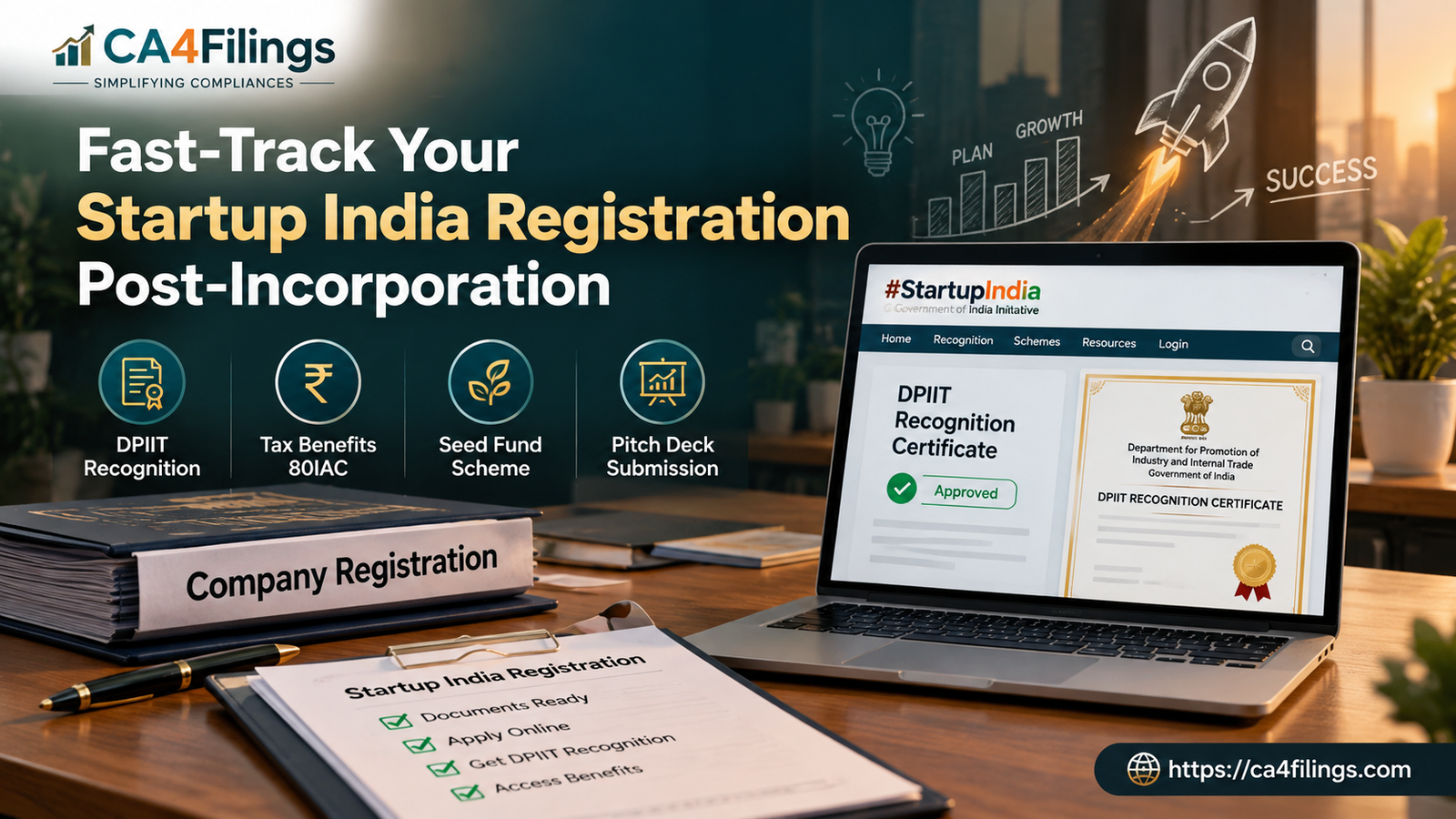
Starting a business is an exciting milestone, but incorporation is only the first step towards building a recognised and growth-ready startup. If you have recently registered your company, completing your startup india registration should be your next priority. It can help you access government-backed funding opportunities, tax benefits, incubation support and other advantages designed for eligible startups in India.
However, many founders delay the process because they are unsure about eligibility criteria, documentation or the application procedure. At CA4Filings, we guide entrepreneurs through these requirements so they can avoid unnecessary delays and focus on growing their businesses. If you are still completing your business formation formalities, our Company Registration services can help you establish the right legal foundation before moving ahead with startup recognition.
The good news is that with proper preparation, accurate documentation and timely submission, you can make your startup india registration process considerably smoother.
What Is Startup India Registration?
Startup India is a Government of India initiative that supports innovation, entrepreneurship and the development of new businesses. For eligible businesses, obtaining recognition from the Department for Promotion of Industry and Internal Trade (DPIIT) is an important step towards accessing the initiative's benefits.
The DPIIT recognition certificate serves as official recognition that a business qualifies as a startup under the applicable framework. It may help eligible businesses access:
Government-supported startup programmes and schemes.
Intellectual property support and applicable fee concessions.
Easier access to certain government procurement opportunities, subject to conditions.
Eligibility to apply for specific tax benefits and funding programmes.
Networking, incubation and mentorship opportunities.
It is important to understand that DPIIT recognition does not automatically guarantee every benefit. Each scheme has its own eligibility conditions and application requirements.
Who Is Eligible for Startup India Registration?
Before applying, check whether your business satisfies the applicable DPIIT eligibility requirements.
Generally, an eligible startup must meet these conditions:
It must be incorporated as a private limited company, registered partnership firm or limited liability partnership (LLP).
It must be within the applicable startup age limit, generally not exceeding 10 years from incorporation or registration.
Its turnover must not have exceeded ₹100 crore in any financial year since incorporation or registration.
It must work towards innovation, development or improvement of products, processes or services, or have a scalable business model with significant potential for employment generation or wealth creation.
It must not have been formed by splitting up or reconstructing an existing business.
Ordinary sole proprietorships do not qualify for DPIIT startup recognition under the standard framework.
Eligibility requirements can change, so review the current official guidelines before submitting your application.
How to Fast-Track Startup India Registration After Incorporation
The most effective way to accelerate the process is to prepare everything before starting the online application. Here is a practical approach recommended by CA4Filings.
Step 1: Keep Your Incorporation Documents Ready
Your legal documents should be complete, accurate and consistent. Missing information or mismatched details can create avoidable delays.
Keep the following documents and information handy, as applicable:
Certificate of Incorporation or registration certificate.
Company PAN and other relevant identification details.
Details of directors, partners or authorised representatives.
Business address and contact information.
A clear description of your products or services.
Website, product demonstration or other evidence of business activity, where available.
For companies, verify that the name, incorporation date and other particulars match the official incorporation records.
Step 2: Prepare a Clear Business Description
One common mistake founders make is describing their business too vaguely.
For example, writing "We provide digital marketing services" may not adequately explain the innovative or scalable nature of the business.
A stronger description could explain how the business uses proprietary technology, automation or a specialised platform to solve a defined customer problem and expand efficiently.
Your application should clearly communicate:
The problem your business addresses.
Your proposed solution and target customers.
What makes your approach different.
How the business can scale.
Its potential for innovation, employment generation or wealth creation.
Avoid exaggerating your achievements. A clear, factual explanation is more useful than unsupported claims.
Step 3: Apply Through the Official Portal
Complete the startup recognition application through the official Startup India or designated government application platform, following the currently applicable process.
Enter the business details carefully and upload the requested documents in the specified format.
Before submitting, check for:
Spelling errors and incorrect incorporation details.
Inconsistent company names or addresses.
Missing mandatory fields.
Unclear or incomplete business descriptions.
Documents that are unreadable or outdated.
A final review can prevent avoidable application queries and resubmissions.
Step 4: Obtain Your DPIIT Recognition Certificate
Once the application is submitted, monitor its status and respond promptly if the authorities request clarification or additional information.
There is no guaranteed approval timeline, so avoid relying on unofficial promises of instant recognition.
After approval, download and securely store your DPIIT recognition certificate. Keep a copy accessible to the founders and the person handling your company's compliance.
Remember that startup india registration is not a substitute for ongoing statutory obligations, such as applicable annual filings, tax returns and corporate compliance.
Step 5: Explore Additional Benefits After Recognition
Receiving DPIIT recognition is an important milestone, but it should not be the end of your compliance planning.
Depending on eligibility, your startup may consider the following opportunities.
Tax exemption under Section 80-IAC
Eligible startups may apply for a tax exemption under Section 80-IAC of the Income-tax Act, 1961, subject to the applicable conditions and approval process. DPIIT recognition alone does not automatically provide this exemption. Check the relevant incorporation date, business structure, profit eligibility and prevailing tax legislation before applying.
Startup India Seed Fund Scheme
The seed fund scheme was designed to support eligible startups at early stages through approved incubators for activities such as proof of concept, prototype development, product trials and market entry. However, scheme availability, application windows and funding conditions must be verified before planning around it.
Intellectual property support
Eligible startups may benefit from applicable intellectual property facilitation mechanisms and fee concessions. These can be particularly useful for businesses developing original technology, designs or other protectable assets.
How to Prepare for Funding and Pitch Deck Submission
Founders who intend to raise capital should prepare their funding materials while completing startup india registration rather than waiting until an investor opportunity appears.
A professional pitch deck submission should communicate your business opportunity clearly and concisely.
Include the following elements:
Problem and solution: Explain the customer pain point and your approach.
Market opportunity: Present realistic market estimates and your target segment.
Business model: Show how the startup generates revenue.
Traction: Include genuine customer numbers, revenue figures, pilot results or partnerships, where available.
Competitive advantage: Explain why customers would choose your offering.
Financial projections: Use reasonable assumptions supported by available data.
Funding requirement: State the amount sought and its intended use.
Keep your incorporation documents, financial statements, ownership details and compliance records organised. Investors and incubators may conduct due diligence before making a decision.
Also, remember that DPIIT recognition does not guarantee funding. Each investor, incubator or government programme applies its own selection criteria.
Common Mistakes That Delay Startup India Registration
Even eligible businesses can experience delays because of avoidable errors.
Watch out for these mistakes:
Applying before confirming the correct legal entity type.
Providing a generic description that does not explain the business model.
Uploading incomplete or illegible documents.
Assuming that DPIIT recognition automatically grants tax exemptions.
Ignoring emails requesting clarification or additional documents.
Depending on agents who promise guaranteed approval.
Overlooking post-incorporation compliance requirements.
At CA4Filings, we recommend creating a document checklist, reviewing eligibility in advance and keeping all application information consistent with official records.
Latest Updates
ca4filings.com Services