How Do You Register a Company in Nevada? Fact vs. Fiction on Tax Benefits
Learn how do you register a company in Nevada, understand tax benefits, registration steps, compliance costs, and common myths before investing.
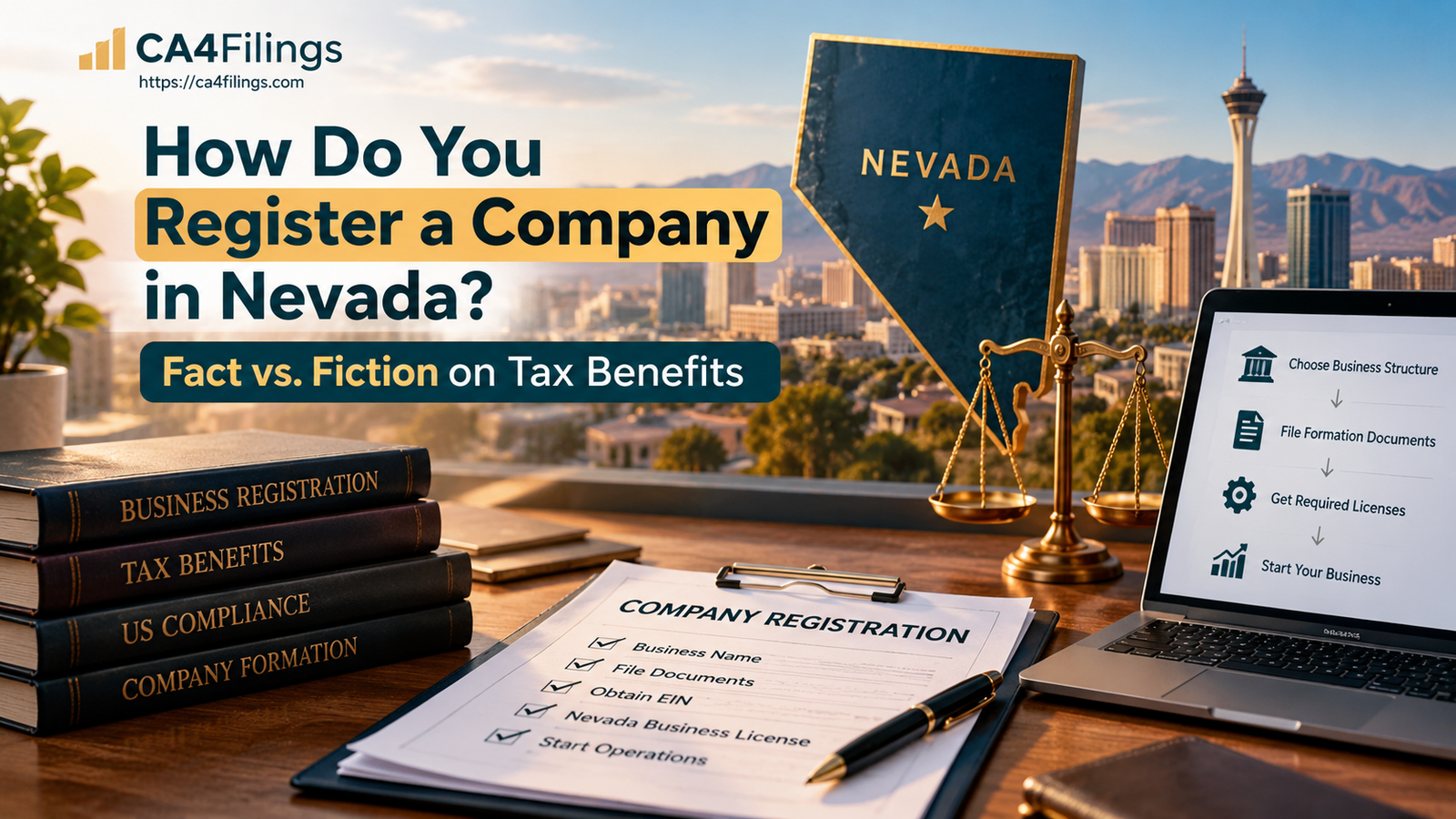
Nevada is often promoted as a business-friendly state in the United States, particularly for entrepreneurs attracted by its favourable tax structure, corporate privacy, and flexible business laws. However, before making a decision, it is important to separate facts from marketing claims. If you are wondering how do you register a company in Nevada, understanding the legal process and the actual tax benefits is just as important as choosing the right business structure.
At CA4Filings, we believe that business registration decisions should be based on practical considerations rather than attractive promises. Whether you are an Indian entrepreneur exploring the US market or an international business owner planning expansion, our Company Registration services can help you understand registration requirements and make informed decisions about your business structure.
How Do You Register a Company in Nevada? Understanding the Basics
Registering a company in Nevada generally involves selecting a business structure, appointing a registered agent, filing the required documents, and completing applicable licensing and compliance formalities.
Most entrepreneurs consider two common structures:
Limited Liability Company (LLC): Suitable for many small businesses, consultants, startups, and independent professionals.
Corporation: Often preferred by businesses seeking a conventional corporate structure, outside investment, or a formal shareholding arrangement.
The right choice depends on your ownership structure, funding plans, operational requirements, and tax position. Indian founders should also consider Indian foreign investment, overseas remittance, and tax reporting requirements before establishing a US entity.
How Do You Register a Company in Nevada? Step-by-Step Process
Understanding the registration process helps you plan the paperwork, costs, and compliance obligations before committing funds.
Step 1: Choose Your Business Name
Select a unique business name that complies with Nevada's naming requirements. Check availability through the Nevada Secretary of State's business search facility before filing your application.
Depending on your business structure, certain words may be restricted or require additional documentation.
Step 2: Select a Registered Agent
Nevada generally requires an entity such as an LLC or corporation to maintain a registered agent with a physical street address in the state.
The registered agent receives official correspondence, legal notices, and service-of-process documents on behalf of the company. A virtual mailing address alone may not satisfy this requirement.
Step 3: File the Formation Documents
For an LLC, you generally file Articles of Organization. For a corporation, you file Articles of Incorporation.
The filing requirements vary according to the structure selected. Ensure the information concerning the company's name, registered agent, management, and authorised shares, where applicable, is accurate.
Step 4: Obtain an EIN
An Employer Identification Number (EIN) is issued by the Internal Revenue Service (IRS). It is commonly required for federal tax administration, hiring employees, and opening certain business bank accounts.
Foreign-owned businesses may need to follow a different application process if the responsible party does not have a US taxpayer identification number.
Step 5: Obtain the Required Licences
Many businesses must obtain a state business licence, subject to the applicable exemptions and rules. A nevada business license is not necessarily sufficient for every activity, as local governments and regulated industries may impose additional requirements.
For example, a consulting business and a restaurant may face very different licensing obligations.
Step 6: Complete Ongoing Compliance
After formation, maintain the company's records and meet applicable annual filing, licensing, and tax obligations.
Nevada entities commonly have annual list and state business licence renewal requirements. Confirm the relevant deadlines and fees with the state before filing.
Nevada Tax Benefits: Fact vs. Fiction
Nevada's tax environment is attractive, but its benefits should not be confused with a complete exemption from taxation.
Fact: Nevada Has No General State Corporate Income Tax
Nevada does not impose a general state corporate income tax. It also has no individual state income tax.
This can be beneficial for eligible businesses and individuals who genuinely establish the relevant tax connections in Nevada. However, federal tax obligations remain applicable, and another state may impose tax if the company operates or has sufficient taxable connections there.
Fiction: Registering in Nevada Means Paying No Taxes
This is one of the most common misconceptions.
A company may still face:
US federal income tax, depending on its classification and circumstances.
Payroll taxes and employment-related obligations.
Sales and use taxes where applicable.
Nevada's Commerce Tax if its Nevada gross revenue exceeds the applicable statutory threshold.
Modified Business Tax obligations for employers, subject to applicable rules.
Taxes and registration requirements in other states where it operates.
For instance, suppose an online business registers an LLC in Nevada but employs staff and maintains its main office in California. The Nevada registration alone does not automatically remove its potential California tax and compliance obligations.
The actual tax outcome depends on the company's activities, ownership, classification, and applicable law.
Fact: Nevada Has a Business-Friendly State Tax Climate
Nevada's state tax climate can be attractive because it lacks a general corporate income tax and individual income tax. Its business environment may also appeal to entrepreneurs seeking flexible entity management.
However, businesses should evaluate the total cost of compliance, including formation fees, annual renewals, registered-agent charges, professional advice, and taxes in the states where they actually conduct business.
Fiction: Nevada Automatically Provides Better Protection Than Every Other State
Nevada is known for liability protections and business-friendly legislation, but protection is not absolute.
The phrase piercing the veil protections is often used when discussing corporate liability. In practice, courts may disregard a company's separate legal identity in certain circumstances, depending on the facts and applicable law.
Owners should maintain separate business accounts, document important decisions, comply with filing requirements, and avoid mixing personal and company funds. Good corporate governance is more valuable than relying on a state's reputation alone.
Nevada vs Delaware: Which State Is Better for Your Business?
The choice between Nevada and Delaware depends on your business objectives rather than a universal ranking.
| Factor | Nevada | Delaware |
|---|---|---|
| State income taxes | No general corporate or individual income tax | Corporate income tax may apply; no state individual income tax |
| Business law | Business-friendly legal framework | Well-established corporate law and specialised Court of Chancery |
| Investor familiarity | Suitable for many privately held businesses | Common choice for venture-backed startups |
| Compliance costs | State filing and renewal costs apply | State filing and franchise tax obligations apply |
| Best fit | Certain privately held businesses and entrepreneurs | Many companies seeking institutional investment |
In a nevada vs delaware comparison, consider where your company will operate, whether you plan to raise venture capital, and which state's legal framework best supports your objectives.
A startup planning to raise institutional investment may prefer Delaware because investors are familiar with its corporate structure. A closely held business may find Nevada suitable, but the decision should follow a cost and compliance assessment.
Does Nevada Offer Corporate Privacy?
Nevada is often associated with corporate privacy, but privacy should not be confused with anonymity or exemption from reporting obligations.
Certain public filings may disclose less ownership information than entrepreneurs expect, depending on the entity and filing requirements. Nevertheless, banks, tax authorities, and other authorised parties may require beneficial ownership and identity information.
Federal beneficial ownership reporting requirements have also changed over time. Businesses should verify the current rules rather than rely on outdated claims about anonymity.
For Indian founders, cross-border reporting, tax residency, foreign investment rules, and disclosure requirements must be evaluated separately.
Common Mistakes to Avoid When Registering a Nevada Company
Before deciding how do you register a company in Nevada, avoid these frequent mistakes:
Choosing Nevada solely because of claims about zero taxes.
Ignoring tax obligations in the state where the business actually operates.
Assuming a registered agent replaces a business licence.
Mixing personal and company finances.
Missing annual filing and licence renewal deadlines.
Overlooking Indian tax and foreign exchange compliance when the owners are Indian residents.
Assuming corporate privacy means complete anonymity.
Professional advice before registration can help prevent costly restructuring and compliance issues later.
Latest Updates
ca4filings.com Services