How Do You Register a Company in Delaware? Pros, Cons, and Realities
Learn how do you register a company in Delaware, including steps, costs, tax rules, pros, cons, and practical advice for Indian founders.
How Do You Register a Company in Delaware? Understanding the Basics
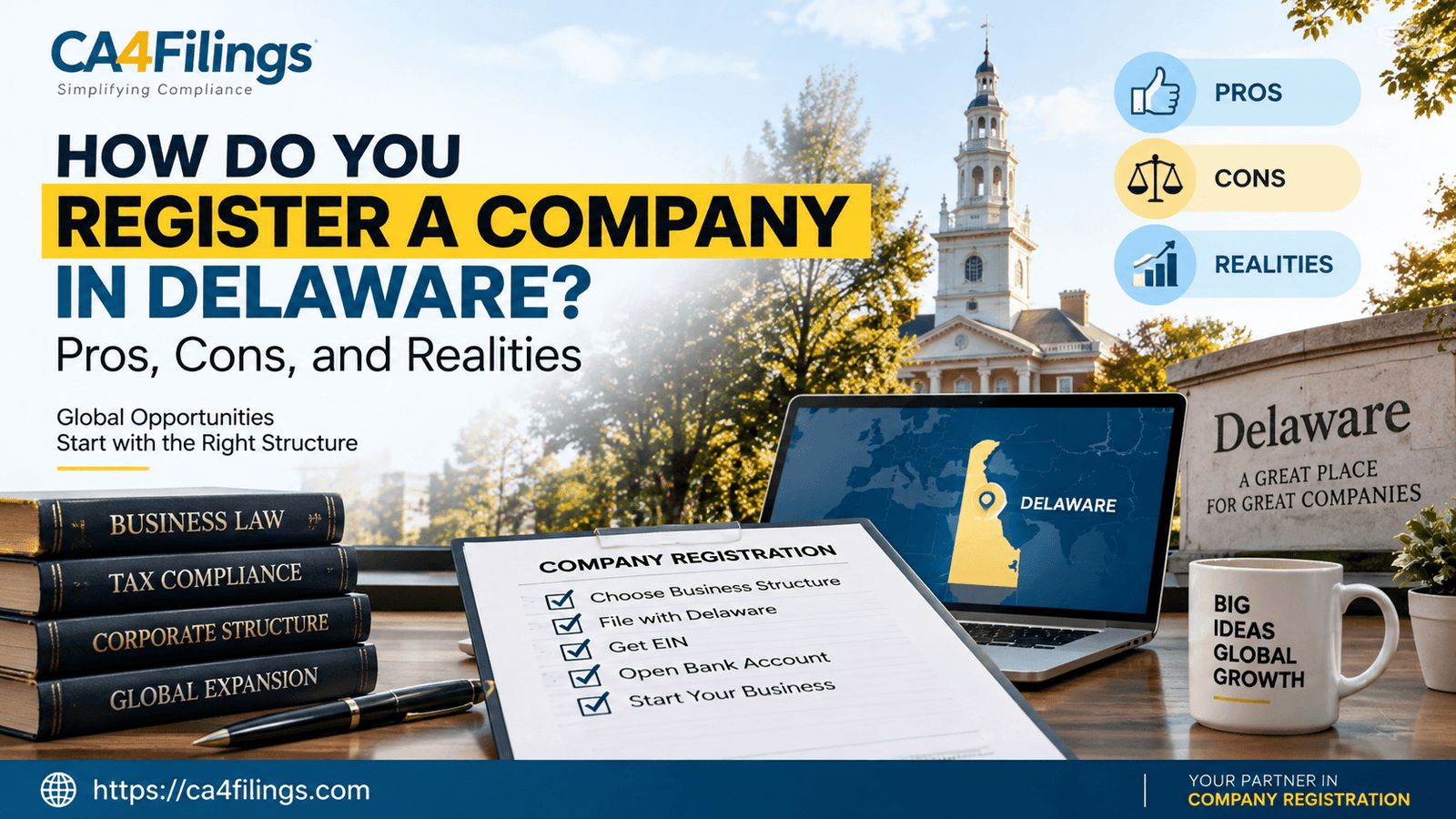
If you are wondering how do you register a company in Delaware, you are not alone. Delaware has become a popular choice for startups, technology businesses, investors, and international founders because of its business-friendly legal framework. However, registering a Delaware company is only the first step. Understanding taxes, banking, compliance, and your obligations outside Delaware is equally important.
For Indian entrepreneurs considering a US business structure, the process can look very different from Indian incorporation. If you are also exploring an Indian entity, professional assistance with Company Registration can help you choose a structure that fits your business and compliance requirements.
At CA4Filings, we often see entrepreneurs focus on the ease of incorporation while overlooking the ongoing obligations. So, let's understand how do you register a company in Delaware and what the process really involves.
How Do You Register a Company in Delaware?
The Delaware incorporation process is relatively straightforward, but there are several decisions to make before filing.
1. Choose the Business Structure
Most startups and businesses choose either a Delaware LLC or a Delaware corporation.
A corporation, particularly a C Corporation, is commonly preferred by businesses planning to raise venture capital or issue shares to investors. An LLC may be more suitable for certain small businesses because of its flexible management and tax treatment.
The right choice depends on your ownership structure, investors, taxation, and long-term plans.
2. Select and Reserve Your Company Name
Your proposed business name must comply with Delaware's naming requirements and should be distinguishable from existing entities.
Before proceeding, check the availability of the name. It is also sensible to check whether the corresponding domain name and trademarks are available.
3. Appoint a Registered Agent
A Delaware company generally needs a registered agent with a physical address in Delaware.
The registered agent receives official correspondence, legal notices, and certain government documents on behalf of the company.
For a founder living outside the US, using a professional registered-agent service is often the practical solution.
4. File the Formation Documents
For a corporation, the key document is generally the Certificate of Incorporation. For an LLC, it is the Certificate of Formation.
Once the relevant document is filed and accepted by Delaware, the legal entity comes into existence.
This answers the basic question of how do you register a company at the state level: choose the entity, appoint a registered agent, prepare the formation documents, and file them with Delaware.
5. Obtain an EIN
After formation, the company may need an Employer Identification Number (EIN) from the US Internal Revenue Service.
An EIN is commonly required for banking, tax filings, hiring employees, and various business transactions.
For non-US founders, obtaining an EIN can involve additional documentation and procedures, particularly where the responsible party does not have a US Social Security Number.
How Do You Register a Company and Handle Compliance?
Incorporation does not mean your compliance responsibilities are finished.
Delaware Franchise Tax
One important ongoing obligation is the Delaware franchise tax.
Delaware corporations are generally required to pay franchise tax and file an annual report. LLCs and certain other entities have different annual tax obligations.
The amount can depend on factors such as the company's structure and, for corporations, the method used to calculate the tax.
This is an area where founders sometimes get caught off guard. A company may have no revenue and still have Delaware compliance or tax obligations.
Federal Tax and Information Reporting
Depending on the business structure, ownership, activities, and transactions, federal tax filings may also be required.
International founders should pay particular attention to US tax reporting because the absence of US customers or physical operations does not automatically mean there are no filing obligations.
For an Indian resident owning a US company, US compliance should also be considered alongside Indian tax and foreign-asset reporting requirements.
How Do You Register a Company When You Actually Operate Elsewhere?
This is one of the biggest realities entrepreneurs should understand.
Suppose you form a Delaware company but operate your business from California, Texas, New York, or another state. Delaware incorporation does not necessarily eliminate your obligations in the state where your business actually operates.
Out-of-State Business Registration
If your Delaware company conducts sufficient business activities in another state, it may need out-of-state business registration, commonly known as foreign qualification.
For example, imagine an entrepreneur incorporates a Delaware corporation but maintains an office and employees in California. The business may have additional California registration, tax, and compliance obligations.
Therefore, Delaware should not be viewed as a shortcut for avoiding the laws of the state where the business actually operates.
Foreign Corporation Filing
A Delaware corporation conducting business in another US state may have to complete a foreign corporation filing in that state.
The word "foreign" in this context does not necessarily mean an overseas company. In US state law, a corporation formed in one state is generally considered a foreign corporation when it registers to conduct business in another state.
Corporate Advantages of Delaware
Why do so many businesses choose Delaware?
Some important corporate advantages include:
- A well-developed body of corporate law.
- The specialized Delaware Chancery Court for many corporate disputes.
- Familiarity among venture capital firms and institutional investors.
- Flexible corporate structures.
- Established procedures for corporate governance and shareholder matters.
- A long history of corporate jurisprudence.
The Role of the Chancery Court
The Chancery Court is one of Delaware's best-known legal institutions. It focuses on equitable and corporate matters and has developed extensive case law involving businesses, directors, shareholders, mergers, and corporate governance.
For companies expecting sophisticated investors or complex corporate transactions, this established legal framework can be an important consideration.
Cons and Realities of Registering in Delaware
Delaware is not automatically the best option for every entrepreneur.
Higher Ongoing Costs
You may have registered-agent fees, Delaware taxes, accounting expenses, federal compliance costs, and potentially additional state-level taxes.
A company that has been incorporated but is not actively operating can still have compliance expenses.
More Compliance for International Founders
For Indian founders, the structure can become more complicated because you may have both US and Indian reporting considerations.
You should evaluate:
- US federal tax obligations
- Delaware annual requirements
- Indian foreign investment and tax implications
- Cross-border transactions
- Banking and payment arrangements
- Transfer pricing, where applicable
- Ownership and beneficial-owner reporting requirements
The exact obligations depend on your circumstances, so professional advice before incorporation can prevent expensive corrections later.
A Practical Example for an Indian Founder
Consider an Indian software entrepreneur who wants to raise money from US investors.
They may establish a Delaware C Corporation because the structure is familiar to many US investors. After incorporation, the founder may obtain an EIN, establish a suitable business banking arrangement, issue shares, and maintain corporate records.
However, if the founder continues managing the company from India, the analysis does not end with Delaware incorporation. Indian tax, foreign investment, and reporting considerations may still arise.
This is why the question how do you register a company should really be followed by another question: Where will the company actually operate, who will own it, and where will its income and management activities arise?
FAQs About How Do You Register a Company in Delaware?
Is Delaware suitable for every business?
No. Delaware can be attractive for startups, corporations, and businesses expecting outside investment, but a local business operating entirely in another state may have little practical benefit from incorporating there.
How long does Delaware company registration take?
The filing process can be relatively quick, although the overall timeline depends on filing method, processing options, EIN requirements, banking, and other post-incorporation steps.
Does a Delaware company have to pay franchise tax?
Generally, Delaware entities have ongoing state tax or annual compliance obligations. The specific amount and filing requirements depend on the entity type.
Can an Indian resident register a Delaware company?
Yes, non-US residents can establish US businesses, subject to applicable US requirements. However, Indian founders should separately evaluate Indian tax and regulatory implications before proceeding.
Do I need a registered agent in Delaware?
A Delaware entity generally needs a registered agent with a Delaware address to receive official notices and legal documents.
How Do You Register a Company the Right Way?
Understanding how do you register a company in Delaware is only the beginning. The real decision involves choosing the correct entity, understanding Delaware franchise tax, maintaining annual compliance, considering out-of-state registration, and evaluating US and Indian tax implications.
Delaware offers established corporate advantages, including its sophisticated corporate legal framework and Chancery Court. But incorporation should be based on your actual business requirements rather than simply following what other startups are doing.
CA4Filings can help you evaluate the structure, incorporation process, and compliance considerations before you commit to a cross-border business setup. Get in touch with CA4Filings today and take your company formation decision with greater clarity and proper professional guidance.
Latest Updates
ca4filings.com Services

























-registration.png)