Low-Cost Startups: Minimizing Your Company Registration Charges Legally
Understand company registration charges in India and learn legal ways startups can reduce costs through smart planning, subsidies and compliance.
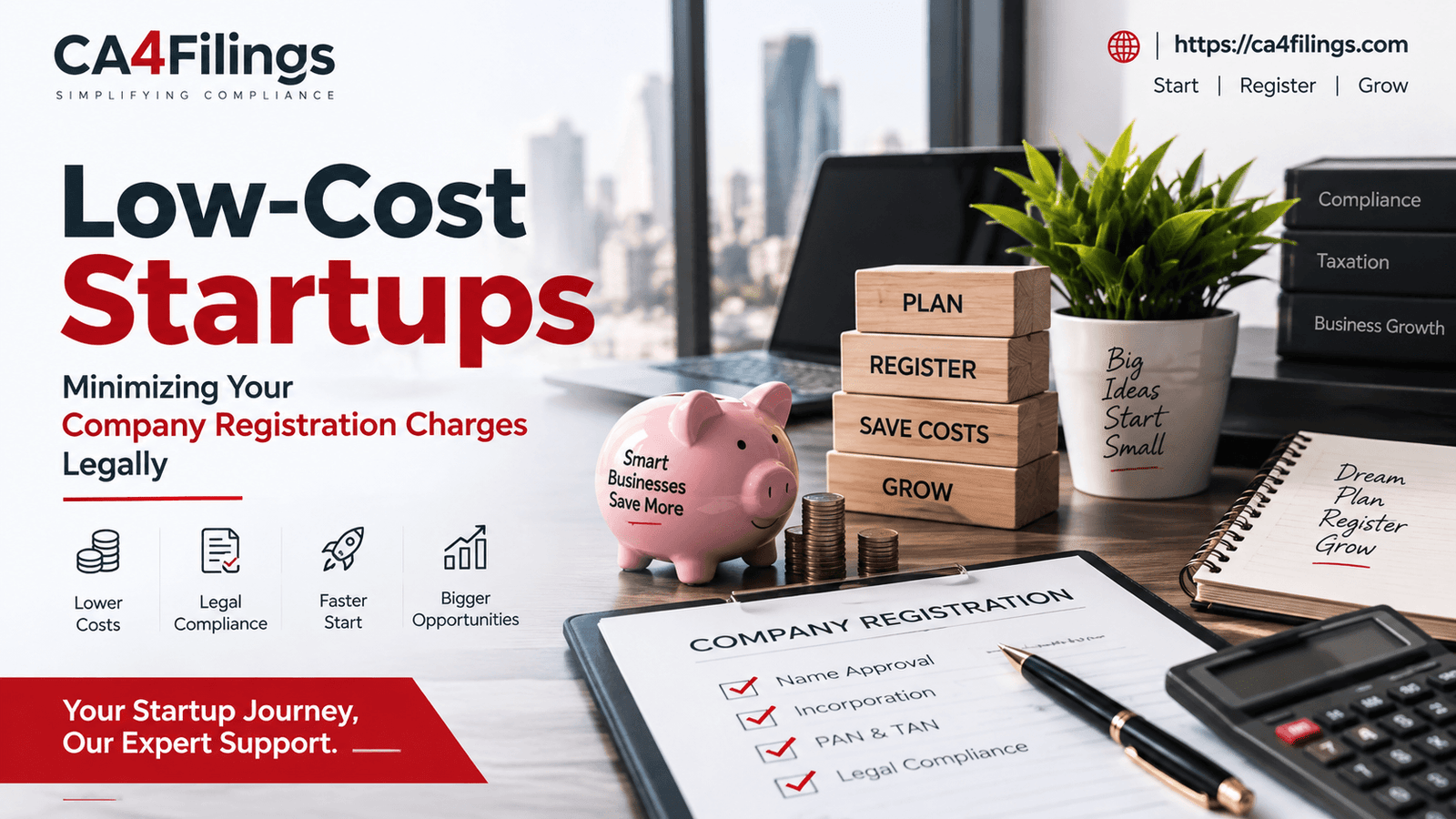
Starting a business in India does not always require a large budget. With the right planning, founders can control their initial expenses, including company registration charges, without compromising legal compliance. For many first-time entrepreneurs, understanding what they actually need to pay for—and what they can avoid paying for—is the first step towards building a financially disciplined business.
If you are planning to incorporate a company, understanding the complete Company Registration process can help you estimate expenses accurately and avoid unnecessary professional or government costs. At CA4Filings, we often advise startups to separate essential incorporation expenses from optional services before spending money.
What Are Company Registration Charges in India?
Company registration charges are not a single fixed amount. The total cost of incorporating a business depends on factors such as the type of company, authorised capital, state of incorporation, number of directors, professional assistance and applicable government fees.
For a typical private limited company, the overall expense may include:
- Government filing and incorporation fees
- Stamp duty applicable in the state
- Digital Signature Certificates (DSCs)
- Director Identification Number (DIN), where applicable
- Professional or consultancy fees
- PAN and TAN-related incorporation formalities
- Additional documentation or compliance services
The important point is that some expenses are statutory, while others depend on the service provider you choose. Therefore, comparing the components of company registration charges is more useful than simply comparing two package prices.
How Can Startups Reduce Company Registration Charges Legally?
Reducing company registration charges does not mean avoiding government requirements. It means eliminating unnecessary expenses and choosing the most suitable structure for your business.
1. Choose the Right Business Structure
Before incorporation, decide whether a private limited company, LLP, OPC or another structure actually suits your business.
For example, two founders planning to raise external investment may consider a private limited company, while a small professional venture with simpler operational requirements may explore an LLP.
Choosing the wrong structure can increase long-term compliance costs, even if the initial company registration charges appear low.
2. Understand Government Fees Separately
Ask your consultant for a clear breakup of company registration charges.
A transparent quotation should ideally distinguish between:
- Government fees
- Stamp duty
- DSC charges
- Professional fees
- Optional services
- Post-incorporation compliance packages
This helps you identify whether you are paying for something legally required or simply an add-on.
3. Avoid Unnecessary Add-On Services
Some startup packages combine incorporation with services that may not be immediately required.
For instance, a new founder may be offered bookkeeping, trademark filing, payroll services, annual compliance packages and multiple certificates along with incorporation.
These services can certainly be useful, but they should not automatically be treated as part of your mandatory company registration charges.
Buy only what your business actually needs at the incorporation stage.
Can DIY Filing Reduce Company Registration Charges?
Technology has made several incorporation procedures easier, but founders should understand the compliance implications before attempting them independently.
The idea behind diy legal filling steps—more accurately, DIY legal filing steps—is to complete eligible documentation yourself instead of paying for every administrative activity.
Basic DIY Approach
A founder can generally begin by:
- Selecting the appropriate business structure.
- Checking and reserving an appropriate company name.
- Arranging the required digital signatures.
- Preparing identity and address documents.
- Collecting registered-office proof.
- Completing the applicable incorporation forms.
- Reviewing declarations and attachments carefully.
- Submitting the application through the prescribed government portal.
- Responding to any clarification or resubmission request.
- Downloading and safely storing incorporation documents.
However, DIY filing is not always the cheapest option. A small documentation mistake can lead to delays, resubmissions or additional professional assistance later.
Therefore, compare the potential saving against the time and compliance risk before deciding.
Use Startup Benefits and Government Startup Subsidy Programs
Founders should also research government startup subsidy programs and incentives available to eligible businesses. Central and state governments periodically introduce schemes aimed at encouraging entrepreneurship, innovation, employment and investment.
Eligibility varies significantly. Some schemes may depend on factors such as:
- Business activity
- Location
- Founder category
- Investment level
- Employment generation
- Innovation or technology involvement
- Startup recognition
These schemes should not be confused with automatic reductions in company registration charges. A subsidy or incentive may reduce certain business costs after eligibility is established, but it does not necessarily mean that incorporation itself will be free.
Always verify the current eligibility rules from official government sources before relying on a scheme.
Are Zero Fee Registration Schemes Really Free?
Searches for zero fee registration schemes can be tempting for a new entrepreneur, particularly when cash flow is tight. But “zero fee” does not always mean “zero cost”.
A scheme may waive a particular government fee while other expenses, such as stamp duty, DSCs, documentation or professional assistance, may still apply.
Before choosing such an offer, ask:
- Which exact fee is waived?
- Is the waiver currently applicable?
- What eligibility conditions apply?
- Are professional charges separate?
- Are stamp duty and other statutory costs included?
- Is the offer applicable to your type of business?
This simple verification can prevent unpleasant surprises in your final company registration charges.
Budget Corporate Generation: Plan More Than Incorporation
A low-cost startup strategy should not stop at incorporation. Entrepreneurs should think about budget corporate generation as a broader approach to building the company economically.
Keep Your Initial Corporate Budget Practical
During the first few months, prioritise expenses that directly support operations and compliance.
For example, a founder might prioritise:
- Legal incorporation
- Business banking
- Accounting setup
- Basic website and domain
- Essential licences
- Customer acquisition
- Tax compliance
Expensive office space, unnecessary software subscriptions and premium branding can often wait until revenue becomes more predictable.
This approach ensures that the money saved on company registration charges is actually redirected towards productive business activities.
Common Mistakes That Increase Company Registration Charges
Trying to save money can sometimes have the opposite effect. We regularly see founders make avoidable mistakes such as:
- Selecting a structure without considering future funding.
- Providing inconsistent identity or address documents.
- Choosing a company name without adequate checking.
- Delaying responses to government queries.
- Selecting an extremely cheap package without checking inclusions.
- Assuming every advertised “free” service is completely free.
- Ignoring post-incorporation compliance.
The cheapest quotation is not necessarily the lowest-cost solution. The better approach is to calculate the complete cost of incorporation and early compliance.
A Practical Example
Suppose two friends want to start a digital marketing business.
Founder A selects the first low-price package available without checking what it includes. Later, they discover that DSCs, stamp duty and certain professional services were excluded.
Founder B requests a complete breakup before making payment. They compare statutory expenses, professional fees and optional services and choose only what is necessary.
Both founders may start with similar budgets, but Founder B has better visibility over their actual company registration charges.
This is why transparency matters more than simply choosing the lowest advertised price.
How CA4Filings Helps Startups Control Company Registration Charges
At CA4Filings, our approach is to make incorporation costs easier to understand. Instead of looking only at a headline package price, founders should know what they are paying for and which expenses are statutory.
A sensible registration plan should provide:
- Clear cost communication
- Appropriate business-structure guidance
- Documentation support
- Incorporation assistance
- Government filing support
- Guidance on immediate compliance requirements
The objective is not merely to make company registration charges look low. It is to help entrepreneurs avoid unnecessary expenses while completing incorporation correctly.
FAQs About Company Registration Charges
1. Are company registration charges the same for every business?
No. Costs can vary depending on the company structure, authorised capital, state stamp duty, documentation and professional services selected.
2. Can I register a company without paying professional fees?
In some cases, founders may complete portions of the process themselves. However, government charges and applicable statutory expenses may still arise. Professional assistance can also reduce documentation errors.
3. Are zero fee registration schemes completely free?
Not necessarily. A particular government fee may be waived, while stamp duty, DSCs or other expenses may still apply. Always check the detailed terms.
4. Can startups get government subsidies for incorporation?
Certain government startup subsidy programs and incentives may support eligible businesses, but eligibility and benefits vary. They should be verified before making financial assumptions.
5. How can I reduce my company registration charges?
Choose the appropriate structure, understand statutory costs, compare transparent quotations, avoid unnecessary add-ons and prepare documentation carefully.
Keep Company Registration Charges Under Control
A low-cost startup does not mean cutting corners. It means making informed financial decisions from day one. By understanding company registration charges, separating mandatory expenses from optional services, researching eligible incentives and avoiding unnecessary add-ons, entrepreneurs can establish their businesses with better control over their initial budget.
At CA4Filings, we believe founders should know exactly what they are paying for before starting the incorporation process. If you are planning to launch your business, speak with CA4Filings for practical guidance on registration, documentation and compliance—so you can focus more of your budget on building the business itself.
Latest Updates
ca4filings.com Services


























-registration.png)