Company Registration Charges for Private Limited vs. Limited Liability Entities
Understand company registration charges for Private Limited and LLP entities, including government fees, capital costs, compliance and expert tips.
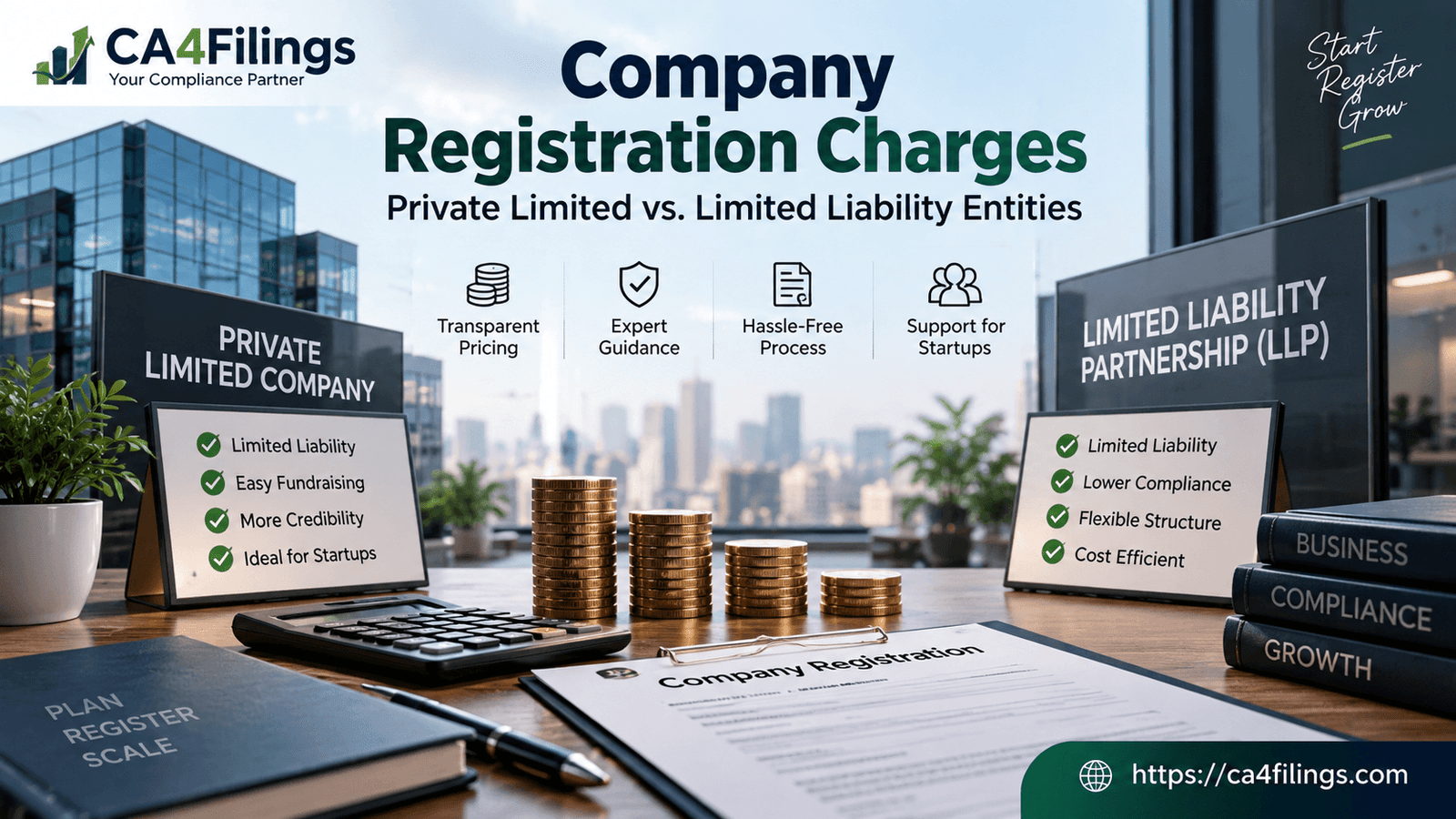
When starting a business in India, choosing the right legal structure is just as important as having a good business idea. One of the first questions entrepreneurs usually ask is about company registration charges and how much they need to spend before the business can officially begin operations. The answer depends on the entity you choose, the authorised capital, the state of registration, professional fees and the complexity of the incorporation process. If you are planning to incorporate a business, understanding the Company Registration process beforehand can help you budget properly and avoid unexpected expenses.
For most entrepreneurs, the comparison generally comes down to a Private Limited Company versus other limited liability entities, such as an LLP. While both offer liability protection, their incorporation costs, compliance requirements and long-term expenses can be quite different. At CA4Filings, we recommend looking beyond the initial company registration charges and considering the complete cost of running the entity.
What Are Company Registration Charges in India?
Company registration charges are not simply the government fee paid to register an entity. The overall incorporation expense can include several components, such as:
- Government and statutory filing fees
- Stamp duty applicable in the state
- Digital Signature Certificates (DSCs)
- Director Identification Number (DIN), where applicable
- Professional or consultant fees
- Name reservation and incorporation-related charges
- PAN and TAN-related formalities
- Additional documentation or certification costs, if required
Therefore, two businesses with similar structures may have different company registration charges depending on their location, capital structure and professional requirements.
This is also why entrepreneurs should not compare quotations based only on the headline price. A cheaper package may exclude important services, while a slightly higher initial cost may include documentation, filing assistance and post-incorporation support.
Private Limited Company Registration Charges
A Private Limited Company is one of the most commonly selected structures for startups, growing businesses and companies planning to raise external investment.
The company registration charges for a Private Limited Company depend on factors such as authorised share capital and the state where the registered office is situated.
Typical Components of Private Limited Company Costs
The main expenses generally include:
- Digital Signature Certificates: Directors and subscribers generally require DSCs for electronic filing.
- Government filing fees: MCA-related incorporation filings may attract statutory fees depending on the circumstances.
- Stamp duty: This varies from state to state and can affect the total incorporation cost.
- Professional fees: CA, CS or other professional assistance may be charged for preparing documents and completing the incorporation process.
- Additional documentation: Special cases involving foreign shareholders, corporate shareholders or complex ownership structures may require additional work.
For a startup founder, the important point is that company registration charges are only the entry cost. Once incorporated, the company must also maintain statutory records, conduct board meetings, prepare financial statements and complete annual filings.
LLP Registration Charges: A Limited Liability Alternative
A Limited Liability Partnership (LLP) combines features of a partnership with limited liability protection. It can be suitable for professional firms, service businesses, consulting practices and ventures where external equity funding is not the immediate priority.
The company registration charges comparison becomes interesting here because LLP incorporation may have a different fee structure based on contribution and applicable government charges.
Why LLP Costs Can Differ
LLP expenses can include:
- Digital Signature Certificates
- Government incorporation fees
- Stamp duty
- Professional fees
- LLP agreement preparation and filing
- Contribution-related statutory charges
The LLP agreement is particularly important because it establishes the rights, responsibilities and profit-sharing arrangements between partners.
From a startup price evaluation perspective, an LLP may appear more economical initially in certain situations. However, the right choice should depend on business objectives rather than registration cost alone.
Private Limited vs LLP: Comparing the Costs
When evaluating company registration charges, entrepreneurs should separate incorporation expenses from recurring compliance expenses.
| Cost Factor | Private Limited Company | LLP |
|---|---|---|
| Initial incorporation | Depends on capital and state | Depends on contribution and state |
| Ownership | Shareholders | Partners |
| Liability protection | Yes | Yes |
| Annual compliance | Generally higher | Generally lower |
| Audit requirements | Governed by applicable company rules | Depends on turnover/contribution thresholds |
| Fundraising through equity | Suitable | Less suitable |
| Ownership transfer | Relatively structured | Governed by LLP agreement |
| Investor preference | Common for startups seeking equity funding | Usually less preferred for venture funding |
These are useful corporate capital tier tables for understanding broad cost differences, but actual statutory fees should always be checked for the specific incorporation structure.
Entry Costs vs Maintenance Fees
One of the biggest mistakes entrepreneurs make is focusing exclusively on registration expenses.
The real financial picture becomes clearer when you compare entry costs vs maintenance fees.
Initial Entry Costs
These are expenses incurred while setting up the entity, including:
- Government filing charges
- Stamp duty
- DSCs
- Professional fees
- Incorporation documentation
Recurring Maintenance Costs
After incorporation, you may have expenses relating to:
- Annual MCA filings
- Income-tax return filing
- Accounting and bookkeeping
- GST compliance, where applicable
- Statutory audit, if applicable
- Payroll and TDS compliance
- Board and corporate secretarial requirements
For this reason, the lowest company registration charges do not necessarily mean the lowest overall business cost.
How Capital Can Affect Registration Costs
Authorised capital can influence certain statutory fees and should be considered while planning incorporation. Entrepreneurs sometimes choose unnecessarily high authorised capital at the beginning, while others keep it too low and later incur costs when increasing it.
A practical approach is to estimate your expected funding requirement and ownership structure before deciding the initial capital.
For example, suppose two founders start a technology company with an expected initial investment of ₹10 lakh. They may not need to structure their authorised capital around a much larger hypothetical funding requirement immediately. Their CA or professional advisor can help them choose an appropriate structure based on their business plan.
This approach makes company registration charges easier to estimate and prevents unnecessary upfront spending.
Which Structure Should You Choose?
There is no universal answer. Your choice should depend on how you plan to operate and grow the business.
Choose a Private Limited Company When:
- You expect to raise equity investment.
- You want a clear shareholder structure.
- You plan to build a scalable startup.
- You expect ownership changes or new investors.
- A formal corporate structure suits your business.
Consider an LLP When:
- The business is partner-driven.
- You are operating a professional or consulting practice.
- External equity investment is not a major priority.
- You want comparatively simpler ongoing compliance.
- The partners want flexibility in defining their commercial arrangement.
These comparative corporate setups should be evaluated based on both immediate and future requirements, rather than registration price alone.
How to Reduce Unnecessary Registration Expenses
You can manage company registration charges effectively by preparing before starting the incorporation process.
Follow these steps:
- Decide the appropriate legal structure.
- Finalise the proposed business name.
- Determine the ownership and capital structure.
- Keep PAN, address and identity documents ready.
- Obtain the required DSCs.
- Prepare the incorporation documents carefully.
- Check applicable state stamp duty and statutory fees.
- Understand the annual compliance obligations before registering.
Proper preparation reduces delays, corrections and avoidable professional costs.
Frequently Asked Questions
Are company registration charges the same in every Indian state?
No. Stamp duty and certain government charges can vary depending on the state and other incorporation details. Professional fees may also differ.
Is an LLP cheaper than a Private Limited Company?
In some situations, LLP incorporation and ongoing compliance may be lower. However, the actual cost depends on contribution, state charges, professional fees and applicable compliance requirements.
Does authorised capital increase registration expenses?
It can affect applicable government or statutory fees. The exact impact depends on the incorporation details and applicable rules.
Are annual compliance costs included in company registration charges?
Usually, no. Incorporation is a one-time setup process, while accounting, tax and statutory compliance can create recurring expenses.
Should startups choose a Private Limited Company only because of investors?
Not necessarily. Funding plans are one consideration among several. Founders should also consider ownership, compliance, taxation, operational requirements and long-term business plans.
Final Thoughts on Company Registration Charges
Understanding company registration charges is important, but entrepreneurs should not make a business-structure decision based solely on the initial quotation. A Private Limited Company may involve greater compliance responsibilities, while an LLP can offer a different balance of flexibility and ongoing obligations.
At CA4Filings, our approach is to help business owners understand both the immediate incorporation expense and the long-term compliance implications. Whether you are launching a startup, professional practice or growing business, a proper comparison of structure, capital, compliance and costs can help you start on a sound footing.
If you are planning incorporation, connect with CA4Filings for professional guidance on the documentation, registration process, applicable company registration charges and compliance requirements for your proposed business structure
Latest Updates
ca4filings.com Services

























-registration.png)