Bootstrap vs. Funded: Tailoring Your Startup Registration Strategy
Startup registration strategy for bootstrapped and funded businesses, covering equity, debt, structure, compliance and practical advice from CA4Filings.
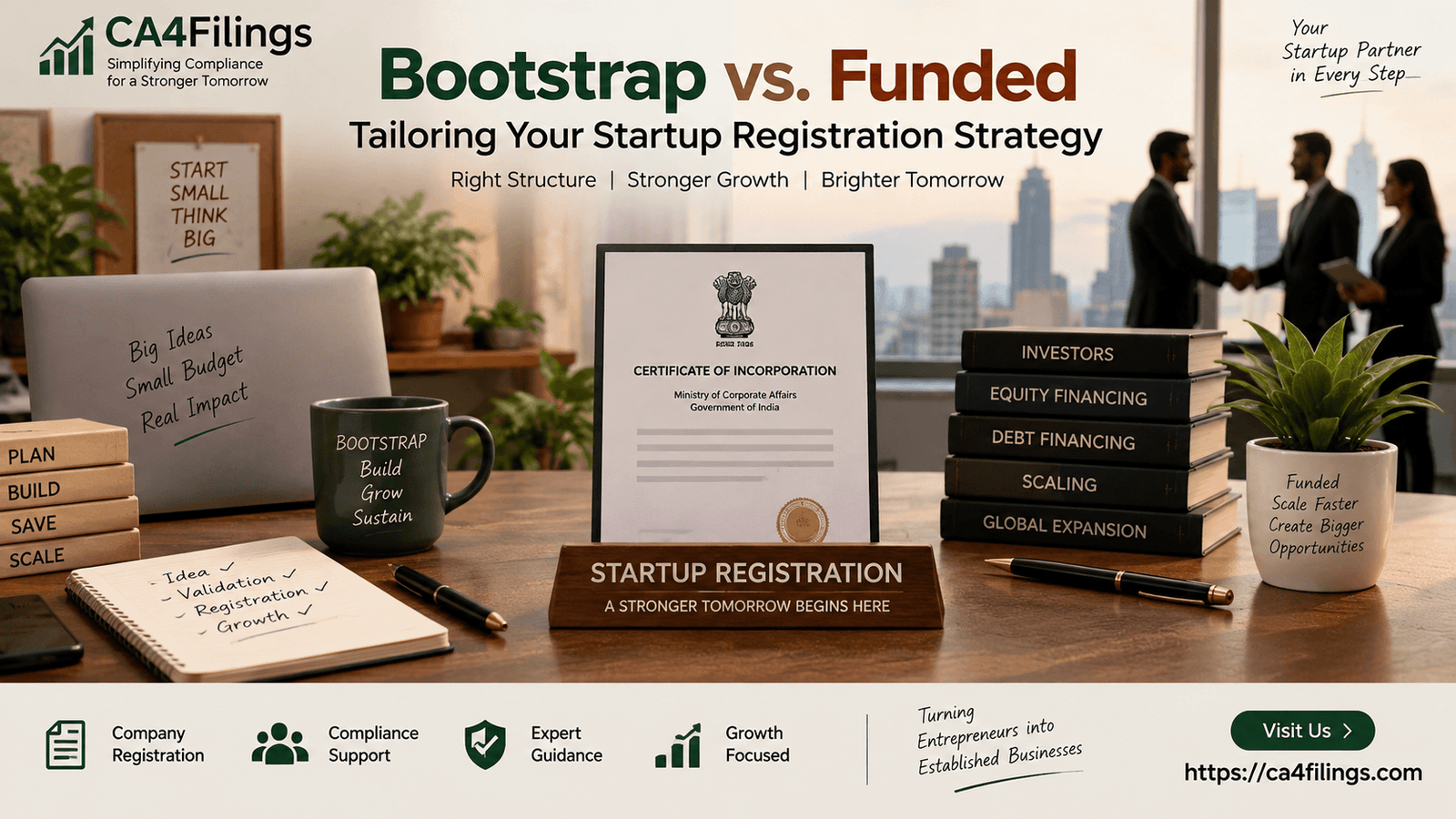
Starting a business in India is exciting, but the decisions you make at the beginning can shape how smoothly your company grows later. One of the first important steps is startup registration, and the right approach can differ significantly depending on whether you are bootstrapping your business or planning to raise external funding. While a self-funded startup may prioritise simplicity and cost control, a venture-backed business usually needs a structure that can accommodate investors, equity transactions and future expansion.
For entrepreneurs who want to establish a legally sound business, Company Registration is often the starting point. At CA4Filings, we believe startup registration should not be treated as a routine compliance exercise. Your funding plans, ownership structure and long-term goals should influence how you set up the business from day one.
What Does Startup Registration Actually Mean?
Startup registration involves legally establishing your business entity and completing the registrations and compliances applicable to it. For many growth-oriented businesses, a private limited company is a common choice because it provides a separate legal identity and can make ownership easier to structure.
However, startup registration is not simply about obtaining a certificate of incorporation. Entrepreneurs should also think about:
- Ownership and shareholding
- Director responsibilities
- Tax and statutory registrations
- Accounting and record-keeping
- Investor requirements
- Future fundraising
- Intellectual property ownership
- Corporate compliance
The ideal setup depends on what you expect the business to look like in the next three to five years, not just what it looks like today.
Startup Registration for a Bootstrapped Business
A bootstrapped startup is generally funded by the founders themselves, business revenue, personal savings or support from family and friends. Since there may be no external investors initially, founders usually want to keep administrative expenses and compliance burdens under control.
Focus on Low-Cost Filing and Simplicity
For a bootstrapped entrepreneur, low-cost filing can be an important consideration. Every rupee saved on unnecessary administrative expenses can instead be used for product development, marketing, hiring or customer acquisition.
That does not mean choosing the cheapest possible registration route without considering future needs. A business structure that saves money today but creates expensive restructuring issues tomorrow may not actually be economical.
Founders should therefore evaluate:
- Expected turnover and business activity
- Number of founders
- Ownership percentages
- Whether employees will receive equity
- Whether outside funding may be required later
- Applicable tax and compliance obligations
Keep Documentation Organised
Even when there are no external investors, maintaining proper records from the beginning is valuable. Share certificates, statutory registers, agreements and organizational minutes should be maintained appropriately.
Some founders are comfortable using legal self-service platforms for basic documentation, but professional advice becomes particularly useful when ownership, contracts, taxation or regulatory obligations become more complicated.
Startup Registration for a Funded Business
The situation changes considerably when external investors are part of the plan. A funded startup may receive capital from angel investors, venture capital firms, strategic investors or other institutional sources.
Here, startup registration should be designed with fundraising in mind.
Equity Financing Changes the Picture
Equity financing means raising money by offering ownership in the business. Investors may receive shares in exchange for capital, which makes the company's shareholding structure extremely important.
For example, imagine two founders start a technology company with equal ownership. Six months later, an angel investor wants to invest ₹50 lakh for a specific percentage of the company. If the founders have not planned their shareholding and documentation properly, negotiating the investment can become unnecessarily complicated.
A well-planned startup registration process can make subsequent share issuance and ownership changes more manageable.
Corporate Structure Flexibility Matters
Funded businesses often need greater corporate structure flexibility than small owner-operated businesses. As the company grows, it may need to accommodate:
- Multiple shareholders
- Investor rights
- Employee stock options
- Additional funding rounds
- Changes in shareholding
- Board-level governance
- Strategic partnerships
- Possible mergers or acquisitions
This is why founders should consider future transactions while deciding the initial structure.
Debt Financing vs. Equity Financing
Not every startup needs investors. Some businesses prefer debt financing, where money is borrowed and repaid according to agreed terms instead of giving away ownership.
The choice between debt and equity can affect startup registration and ongoing corporate planning in different ways.
With equity financing, founders need to consider dilution, shareholder rights and ownership percentages. With debt financing, the focus may shift towards repayment obligations, interest costs, cash flow and lender requirements.
For example, a profitable service business with predictable monthly revenue may be able to use business loans to fund expansion while retaining ownership. A technology startup investing heavily in product development before generating revenue may instead seek equity capital.
There is no universal funding model. The appropriate approach depends on the company's cash flow, risk profile, growth strategy and founders' objectives.
How to Tailor Startup Registration to Your Funding Plan
Before completing startup registration, founders should work through a few practical steps.
Step 1: Define Your Funding Roadmap
Ask yourself:
- Will the business be funded entirely by the founders?
- Will you approach angel investors?
- Are venture capital investors part of the plan?
- Could you require a business loan?
- Do you expect to offer employee equity?
Your answers can influence how you structure the company.
Step 2: Decide the Ownership Structure
Clearly establish who owns what percentage of the company. If there are multiple founders, document their respective contributions and responsibilities.
Do not rely solely on verbal agreements. Proper founder arrangements can prevent disputes when the company becomes more valuable.
Step 3: Consider Future Dilution
If you expect to raise equity funding, remember that new shares can dilute existing ownership. Founders should understand how future funding rounds could affect their percentage holding.
This does not mean avoiding fundraising. It means entering fundraising discussions with a clear understanding of the ownership implications.
Step 4: Build Compliance Into the Business
Startup registration is only the beginning. Depending on the company's circumstances, ongoing requirements may include statutory filings, accounting records, tax compliance, board processes and maintenance of corporate records.
Treat compliance as part of business administration rather than an annual emergency.
Common Mistakes Founders Should Avoid
Whether you bootstrap or raise funding, some mistakes appear repeatedly during the early stages of a startup.
Choosing a Structure Without Considering Growth
A business may start small but grow rapidly. Choosing an entity without considering future investors, employees or expansion can create avoidable restructuring work.
Ignoring Founder Agreements
Friends and business partners may have complete trust at the beginning. However, responsibilities, ownership and expectations can change as the company grows.
Written agreements provide clarity when circumstances change.
Treating Compliance as Optional
Delayed filings, incomplete records or poorly maintained documents can create problems during due diligence, fundraising or business transactions.
Focusing Only on Registration Cost
The cheapest startup registration option is not necessarily the most suitable one. Consider the total cost of compliance, restructuring and professional support over the life of the business.
FAQs About Startup Registration
Is startup registration mandatory for every new business?
No. The appropriate legal structure depends on the nature and scale of the business. Entrepreneurs can choose from different business structures depending on their objectives, ownership and compliance requirements.
Is a private limited company suitable for a funded startup?
A private limited company is commonly used by startups that expect equity investment because its share-based structure can accommodate multiple shareholders and future investment transactions.
Can a bootstrapped startup raise funding later?
Yes. A business can begin with founder capital and subsequently seek equity or debt financing. However, founders should consider future fundraising while setting up the business.
Should founders use legal self-service for startup registration?
Legal self-service may be suitable for straightforward tasks, but professional guidance can be valuable when there are multiple founders, complex ownership arrangements, intellectual property concerns or anticipated investment.
Does startup registration complete all business compliance?
No. Incorporation is only one part of establishing a compliant business. Depending on the company and its activities, additional tax, accounting, employment and regulatory requirements may apply.
Plan Startup Registration Around Your Growth
Whether you are building a lean bootstrapped venture or preparing for institutional investment, startup registration should support your business strategy rather than simply satisfy a legal formality.
Bootstrapped founders may prioritise simplicity, controlled expenses and efficient compliance, while funded startups may need stronger corporate structure flexibility to accommodate investors, share issuance and future funding rounds. The important point is to make these decisions before the business becomes complicated.
At CA4Filings, we help entrepreneurs approach startup registration with both today's requirements and tomorrow's growth in mind. From choosing an appropriate structure to understanding documentation and compliance requirements, professional guidance can help you build a stronger foundation for your business.
Planning to start your business? Connect with CA4Filings and take the first step towards a properly structured and compliant startup.
Latest Updates
ca4filings.com Services




























-registration.png)