Importance of FSSAI Registration for Food Processing Units
Discover the Importance of FSSAI Registration for Food Processing Units. Learn how it boosts compliance, trust, and business growth with CA4Filings.
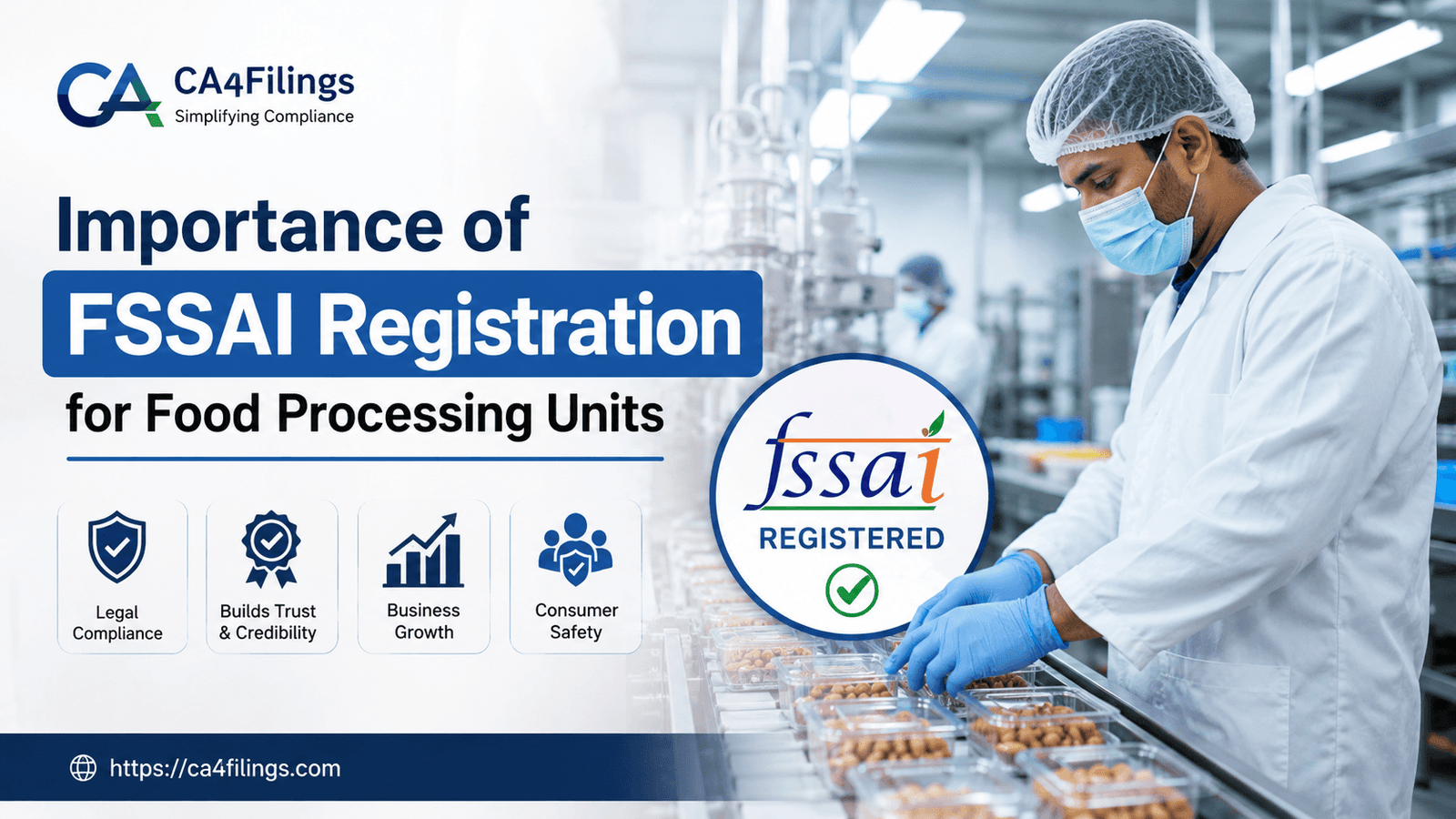
Starting a food business in India is an exciting venture. Whether you are setting up a small unit to manufacture local snacks or establishing a large-scale plant for packaged goods, the opportunities are massive. However, the food industry operates on a foundation of trust and health. A single mistake can impact thousands of consumers and ruin a brand overnight. This is exactly where food regulations India come into play to safeguard public health and streamline business operations.
If you are running or planning to establish a food manufacturing facility, understanding the Importance of FSSAI Registration for Food Processing Units is your first step toward long-term success. Obtaining your license is not just about completing paperwork; it is about securing a legal passport to operate, scale, and thrive in a competitive market. At CA4Filings, we assist entrepreneurs daily in navigating these legal waters. If you are ready to secure your business legally, you can easily apply for your FSAAI Registration through our dedicated compliance portal to ensure a hassle-free, smooth approval process.
Understanding the Core: What is FSSAI?
The Food Safety and Standards Authority of India (FSSAI) is the apex regulatory body established under the Food Safety and Standards Act, 2006. It monitors and regulates the manufacture, processing, distribution, sale, and import of food products to ensure they are safe for human consumption.
For food processing units, which transform raw agricultural products into consumable goods, the FSSAI acts as both a supervisor and a guide. Operating without this certification is a serious legal offense that can lead to heavy penalties, business closure, and even imprisonment.
Legal Obligations: Regulatory Compliance for Food Processors
The primary reason to secure your license lies in regulatory compliance. The Indian government has made it mandatory for every food business operator (FBO) to register with the FSSAI.
Depending on your production capacity and turnover, you will require one of the following:
Basic FSSAI Registration: For tiny food units with an annual turnover under ₹12 Lakhs.
State FSSAI License: For medium-sized food processing units with an annual turnover between ₹12 Lakhs and ₹20 Crores, or a production capacity up to 2 Metric Tonnes (MT) per day.
Central FSSAI License: For large-scale units with a turnover exceeding ₹20 Crores, a production capacity greater than 2 MT per day, or those operating across multiple states.
Fulfilling these food industry regulations protects your business from sudden government audits, hefty fines, and unwanted legal disputes.
Real Value: Importance of FSSAI Registration for Food Processing Units
Beyond avoiding legal trouble, obtaining an FSSAI certification brings massive commercial and operational advantages to your processing unit. Let's look at why this registration is a foundational asset for your company.
1. Building Solid Consumer Trust
In the modern market, consumers are highly conscious of what they eat. They look for validation that the packaged food they buy is safe. The FSSAI logo on your product packaging instantly builds consumer trust. It tells shoppers that your product has undergone scrutiny and adheres to established safety guidelines.
2. Ensuring the Safety of Food Products
The core objective of the FSSAI framework is to maintain the safety of food products across the supply chain. When you apply for a license, your unit must follow the schedule 4 requirements, which outline specific rules for food hygiene and sanitary practices. This structured approach drastically reduces the risk of food contamination, product recalls, and foodborne illnesses.
3. Comprehensive Quality Assurance
An FSSAI license is not a one-time paper shield; it enforces a continuous system of quality assurance. Registered food processing units are required to conduct regular food testing through approved laboratories. This ensures that the chemical, microbiological, and physical properties of your food remain within permissible, healthy limits.
4. Strict Standardization of Food Labeling and Packaging
Proper food packaging and accurate food labeling are critical aspects of running a compliant food business. FSSAI guidelines mandate that your labels clearly state:
Accurate nutritional information.
Ingredients and allergen warnings.
Veg/Non-veg symbols.
Expiry, best before dates, and batch numbers.
This transparency protects your consumers and saves your business from deceptive labeling lawsuits.
Business Growth: Commercial Benefits of FSSAI Registration
As Chartered Accountants, we analyze businesses through a financial lens. The financial benefits of FSSAI Registration go far beyond simple legal safety.
| Growth Driver | Impact on Food Processing Unit |
|---|---|
| Market Expansion | Large retail chains, supermarkets, and e-commerce platforms (like Blinkit, Instamart, or Amazon) will refuse to list your products if you lack a valid FSSAI license. |
| Corporate Contracts | If you want to supply mid-day meals, airline catering, or corporate cafeterias, a Central or State FSSAI license is a mandatory prerequisite in every tender. |
| Easy Funding & Loans | Banks, venture capitalists, and financial institutions view unlicensed businesses as high-risk. A valid registration makes securing business loans and expansion capital much smoother. |
| Export Opportunities | To export Indian food products globally, you must hold a Central FSSAI License. This unlocks access to lucrative international markets. |
Step-by-Step Overview of the FSSAI Registration Process
To help your processing unit secure its license, the typical operational workflow includes the following phases:
Eligibility Check: Evaluate your daily production capacity and annual turnover to determine if you need a Basic, State, or Central license.
Documentation Gathering: Compile essential documents including your processing unit's blueprint, equipment lists, food category lists, water test reports, and promoter IDs.
Form Submission: Fill out Form A (for Basic) or Form B (for State/Central) on the government’s FoSCoS portal.
Application Scrutiny: Food Safety Officers review your application. If they find any anomalies, they may issue a clarification request.
Inspection (If Applicable): For State and Central licenses, officials often conduct a physical inspection of your manufacturing unit to check sanitation and infrastructure.
License Generation: Once satisfied that you meet all food safety standards, the authority issues your digital certificate containing a unique 14-digit registration number.
Common Mistakes to Avoid in Food Processing Compliance
Having managed numerous filings at CA4Filings, we often see business owners make critical mistakes that delay their operations:
Declaring Incorrect Capacity: Understating your daily manufacturing capacity to fit into a cheaper tier can lead to immediate application rejection or penalties during a surprise inspection.
Ignoring Renewal Deadlines: An FSSAI license can be issued for a period of 1 to 5 years. You must apply for renewal at least 30 days before your current license expires to avoid daily late fees.
Flawed Label Formatting: Printing packaging materials without validating font sizes, logo placement, and nutritional formats can lead to seized inventory.
Frequently Asked Questions (FAQs)
Q1: Can I start my food processing unit first and apply for FSSAI later?
No. You must obtain at least an applied-for application status or a valid FSSAI number before commencing any commercial manufacturing operations.
Q2: What are the penalties for running a processing unit without FSSAI?
Operating a food processing business without a license can attract a penalty of up to ₹5 Lakhs and imprisonment for up to 6 months under the FSSAI Act.
Q3: Is a water analysis report mandatory for a food processing unit?
Yes. For State and Central licenses, an official water testing report from an NABL-accredited lab is mandatory to confirm that the water used in your manufacturing process is completely potable.
Q4: Do I need separate registrations if I manufacture different types of food products in the same unit?
No, you do not need multiple licenses for the same premises. However, you must explicitly add all relevant food product categories to your single existing FSSAI license.
Legal Growth with CA4Filings
Understanding the true Importance of FSSAI Registration for Food Processing Units helps you transition from a small local kitchen into a respected, scalable brand. It protects your capital, establishes consumer goodwill, and builds a clear runway for nationwide expansion.
Managing factory operations, supply chains, and staff leaves very little time to track changing government notifications and coordinate with regulatory portals. Let our corporate compliance experts handle your licensing. Connect with CA4Filings today, and we will manage your corporate registrations, financial planning, and regulatory compliance while you focus entirely on creating exceptional food products.
Latest Updates
ca4filings.com Services
























-registration.png)