The Ultimate Start Up Registration Timeline: From Concept to Legal Entity
Understand the start up registration timeline in India, from business planning and name selection to incorporation and post-registration setup.
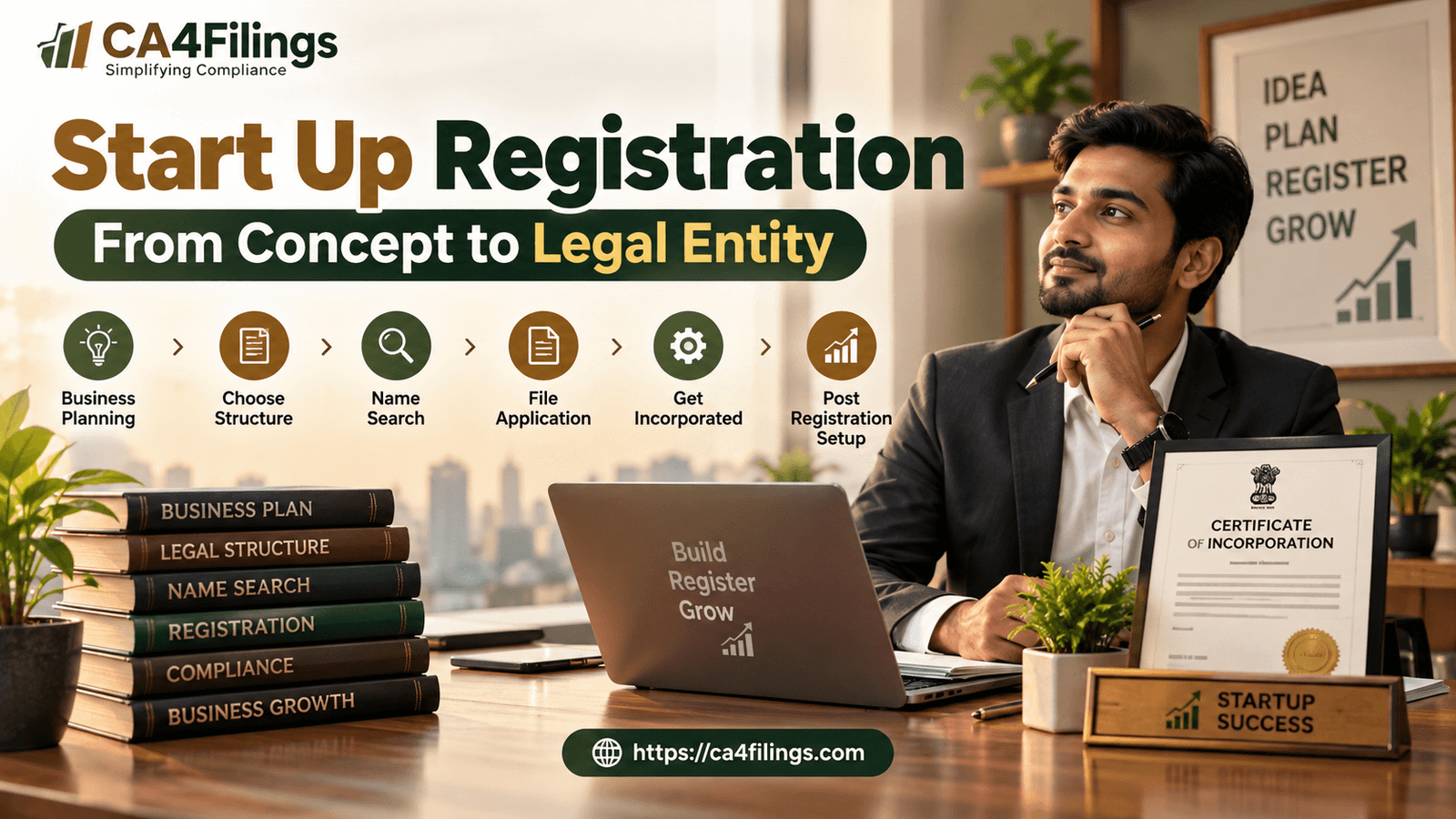
Starting a new business is exciting, but turning an idea into a legally recognised company requires more than just a good concept. Proper start up registration helps entrepreneurs establish the right legal identity, protect their interests, open a business bank account, raise funds, and operate with greater credibility. At CA4Filings, we often see founders delay registration because they are unsure about the process or believe it is complicated. In reality, with the right planning, the journey can be organised into clear and manageable stages. If you are ready to formalise your venture, professional Company Registration support can make the process smoother and help avoid common compliance mistakes.
Start Up Registration Begins With a Clear Business Plan
Before thinking about government forms and incorporation documents, spend time understanding your business. The business planning phase is where you decide what you are selling, who your customers are, how you will earn revenue, and what resources you need.
A practical business plan should cover:
- Your product or service
- Target customers and market
- Expected investment and expenses
- Revenue model
- Number of founders
- Initial hiring requirements
- Funding requirements
- Short-term and long-term business goals
For example, suppose two founders want to launch a digital marketing agency. They may initially operate informally while testing their idea. Once they begin signing larger contracts or planning to hire employees, formal start up registration can provide the legal foundation needed for growth.
Start Up Registration Timeline: Choose the Right Legal Structure
One of the most important decisions in the start up registration process is selecting the appropriate legal structure.
Legal Structure Selection
Common options in India include:
- Private Limited Company
- Limited Liability Partnership (LLP)
- One Person Company (OPC)
- Partnership Firm
- Sole Proprietorship
For startups expecting outside investment, multiple shareholders, or rapid expansion, a Private Limited Company is commonly considered. An LLP may be more suitable where flexibility and limited liability are important but equity investment is not the immediate priority.
The right choice depends on factors such as ownership, liability, taxation, funding plans, compliance requirements, and future expansion. Do not select a structure simply because another business owner recommended it.
Start Up Registration Step 1: Conduct a Name Availability Search
Once your legal structure is decided, the next stage is selecting a suitable business name.
A name availability search helps identify whether the proposed name is already being used or resembles an existing registered entity or trademark. Founders should ideally prepare multiple name options instead of relying on only one.
Your proposed name should:
- Be distinctive
- Avoid prohibited or misleading terms
- Not create confusion with an existing company
- Have a suitable domain name, where possible
- Be consistent with your proposed business activities
A good name at this stage can save considerable time later. Name rejection can otherwise delay the entire start up registration timeline.
Start Up Registration Step 2: Prepare the Required Documents
After deciding on the name and structure, documentation becomes the next major stage.
For a typical company incorporation, founders and directors may need documents such as:
- PAN and identity proof
- Address proof
- Passport-size photographs
- Residential address details
- Registered office proof
- Utility bill or ownership/rental documents, where applicable
- Digital Signature Certificates (DSCs)
The exact requirements can vary depending on the proposed entity, directors, shareholders, and registered office arrangement.
At CA4Filings, we recommend checking every document carefully before submission. A small mismatch in names, addresses, signatures, or supporting documents can result in unnecessary delays.
Start Up Registration Step 3: Complete Filing Execution
Once the documentation is ready, the application moves into the filing execution stage.
For company incorporation, the relevant incorporation forms and linked registrations are submitted through the Ministry of Corporate Affairs (MCA) system. Depending on the circumstances, the incorporation process can also cover requirements such as PAN, TAN and other linked registrations.
This is the technical part of start up registration, where accuracy matters significantly. Incorrect information may lead to resubmission or additional clarification.
A useful approach is to review the complete application before submission rather than trying to correct mistakes after filing.
Start Up Registration Step 4: Receive the Incorporation Certificate
After the application is reviewed and accepted, the company receives its Certificate of Incorporation.
This is an important milestone because the business has now obtained its separate legal identity.
The certificate generally contains important details such as:
- Corporate Identification Number (CIN)
- Name of the company
- Date of incorporation
- Type of company
- Registered office information
At this point, the startup has moved from an idea or proposed business into a formally incorporated legal entity.
However, start up registration does not end immediately after receiving the incorporation certificate.
Start Up Registration Step 5: Complete Post-Incorporation Setup
The post-incorporation setup is often overlooked by new entrepreneurs.
After incorporation, founders should focus on putting the company's operational and compliance framework in place.
Depending on the business, this may include:
- Opening a current bank account
- Bringing in the subscribed share capital
- Maintaining statutory records
- Appointing professionals where necessary
- Setting up accounting and bookkeeping systems
- Obtaining GST registration, if applicable
- Obtaining other business-specific licences
- Setting up payroll and employee compliance systems
- Understanding annual filing requirements
For eligible companies, certain commencement-related compliance requirements may also need attention. The exact obligations depend on the company's circumstances.
How Long Does Start Up Registration Take?
There is no single fixed timeline for every business. The duration can depend on document readiness, name approval, government processing, resubmissions, and the complexity of the proposed structure.
A simplified timeline may look like this:
- Business planning: Define the business model and objectives.
- Legal structure selection: Decide between a company, LLP or another structure.
- Name availability search: Check and finalise the proposed name.
- Documentation: Prepare identity, address and office documents.
- Filing execution: Complete and submit the applicable incorporation forms.
- Government processing: Respond to any clarification or resubmission request.
- Incorporation: Receive the Certificate of Incorporation.
- Post-incorporation setup: Establish banking, accounting and compliance systems.
Planning these stages in advance makes start up registration considerably easier for first-time founders.
Common Mistakes to Avoid During Start Up Registration
Entrepreneurs can avoid many unnecessary delays by watching out for a few common mistakes.
Choosing a Structure Without Considering Future Plans
A structure that works for a small business today may not be ideal if you plan to bring in investors, add shareholders, or expand internationally.
Ignoring Name Conflicts
Do not assume that a name is available simply because you cannot find it through a basic Google search. Proper checks are important.
Using Inconsistent Documents
Differences in spelling, addresses, dates, or identification details can create filing issues.
Forgetting Post-Incorporation Compliance
Receiving the incorporation certificate is a milestone, not the end of your responsibilities. Accounting, statutory records and applicable filings must be managed from the beginning.
Start Up Registration: Practical Example
Consider three founders launching an online education platform. During the business planning phase, they determine that they will require external funding within the next two years.
Instead of choosing a structure solely on today's requirements, they consider their expected funding plans and ownership arrangements. They shortlist a name, complete the name availability search, prepare their documents, complete filing execution, and obtain incorporation.
Afterward, they establish their bank account, accounting process, statutory records and other applicable registrations.
This approach makes the start up registration process part of the overall business strategy rather than treating incorporation as a standalone formality.
FAQs About Start Up Registration
1. What is start up registration?
Start up registration generally refers to the process of legally establishing a new business entity and completing the registrations and formalities applicable to its chosen structure.
2. Is start up registration mandatory for every business?
Not every business needs to incorporate as a company. The requirement depends on the business structure and applicable laws. A professional assessment can help determine the appropriate route.
3. How do I choose the right structure for my startup?
Consider ownership, liability, investment plans, taxation, compliance obligations, number of founders and future expansion before making the legal structure selection.
4. Can I register a startup without a physical office?
Depending on the entity and applicable requirements, a registered office arrangement must generally satisfy the relevant legal requirements. The documents required can vary based on the premises and ownership arrangement.
5. What happens after start up registration?
Once incorporation is completed, founders should move to post-incorporation setup, including banking, accounting, statutory records, applicable tax registrations and ongoing compliance.
Complete Your Start Up Registration With Confidence
A successful start up registration journey is not simply about submitting incorporation forms. It begins with a practical business plan, continues through legal structure selection, name availability search, documentation and filing execution, and ends with a proper post-incorporation setup.
At CA4Filings, we help entrepreneurs approach the process with clarity so they can spend less time worrying about paperwork and more time building their business. Whether you are starting a small venture or planning a scalable company, getting the legal foundation right from day one can make future growth much easier.
Ready to turn your business idea into a legally established entity? Connect with CA4Filings and take the next step toward a structured and compliant start up registration journey.
Latest Updates
ca4filings.com Services




























-registration.png)