The Founder’s Guide to Startup Registration and Raising Angel Capital
Startup registration and angel funding explained for Indian founders. Learn valuation, equity dilution, convertible notes, term sheets and investor readiness.
The Founder’s Guide to Startup Registration and Raising Angel Capital
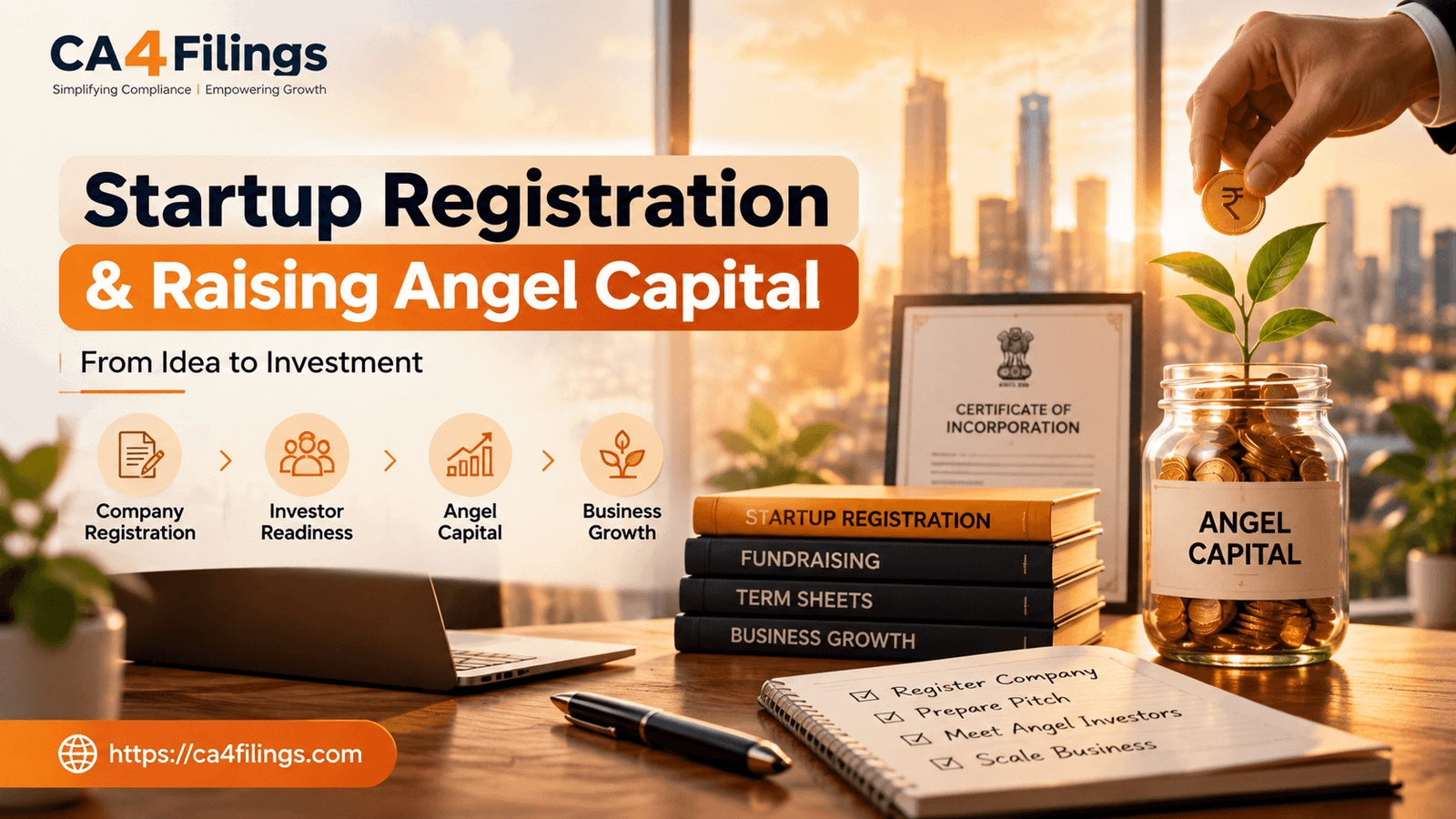
Starting a business is exciting, but turning an idea into an investable company requires more than a good product. Proper startup registration gives your business a legal identity, while the right fundraising structure helps you bring in capital without losing unnecessary control.
For most founders in India, the journey begins with choosing the right business structure. If you plan to build a scalable venture and approach angel investors, getting professional assistance with Company Registration can help you establish the right foundation from day one.
At CA4Filings, we often see founders focus heavily on their pitch deck while overlooking compliance, ownership structure, valuation, and documentation. Investors, however, look at the complete picture. Here's how to approach startup registration and angel fundraising in a practical way.
Why Startup Registration Matters Before Raising Capital
A founder may start with a business idea, but investors invest in a legally structured business. This is why startup registration should be one of the early priorities for a serious founder.
A properly incorporated company can:
- Enter contracts in its own name
- Open a current bank account
- Issue shares to founders and investors
- Maintain a formal ownership structure
- Build credibility with customers and investors
- Raise external capital through legally documented instruments
For startups planning to raise angel capital, a Private Limited Company is commonly considered because its shareholding structure is well suited to equity investment.
However, incorporation alone is not enough. Founders should also ensure that statutory records, share allotments, accounting records, tax registrations, and annual filings are maintained properly.
Startup Registration: Choosing the Right Structure
Before completing startup registration, founders should understand the difference between common business structures.
Private Limited Company
A Private Limited Company is generally suitable for startups expecting outside investment. It provides limited liability and allows the company to issue shares to investors.
It is particularly useful when founders expect multiple funding rounds, employee stock options, or institutional investment later.
LLP
An LLP can work well for professional businesses and ventures where external equity investment is not the immediate priority. However, its structure may not be as convenient for traditional equity fundraising.
Proprietorship
A proprietorship is simple to operate but is generally not the preferred structure for a venture intending to raise angel capital because there is no separate corporate shareholding structure.
For a founder planning serious fundraising, startup registration should therefore be approached with the future ownership and funding strategy in mind.
What Founders Should Prepare Before Startup Registration
Good preparation can make the incorporation process smoother.
Before beginning startup registration, keep the following information ready:
- Proposed company names
- Details and identity documents of directors
- Registered office details
- Digital signatures where required
- Proposed shareholding between founders
- Main business activities
- Initial authorised and paid-up capital
- Basic constitutional documents
Founders should also discuss how ownership will work if another co-founder joins later.
A common mistake is dividing shares informally based on initial enthusiasm rather than contribution, responsibilities, intellectual property, and future commitment.
Startup Registration and Startup Recognition Are Different
Another important point is that incorporation and government startup recognition are not exactly the same thing.
Startup registration creates the legal entity. Depending on eligibility, a business may separately seek recognition under the relevant startup framework.
This distinction matters because founders sometimes assume that incorporation automatically provides every benefit associated with startup recognition.
Depending on the company's circumstances, founders should evaluate eligibility for applicable tax, intellectual property, compliance, and other startup-related benefits rather than assuming they apply automatically.
Preparing for Angel Investment
Once startup registration is completed, the next challenge is making the business investment-ready.
Angel investors generally want to understand four things:
- What problem does the startup solve?
- How large is the potential market?
- What traction has the business achieved?
- How will their investment generate value over time?
Your pitch should therefore go beyond revenue projections.
For example, imagine a SaaS startup generating ₹8 lakh in annual revenue with 50 paying customers. Instead of simply stating that it wants ₹1 crore, the founder should explain how the capital will be used—perhaps ₹40 lakh for product development, ₹35 lakh for sales and marketing, and the balance for hiring and working capital.
Specificity builds credibility.
Understanding Pre-Money Valuation
One of the most important concepts in fundraising is pre-money valuation.
Suppose your company is valued at ₹4 crore before investment and an angel investor invests ₹1 crore. The post-money valuation becomes ₹5 crore.
The investor's ownership would therefore be:
₹1 crore ÷ ₹5 crore = 20%
This simple calculation demonstrates why valuation and equity dilution must be discussed carefully.
Founders should not focus only on the amount of money being raised. They should also understand how much ownership they are giving away and what that means for future funding rounds.
Equity Dilution: What Founders Should Watch
Equity dilution is not necessarily a bad thing. Raising capital can accelerate growth and potentially increase the overall value of the company.
The real issue is whether the dilution is commercially reasonable.
Before accepting an offer, consider:
- Current founder ownership
- Investor ownership
- Future fundraising requirements
- Employee ESOP pool
- Voting rights
- Board rights
- Founder responsibilities
- Exit provisions
A founder who gives away a large percentage at an early stage may have significantly less ownership when the company eventually raises Series A or Series B funding.
This is why startup registration should be followed by disciplined cap-table management.
Convertible Notes and SAFE Notes
Not every angel investment has to immediately involve a conventional equity issue.
Convertible Notes
Convertible notes are debt instruments that can convert into equity under agreed conditions, often during a future funding round.
They can be useful when the parties find it difficult to agree on a precise valuation at an early stage.
However, founders must understand interest, maturity, conversion triggers, valuation caps, discounts, and other contractual terms.
SAFE Notes
SAFE notes—short for Simple Agreement for Future Equity—are another instrument used in startup financing, particularly in certain early-stage investment structures.
Their legal and regulatory suitability depends on the transaction, investor, company structure, and applicable Indian regulations. Founders should therefore obtain professional advice before using a foreign-style funding document without adapting it to the Indian legal environment.
Angel Investor Checklist for Founders
A practical angel investor checklist can prevent unpleasant surprises later.
Before accepting funds, verify:
- Investor identity and background
- Source and terms of investment
- Proposed investment instrument
- Valuation and dilution
- Investor rights
- Board or information rights
- Exit provisions
- Founder lock-in or transfer restrictions
- Intellectual property ownership
- Existing liabilities
- Compliance status of the company
Do not choose an investor solely because they are willing to invest quickly. Strategic experience, industry connections, expectations, and working style can also affect the founder-investor relationship.
Understanding Fundraising Term Sheets
A term sheet summarises the major commercial terms proposed by the investor.
Fundraising term sheets may cover:
- Investment amount
- Valuation
- Shareholding
- Liquidation preference
- Anti-dilution provisions
- Board rights
- Reserved matters
- Information rights
- Founder obligations
- Exit-related provisions
A founder should never treat a term sheet as a simple formality. Certain terms can have a major impact on future fundraising and decision-making.
Professional review before signing can help identify provisions that may create difficulties later.
Step-by-Step Startup Fundraising Roadmap
A practical fundraising journey can look like this:
Step 1: Complete Startup Registration
Set up the appropriate legal entity and establish proper ownership between founders.
Step 2: Clean Up Compliance
Ensure statutory filings, accounting records, tax registrations, contracts, and intellectual property documentation are in order.
Step 3: Prepare the Cap Table
Clearly document founder ownership and any existing investor or employee interests.
Step 4: Establish Your Valuation
Prepare a defensible explanation for your pre-money valuation using traction, market opportunity, revenue, growth, comparable businesses, and other relevant factors.
Step 5: Build the Investor Materials
Prepare a concise pitch deck, financial projections, business plan, customer data, and fundraising requirement.
Step 6: Negotiate the Terms
Review valuation, equity dilution, investor rights, and other commercial provisions carefully.
Step 7: Complete the Investment Legally
Do not rely on informal agreements. Complete share issuance or the relevant investment documentation and maintain proper corporate records.
Common Mistakes Founders Should Avoid
Several mistakes repeatedly create problems during startup fundraising.
Raising money before understanding dilution:
The cash may solve an immediate problem but create long-term ownership issues.
Ignoring compliance:
An investor's due diligence can uncover missed filings, undocumented transactions, or inconsistent accounts.
Using generic agreements:
A document downloaded from the internet may not properly address the Indian regulatory and commercial context.
Overestimating valuation:
An unrealistic valuation can make future fundraising difficult if the company cannot meet expected growth.
Choosing an investor only for money:
The right investor relationship involves more than a bank transfer. Mentoring, networks, industry knowledge, and strategic support can be valuable.
FAQs About Startup Registration and Angel Funding
Is startup registration mandatory before raising angel investment?
A legally structured business is generally necessary for issuing equity or entering formal investment arrangements. The exact requirements depend on the investment structure and entity type.
Which company structure is suitable for angel funding?
For many scalable startups seeking equity investment, a Private Limited Company is commonly used because it provides a clear shareholding framework.
How much equity should a founder give to an angel investor?
There is no universal percentage. It depends on valuation, investment amount, stage, traction, future capital requirements, and negotiated investor rights.
Are convertible notes suitable for Indian startups?
They may be suitable in specific circumstances, but founders should verify applicable Indian corporate and regulatory requirements before using them.
What documents do angel investors usually review?
Investors may review incorporation documents, cap tables, financial statements, bank records, contracts, intellectual property documents, tax filings, and existing investment agreements.
Build the Right Foundation Before You Raise
Successful fundraising starts long before the investor sends money. A well-planned startup registration creates the legal foundation, while clean accounts, a sensible cap table, realistic pre-money valuation, and carefully negotiated fundraising term sheets help protect the founder's interests.
At CA4Filings, we help entrepreneurs approach startup registration and business compliance with a practical, growth-oriented mindset. If you're preparing to incorporate your company or planning your first angel round, getting the structure right at the beginning can save considerable time, cost, and complications later.
Ready to start your venture on the right foundation? Connect with CA4Filings for professional guidance on startup registration, company incorporation, compliance, and fundraising readiness
Latest Updates
ca4filings.com Services


























-registration.png)