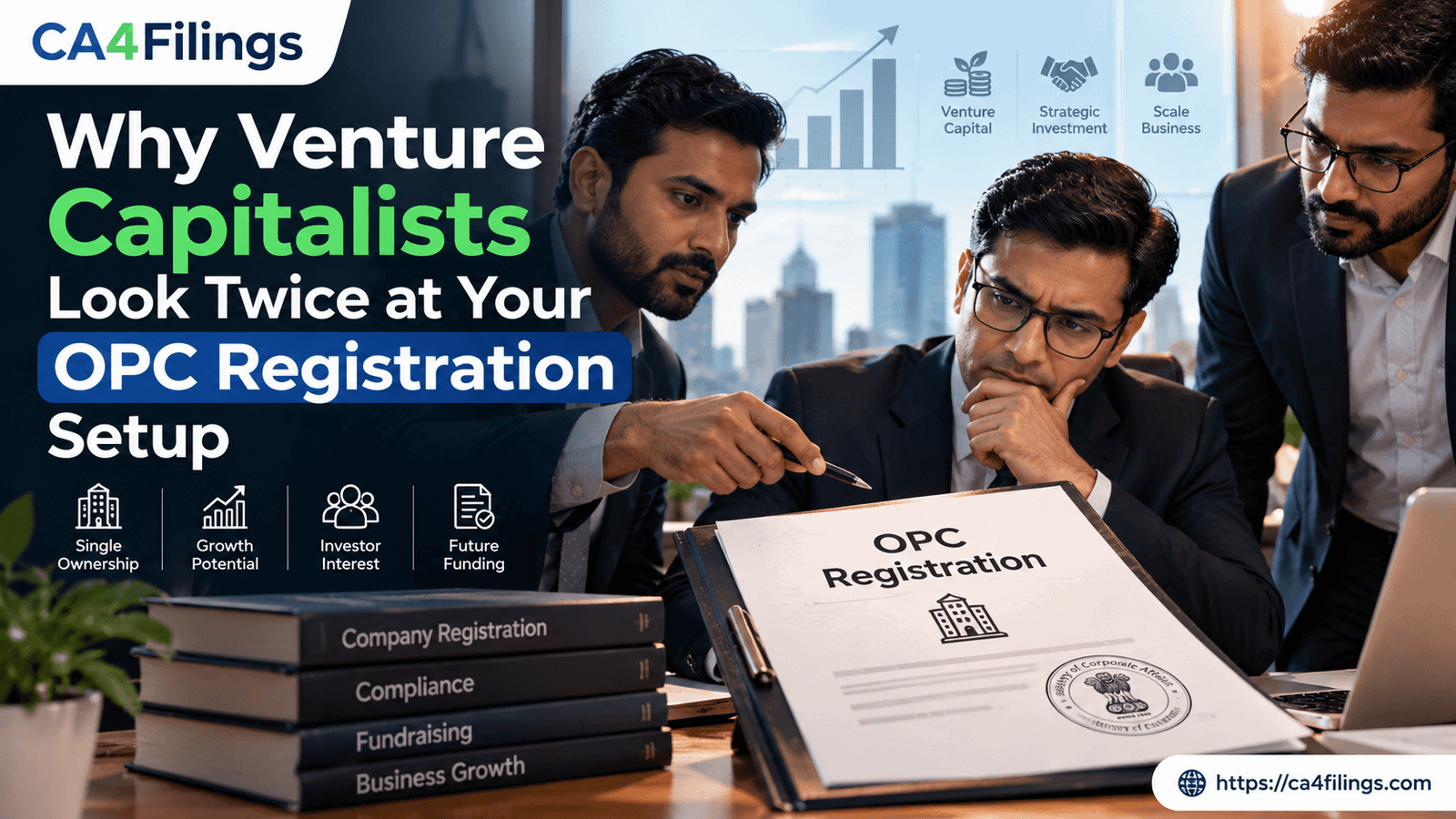
Why Venture Capitalists Look Twice at Your OPC Registration Setup
Understand how OPC registration can affect VC funding, equity dilution, restructuring and investor readiness, with practical guidance from CA4Filings.
Why Venture Capitalists Look Twice at Your OPC Registration Setup
Starting a business as a solo founder often feels simpler with opc registration. An OPC gives an individual the ability to operate through a separate legal entity while retaining complete ownership and control. But when the business starts attracting angel investors or venture capitalists, the same structure can come under much closer scrutiny. If you are planning to raise institutional funding, understanding how your opc registration affects future fundraising is essential. For entrepreneurs considering a more investment-ready structure, professional Company Registration guidance can help avoid expensive restructuring later.
At CA4Filings, we regularly see founders focus heavily on incorporation and much less on what happens when outside capital enters the picture. Investors, however, look beyond revenue and product ideas. They examine the legal structure, ownership, governance, shareholding flexibility and the founder's ability to accommodate future investors.
Why VCs Examine OPC Registration More Closely
The fundamental attraction of an OPC is simplicity. A single person can own and operate the company without having to manage multiple shareholders. For a consultant, professional, small business owner or early-stage entrepreneur, this can be practical.
Venture capital works differently.
A VC generally expects to invest money in exchange for equity or another legally structured interest in the company. This means the company's ownership structure must be capable of accommodating investors and future funding rounds.
During opc registration, a founder may naturally think about today's requirements. A VC is more interested in whether the structure can support tomorrow's requirements.
Investors may examine:
- Current ownership and shareholding
- Ability to issue shares to new investors
- Governance and decision-making arrangements
- Compliance history
- Financial records and tax filings
- Existing contracts and liabilities
- Future restructuring requirements
- The possibility of founder equity dilution
This is where an apparently straightforward opc registration setup can become a discussion point during due diligence.
OPC Registration and the Fundraising Challenge
One of the biggest concerns is structural compatibility with institutional investment.
An OPC is designed around a single member. Institutional investors usually require a company structure where multiple shareholders can participate. As a result, a founder expecting substantial VC funding may eventually need to transition from the OPC structure to another suitable company structure.
This does not mean opc registration is automatically a bad choice. It simply means founders should understand the likely journey before selecting the structure.
For example, imagine a founder starts a technology business independently. The company reaches ₹50 lakh in annual revenue and subsequently receives interest from a VC willing to invest ₹2 crore for an equity stake.
The investor will not only ask, "What is your revenue"
They may also ask, "Can the existing corporate structure accommodate our investment"
If restructuring becomes necessary immediately before funding, the transaction can take additional time and involve professional fees, documentation and compliance work.
Seed Level Investing Traps Founders Should Understand
At the seed stage, founders sometimes concentrate entirely on getting the first cheque.
That can create seed level investing traps.
A founder may agree to an investment without fully understanding:
- How much equity is being given away
- Whether additional shares will be issued later
- Investor rights attached to the investment
- How future funding rounds affect ownership
- Whether the existing corporate structure needs modification
- What happens when a new investor enters the cap table
For a business initially established through opc registration, these questions become even more important because future institutional participation may require structural changes.
A practical approach is to think at least two or three funding rounds ahead rather than designing the company only around the first investor.
Structural Flexibility Matters to Investors
VCs invest with the expectation that a company will grow significantly. They therefore value structural flexibility.
A scalable corporate structure should ideally make it easier to:
- Bring in new shareholders.
- Issue additional shares when required.
- Allocate equity to employees or key executives.
- Accommodate multiple investment rounds.
- Implement appropriate governance arrangements.
- Complete future mergers, acquisitions or strategic transactions.
The problem is not necessarily opc registration itself. The issue is whether the chosen structure continues to match the company's growth stage.
A founder who knows that external investment is likely should discuss the long-term structure with a CA or company law professional before incorporation.
Converting for Institutional Cash: What Founders Should Know
The phrase converting for institutional cash may sound complicated, but the basic idea is straightforward: a business may need to change its legal structure before institutional investors can enter comfortably.
Suppose a founder has operated successfully under opc registration and now wants to raise institutional capital. The business may need to transition into a structure that permits multiple shareholders.
This process should not be treated as a last-minute administrative task.
Before approaching investors, founders should review:
- Existing financial statements
- Statutory compliance
- Shareholding records
- Contracts and intellectual property ownership
- Loans and liabilities
- Tax filings
- Business valuation
- Proposed investment terms
Planning the transition early can reduce friction during due diligence.
Founder Equity Dilution Equations Matter More Than You Think
Another area where founders often need professional guidance is dilution.
Consider a simple example.
A founder owns 100% of a company before investment. If a VC invests ₹1 crore at a post-money valuation of ₹5 crore, the investor's theoretical ownership would be 20%, assuming a straightforward equity transaction with no other adjustments.
The founder would retain 80%.
But subsequent funding rounds can change the picture.
This is why founders should understand founder equity dilution equations before accepting investment terms. An apparently small percentage given away today can have a much larger impact after several rounds of financing.
With opc registration, founders may initially have complete control, which can make dilution feel like a distant issue. Once external funding becomes a serious possibility, however, ownership planning becomes central to the discussion.
How Founders Can Prepare Before Approaching VCs
If your company currently operates through opc registration and you expect to seek institutional funding, take a structured approach.
Step 1: Define Your Funding Timeline
Are you looking for angel funding in six months, seed funding in two years, or institutional capital after reaching a particular revenue target?
Your timeline can influence whether the current structure remains practical.
Step 2: Review Your Corporate Compliance
Investors generally expect clean documentation. Review statutory filings, financial statements, tax records and company registers before beginning discussions.
Step 3: Understand Your Cap Table
Know exactly who owns what and how future investment could affect ownership.
Step 4: Discuss Restructuring Early
If opc registration is no longer aligned with your fundraising plans, discuss the possible transition well before signing an investment agreement.
Step 5: Model Future Dilution
Do not look only at the first investment. Prepare scenarios for future funding rounds and employee equity allocation.
Is OPC Registration Wrong for a Startup?
Not necessarily.
For a solo entrepreneur testing an idea, building initial revenue or operating a small business, opc registration can provide a useful corporate framework.
The important question is whether the structure matches the business's present and expected future needs.
If the business is intended to become a venture-backed startup with multiple investors, the founder should consider future requirements from the beginning.
At CA4Filings, we recommend looking at incorporation as the first step of a longer business journey—not as an isolated compliance exercise.
FAQs About OPC Registration and Venture Capital
Can an OPC raise venture capital?
An OPC may face structural limitations when an institutional investor needs to become a shareholder. Depending on the proposed investment, restructuring into a more suitable company structure may be required.
Does OPC registration guarantee complete founder control?
An OPC is designed around a single member, but founder control can change if the business later brings in external capital and ownership interests.
Should I choose OPC registration if I plan to raise VC funding?
It depends on your business plan and fundraising timeline. If institutional funding is a serious near-term objective, discuss the expected funding structure with a professional before incorporation.
Does restructuring affect the fundraising process?
It can. Restructuring may involve documentation, compliance steps, professional fees and additional due diligence. Early planning can make the process more organised.
What should founders check before accepting VC money?
Founders should understand valuation, ownership dilution, investor rights, governance, documentation, future funding requirements and the company's ability to accommodate new shareholders.
Plan OPC Registration With the Next Funding Round in Mind
opc registration can be an effective starting point for an individual entrepreneur, but founders should not look at incorporation only from today's perspective. If venture capital is part of your long-term plan, think about ownership, governance, structural flexibility, future dilution and the possibility of converting the business for institutional investment.
The right structure depends on your business model, funding expectations and growth plans. At CA4Filings, we help entrepreneurs evaluate these considerations before they become expensive problems during fundraising.
Planning your business structure or considering OPC registration? Connect with CA4Filings for professional guidance on company incorporation, compliance and future-ready business structuring.
Latest Updates
ca4filings.com Services




























-registration.png)