How to Registration Company Frameworks for SaaS (Software as a Service) Startups
How to registration company for SaaS startups in India, covering business structure, taxation, privacy, recurring billing and compliance essentials.
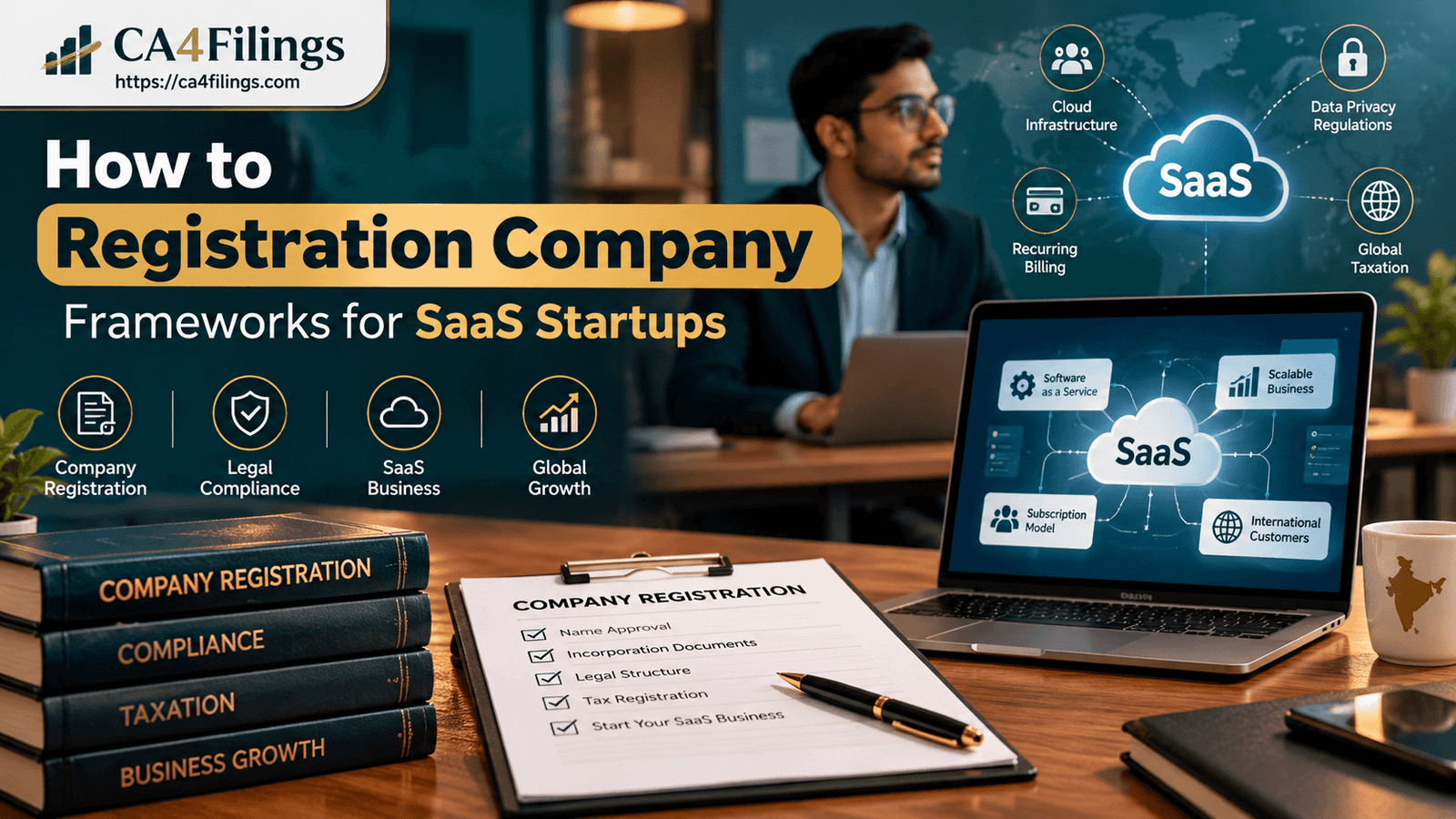
A SaaS startup may begin with nothing more than a software idea, a laptop and a few early customers. But as subscriptions grow, founders quickly realise that choosing the right legal structure is just as important as building the product. Understanding how to registration company frameworks work helps SaaS founders create a compliant business foundation from day one. If you are planning to incorporate your venture in India, professional Company Registration support can make the process much smoother.
At CA4Filings, we regularly guide entrepreneurs through the process of selecting and registering a suitable business structure. For SaaS businesses, the decision deserves extra attention because the company may handle customer data, recurring payments, overseas transactions, software licences and international customers.
How to Registration Company Frameworks for SaaS Startups
Before understanding how to registration company, founders should first identify what they want the business to achieve. A small SaaS product serving Indian customers may have very different requirements from a cloud platform planning to raise venture capital internationally.
For many technology startups, a Private Limited Company is considered because it provides a separate legal identity and can be structured to accommodate shareholders and future investment. Other structures, such as an LLP or proprietorship, may suit businesses with different ownership and operational objectives.
The right framework depends on factors such as:
- Number of founders and shareholders
- Expected investment
- Business risk and liability
- Domestic or international operations
- Employee stock option plans
- Future fundraising requirements
- Intellectual property ownership
- Tax and compliance requirements
Therefore, how to registration company should not simply mean completing an incorporation form. It should mean selecting a structure that supports the startup's long-term business model.
Why SaaS Startups Need a Different Registration Approach
A conventional local business may primarily deal with physical products or services. A SaaS company, however, delivers software through the internet, generally using a subscription or recurring-payment model.
This creates additional commercial and compliance considerations.
For example, imagine an Indian SaaS company offering project-management software for ₹999 per user every month. Within two years, it could have customers in India, Singapore, the UK and the US. The company may need to consider invoicing, taxes, payment gateways, customer agreements, data protection and international contracts.
This is why how to registration company planning should happen alongside the SaaS business model rather than after the product has already launched.
How to Registration Company: Step-by-Step Process
1. Decide the Appropriate Business Structure
Start by evaluating ownership, funding plans and liability requirements. A founder expecting angel or venture-capital investment may have different priorities from someone building a bootstrapped SaaS consultancy.
Do not select a structure only because another startup is using it. Your expected revenue, ownership arrangement and expansion plans should influence the decision.
2. Finalise the Company Name
Choose a distinctive name that is relevant to the business and check its availability before proceeding. It is also sensible to consider the availability of the corresponding domain name and trademark.
A SaaS company may invest heavily in branding, so checking intellectual property considerations early can prevent unnecessary complications later.
3. Arrange the Required Documents
The incorporation process generally requires information and documents relating to the proposed directors, shareholders and registered office.
Depending on the circumstances, founders may need documents such as:
- PAN and identity documents
- Address proof
- Photographs
- Registered office address proof
- Utility bill and ownership/rent-related documents
- Digital signatures and applicable declarations
The exact requirements can vary according to the company's circumstances.
4. Complete Incorporation Formalities
The applicable incorporation forms and declarations need to be prepared accurately and submitted through the prescribed government process.
This is where understanding how to registration company becomes practically important. Errors in names, addresses, business activities or supporting documents can result in delays and additional work.
5. Set Up Banking and Accounting Systems
Once the company is incorporated, establish a dedicated business bank account and accounting system.
For SaaS businesses, accounting should ideally track:
- Monthly recurring revenue
- Annual recurring revenue
- Subscription cancellations
- Refunds
- Payment gateway charges
- Domestic and overseas sales
- Software and cloud expenses
- Employee and contractor costs
A clean accounting system from the beginning makes taxation and financial reporting much easier.
How to Registration Company and SaaS Data Protection
Company incorporation is only one part of building a compliant SaaS business. Since SaaS platforms often collect names, email addresses, payment information, usage data and other customer information, founders should also consider applicable data privacy regulations.
If the startup serves customers outside India, additional privacy obligations may arise depending on the customer's location and the type of data processed.
For businesses dealing with European users, GDPR compliance can become particularly relevant. Privacy policies, data-processing arrangements, consent mechanisms, security controls and customer rights should be reviewed according to the company's actual operations.
A common mistake is to treat privacy compliance as something to address after acquiring international customers. It is generally better to build appropriate privacy processes into the product and business model early.
How to Registration Company for Subscription-Based SaaS
Recurring subscriptions are at the heart of many SaaS businesses. However, founders should understand the contractual and financial implications of recurring billing.
Your terms should clearly explain:
- Subscription pricing
- Billing frequency
- Renewal conditions
- Cancellation procedure
- Refund policy
- Trial-period terms
- Payment failures
- Upgrades and downgrades
Understanding recursive billing legalities is particularly important when customers are automatically charged at regular intervals. The business should ensure that its payment process, customer communication and terms are consistent with applicable requirements.
For example, if a customer starts with a free trial and automatically moves to a paid subscription, the transition should be clearly disclosed rather than hidden in lengthy terms.
Cloud Infrastructure and SaaS Company Compliance
Most SaaS businesses depend on third-party cloud providers for hosting, databases, backups and application infrastructure. This makes cloud service infrastructure an important consideration during business planning.
Founders should know:
- Where customer data is stored
- Who has access to production systems
- How backups are maintained
- How security incidents are handled
- What third-party processors are being used
- What happens when a customer terminates the service
These considerations can also affect contracts with enterprise customers. Larger clients may ask for security policies, data-processing agreements and information about hosting arrangements before purchasing a SaaS product.
How to Registration Company for International SaaS Sales
One of the biggest advantages of SaaS is the ability to sell globally without opening a physical store in every country. But international sales can introduce tax and regulatory complexities.
Founders should consider global SaaS taxation, including the possible tax treatment of digital services, indirect taxes, invoicing requirements and obligations in countries where customers are located.
The treatment can vary significantly based on factors such as:
- Customer location
- Type of software service
- Business-to-business or business-to-consumer sales
- Revenue levels
- Local registration thresholds
- Permanent establishment considerations
Therefore, how to registration company should be considered together with the company's intended markets. If the startup plans to sell internationally from the beginning, discuss the proposed structure and tax model with a qualified professional.
Common Mistakes SaaS Founders Should Avoid
Choosing a Structure Only to Save Initial Cost
The cheapest structure today may not necessarily be suitable when the startup begins fundraising or entering international markets.
Ignoring Intellectual Property Ownership
The company should have appropriate arrangements concerning software code, trademarks, designs and other intellectual property created by founders, employees or contractors.
Mixing Personal and Business Transactions
Using personal bank accounts or payment accounts for company transactions can create accounting and compliance problems.
Launching Without Proper Customer Terms
A SaaS business should clearly document pricing, subscriptions, cancellation, refunds, acceptable use and limitations of liability.
Leaving Compliance Until Later
Trying to fix accounting, taxation, contracts and privacy processes after significant growth can be much more complicated than setting them up properly at the beginning.
How to Registration Company: Practical Checklist
Before launching your SaaS company, keep this checklist handy:
- Select the appropriate legal structure
- Finalise and check the proposed company name
- Prepare incorporation documents
- Complete the applicable registration process
- Open a dedicated business bank account
- Set up accounting and invoicing
- Establish subscription and payment terms
- Review applicable data privacy regulations
- Assess GDPR compliance where relevant
- Document intellectual property ownership
- Review recurring billing legalities
- Understand applicable domestic and international taxes
- Maintain proper contracts with employees and contractors
- Review cloud service infrastructure and data handling
This approach makes how to registration company much more than a registration exercise. It becomes part of the startup's overall risk-management and growth strategy.
FAQs on How to Registration Company for SaaS Startups
1. What is the most suitable company structure for a SaaS startup?lt;/h3>
There is no universal answer. The appropriate structure depends on the founders, ownership, investment plans, liability concerns, revenue model and expansion strategy. A professional assessment should be made before incorporation.
2. Can an Indian SaaS company sell software to foreign customers?lt;/h3>
Yes, an Indian SaaS business can serve international customers, subject to applicable foreign exchange, taxation, invoicing, contractual and regulatory requirements.
3. Is GDPR compliance necessary for every SaaS company?lt;/h3>
Not necessarily. Its applicability depends on factors including the customers served, geographic reach and processing of personal data. SaaS businesses targeting or serving relevant European users should specifically assess their obligations.
4. Should SaaS founders register the company before launching the product?lt;/h3>
The timing depends on the business model and circumstances. However, incorporating before significant commercial activity can help separate personal and business affairs and establish clearer ownership and contractual arrangements.
5. Why should a CA be involved in SaaS company registration?lt;/h3>
A CA can help founders look beyond incorporation and consider accounting, taxation, compliance, invoicing and financial planning. For SaaS businesses with international ambitions, early professional advice can also help identify issues before they become expensive problems.
Conclusion: How to Registration Company the Right Way
Understanding how to registration company frameworks for a SaaS startup is about much more than obtaining a certificate of incorporation. Founders need to think about ownership, investment, taxation, recurring subscriptions, intellectual property, customer contracts, privacy and international expansion from the beginning.
At CA4Filings, we help entrepreneurs approach company formation with the larger business picture in mind. Whether you are developing your first SaaS product or preparing an existing software venture for growth, getting the legal and financial foundation right can make future expansion considerably smoother.
Ready to set up your SaaS business? Connect with CA4Filings for professional guidance on company incorporation, taxation and ongoing compliance.
Latest Updates
ca4filings.com Services























-registration.png)