How to Company Registration Processes Vary for Traditional vs. Digital Businesses
Learn how to company registration differs for traditional and digital businesses, including permits, taxes, zoning, compliance, and practical CA advice.
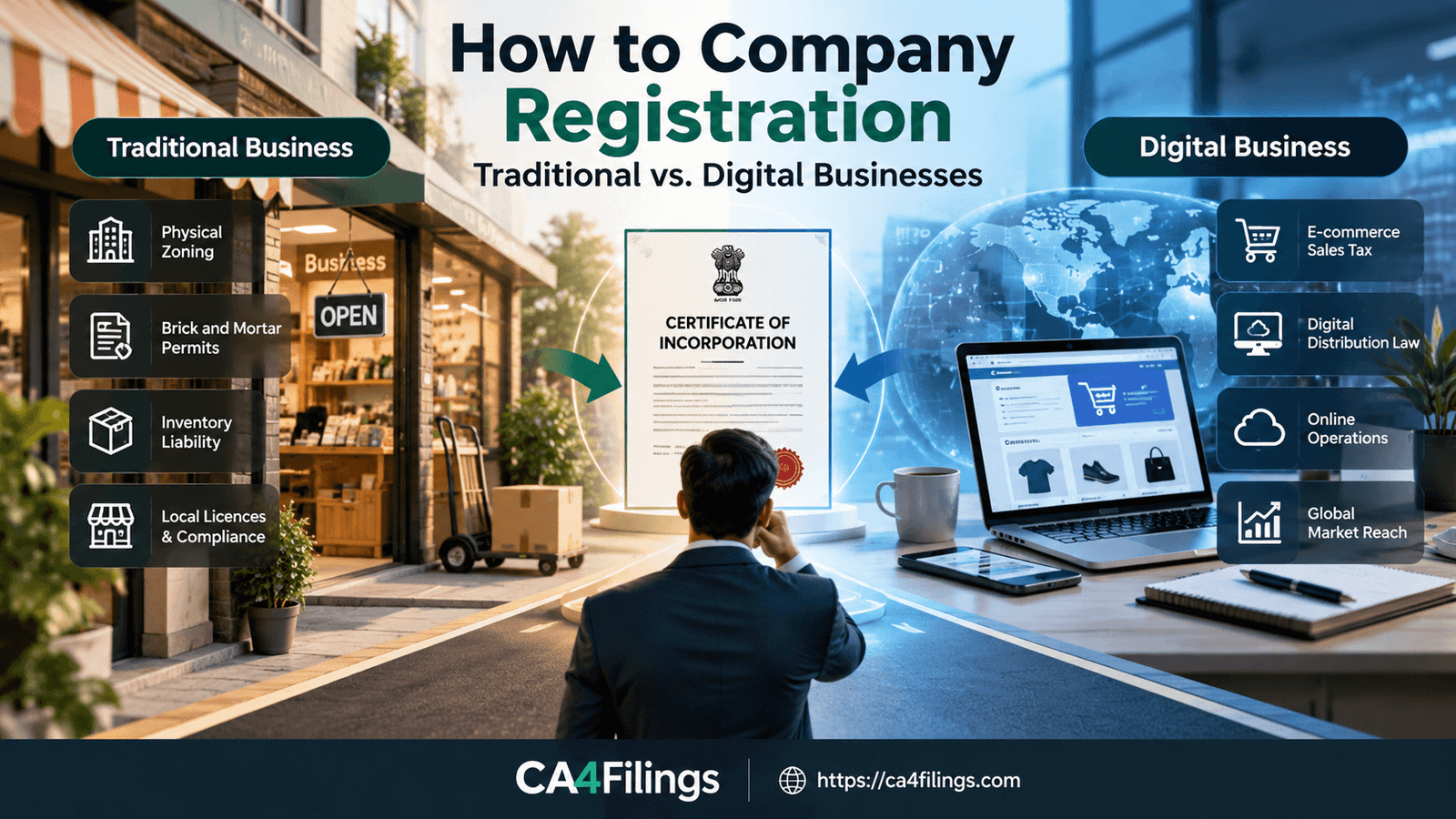
When entrepreneurs ask how to company registration, they often expect the process to be the same for every type of business. In reality, registering a company in India may begin with similar legal formalities, but the requirements after incorporation can differ significantly depending on how the business operates. A retail store, manufacturing unit, consultancy firm, SaaS startup, and e-commerce company may all be incorporated under the Companies Act, yet their regulatory and compliance requirements are not identical.
For business owners planning incorporation, understanding Company Registration is only the first step. The real question is how the nature of your business affects licences, taxation, premises, inventory, online transactions, and ongoing compliance.
At CA4Filings, we regularly advise entrepreneurs to look beyond incorporation paperwork. A properly planned registration structure can help avoid unnecessary compliance costs and regulatory problems later.
How to Company Registration for Traditional Businesses
Traditional businesses usually operate from a physical location. Examples include retail shops, restaurants, manufacturing units, warehouses, clinics, offices, and service centres.
For such businesses, how to company registration involves considering not only corporate documents but also the location and physical activities of the business.
Physical Location and Zoning Requirements
A traditional business may need to comply with local rules relating to its premises. Depending on the activity and location, entrepreneurs may need trade licences, shop and establishment registration, fire-related approvals, pollution-related permissions, or other local registrations.
Physical zoning can also become relevant. Certain commercial activities may not be permitted in every type of property or locality. Before signing a long-term lease, it is sensible to verify whether the proposed business activity is permitted at that location.
For example, a small consulting office and a food manufacturing unit have completely different premises-related requirements.
Brick and Mortar Permits
Businesses with a physical establishment may encounter several brick and mortar permits depending on their industry and state.
These could include:
- Local municipal registrations
- Shops and Establishments registration
- Trade licences
- Fire safety approvals, where applicable
- Factory-related registrations for eligible manufacturing operations
- Pollution control permissions for specified activities
- Professional tax registrations, where applicable
- GST registration, subject to applicable conditions
Therefore, how to company registration should not be viewed as simply obtaining a Certificate of Incorporation. The business model and premises determine many of the registrations that may follow.
How to Company Registration for Digital Businesses
Digital businesses often have fewer physical-location requirements, but that does not mean they have fewer compliance obligations.
Consider an online marketplace, software company, digital agency, mobile application business, or subscription-based platform. Such businesses may operate from a small office—or even primarily online—while serving customers across India or internationally.
Online Sales and Tax Considerations
One important area is e-commerce sales tax and GST compliance.
The exact GST treatment depends on the business model, nature of supplies, turnover, customer location, and applicable rules. An online seller may also have different responsibilities from a software consultancy or a subscription-based SaaS company.
For example, an e-commerce business selling physical products may need to manage GST invoices, returns, marketplace transactions, stock records, and delivery-related documentation.
A SaaS business, meanwhile, may need to carefully examine the tax treatment of software subscriptions and services, particularly when customers are located outside India.
This is why how to company registration should be planned alongside the expected revenue model and customer base.
Digital Distribution Law and Online Operations
Digital businesses can also face legal considerations that are less common for traditional businesses.
Depending on the business model, entrepreneurs should consider areas such as:
- Website terms and conditions
- Privacy and data protection requirements
- Consumer protection obligations
- Intellectual property protection
- Online payment arrangements
- Software licensing
- Digital contracts
- Cross-border transactions
- Applicable digital distribution law
For a digital product company, these issues can be just as important as securing a physical business licence.
How to Company Registration: Key Differences at a Glance
Although incorporation itself follows a formal legal framework, the compliance environment surrounding the company can vary considerably.
| Area | Traditional Business | Digital Business |
|---|---|---|
| Physical premises | Usually important | May be minimal |
| Physical zoning | Often relevant | Generally less significant |
| Local licences | May be extensive | Usually activity-dependent |
| Inventory | Common in many businesses | May be minimal or nonexistent |
| E-commerce sales tax | Relevant for online sales channels | Often central to operations |
| Data compliance | Depends on operations | Often highly relevant |
| Digital contracts | Useful | Frequently essential |
| Physical permits | More likely | Usually limited |
| Cross-border digital services | Less common | Often relevant |
The table shows why there is no single universal answer to how to company registration for every entrepreneur.
Inventory Liability: A Major Difference
Inventory is another important distinction.
A traditional retailer may hold significant quantities of products. That creates risks related to storage, theft, damage, expiry, obsolete stock, insurance, and accounting.
This creates potential inventory liability and working-capital pressure.
A digital business selling downloadable software may have almost no physical inventory. Its primary assets may instead include intellectual property, source code, customer data, software infrastructure, and digital contracts.
For entrepreneurs deciding how to company registration, understanding these differences helps determine the accounting systems, insurance requirements, internal controls, and financial planning needed after incorporation.
How to Company Registration: A Practical Step-by-Step Approach
Whether you are launching a physical or digital business, a practical approach can make incorporation smoother.
Step 1: Define the Business Model
Clearly identify what the company will sell, who its customers are, and how revenue will be generated.
Step 2: Select the Appropriate Business Structure
Discuss whether a private limited company, LLP, or another structure is suitable based on ownership, funding plans, liability, and compliance expectations.
Step 3: Choose the Registered Office
Traditional businesses should consider whether the premises are suitable for the intended activity. Digital businesses should still maintain a valid registered office and appropriate documentation.
Step 4: Complete Incorporation Formalities
The incorporation process generally involves selecting a suitable name, preparing incorporation documents, obtaining required digital signatures and identification, and filing the prescribed forms with the Ministry of Corporate Affairs.
Step 5: Identify Additional Registrations
After incorporation, determine whether the business requires GST, Shops and Establishments registration, professional tax, import-export registration, industry-specific licences, or other approvals.
Step 6: Set Up Accounting and Compliance Systems
Do not wait until the first tax deadline. Establish bookkeeping, invoicing, payroll, statutory records, and compliance calendars from the beginning.
Common Mistakes Entrepreneurs Should Avoid
Many entrepreneurs focus heavily on incorporation and overlook what happens afterward.
Common mistakes include:
- Choosing a company structure without considering future funding
- Taking commercial premises without checking applicable permissions
- Ignoring GST implications of online sales
- Mixing personal and business expenses
- Failing to maintain proper accounting records
- Assuming a digital business has no regulatory obligations
- Ignoring contracts and intellectual property protection
- Missing annual and tax compliance deadlines
A CA can help identify these issues before they become expensive problems.
FAQs
Is company registration different for online and offline businesses?
The core incorporation framework can be similar, but the registrations, licences, taxation, premises requirements, and operational compliance can differ according to the business activity.
Do digital businesses need a registered office?
Yes. A company incorporated in India needs a registered office as required under applicable company law. Operating primarily online does not eliminate this requirement.
Does every traditional business need a trade licence?
Not necessarily. Requirements depend on the nature of the business, local authority rules, premises, and applicable state or municipal regulations.
Is GST registration compulsory for every digital business?
No. GST registration depends on factors such as turnover, nature of supplies, business model, and specific provisions applicable to the taxpayer. Certain situations can trigger registration even when ordinary turnover-based thresholds may not apply.
Can a company change its business activities after registration?
A company can generally undertake activities permitted by its constitutional documents and applicable law. If necessary, its corporate documents and registrations may need to be updated before expanding into a new activity.
How to Company Registration the Right Way
Understanding how to company registration works is much easier when incorporation is viewed as the beginning of your business journey rather than the end of it. Traditional businesses may need greater attention to physical zoning, local permissions, premises, and inventory, while digital businesses may need stronger focus on online transactions, data, intellectual property, e-commerce sales tax, and digital operations.
At CA4Filings, we help entrepreneurs look at the complete picture—from selecting the appropriate structure and completing incorporation formalities to identifying relevant registrations and planning ongoing compliance.
If you are starting a traditional business, e-commerce venture, consultancy, SaaS company, or other digital enterprise, getting professional guidance at the beginning can help you build the right compliance foundation from day one. Choose CA4Filings for practical, end-to-end guidance on company incorporation and business compliance.
Latest Updates
ca4filings.com Services




























-registration.png)