How Can I Register a Company for a Creative Writing or Publishing Venture?
Learn how can i register a company for creative writing or publishing in India, including legal structures, registration steps, taxes, and copyright protection.
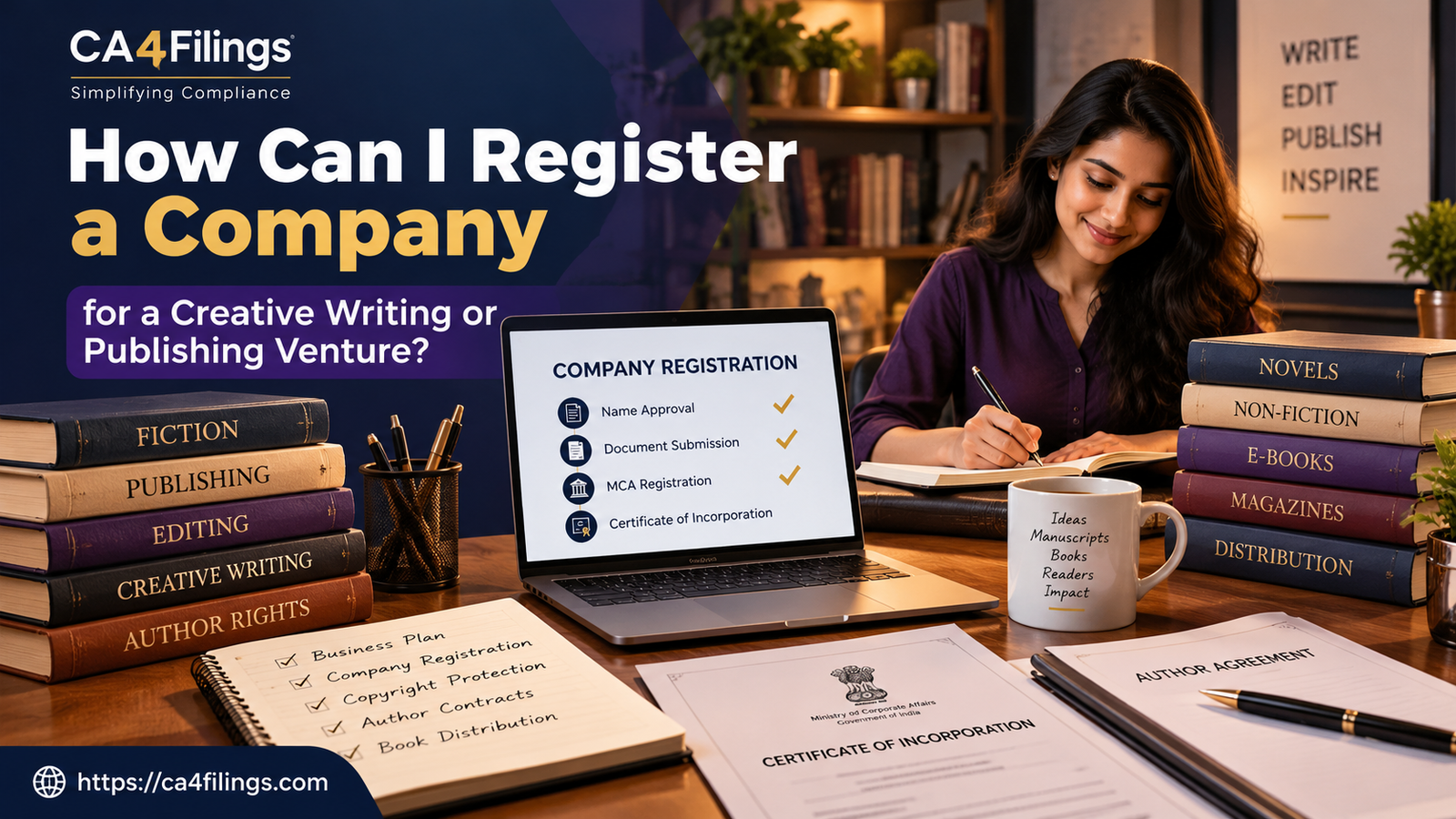
If you are planning to turn your passion for storytelling, book publishing, editing, or content creation into a business, you may be wondering, how can i register a company for a creative writing or publishing venture in India? Whether you want to publish novels, launch a digital magazine, sell e-books, or build a publishing house for emerging authors, choosing the right business structure is an important first step.
A properly registered business helps establish credibility, manage finances, enter into publishing agreements, and expand your operations. At CA4Filings, we guide entrepreneurs through the legal and financial aspects of setting up a business. Our Company Registration services can help you understand the registration process and select a suitable structure for your publishing ambitions.
Let us explore the practical steps, legal requirements, and financial considerations involved in registering a creative writing or publishing business in India.
How Can I Register a Company for a Creative Writing or Publishing Business?
The registration process depends on your business goals, expected revenue, number of founders, and plans for future expansion. A freelance writer working independently may not need the same structure as a publishing house managing multiple authors and selling books nationwide.
Before starting, consider what your venture will do:
Write and sell original books or e-books.
Publish manuscripts written by other authors.
Offer editing, proofreading, and ghostwriting services.
Operate a literary magazine or online publishing platform.
Manage copyrights, royalties, and book distribution.
Identifying your primary activities helps determine the appropriate legal structure and the registrations your business may require.
Step 1: Choose the Right Business Structure
When considering how can i register a company, start by comparing the available business structures.
Private Limited Company
A private limited company is often suitable for entrepreneurs planning to build a publishing brand, hire employees, enter into commercial contracts, or attract investors.
Key benefits include:
A separate legal identity.
Limited liability for shareholders, subject to applicable law.
Better suitability for bringing in investors.
Continuity even when ownership changes.
For example, if two writers want to establish a publishing house, commission books from other authors, and expand into digital publishing, a private limited company may be a practical choice.
Limited Liability Partnership (LLP)
An LLP can work well for two or more partners offering editorial, writing, translation, or publishing services. It combines a separate legal identity with limited liability and generally offers operational flexibility.
Partnership Firm or Sole Proprietorship
A sole proprietorship may suit an individual writer starting with a small freelance operation. A partnership firm may suit individuals working together on a smaller venture.
However, these structures do not offer all the legal and funding advantages of a company incorporated under the Companies Act.
CA4Filings tip: Do not choose a private limited company merely because it sounds more professional. Consider compliance costs, liability exposure, ownership arrangements, and long-term business plans before making a decision.
Step 2: Select a Business Name and Understand Publishing Imprint Legalities
Your business name should reflect your literary identity while remaining distinctive and legally acceptable.
For a publishing venture, you may want to operate under a separate publishing imprint. An imprint is the name under which books are published and marketed, and it may differ from the registered company's legal name.
For instance, a company named Silver Leaf Media Private Limited might publish fiction under the imprint Silver Leaf Books.
Before finalising the name:
Check name availability through the Ministry of Corporate Affairs (MCA).
Ensure the proposed name follows applicable naming rules.
Check relevant trademark records to identify potential conflicts.
Consider domain name availability for your website.
Publishing imprint legalities deserve particular attention because a company name, trade name, imprint, and trademark are not interchangeable. Registering a company does not automatically grant trademark protection for every brand name it uses.
Step 3: Obtain the Required Documents
If you are exploring how can i register a company through the MCA, prepare the required identity, address, and incorporation documents in advance.
For a typical private limited company, the documentation may include:
PAN and identity proof of proposed directors and subscribers.
Address proof for the individuals involved.
Recent residential address evidence, where required.
Registered office address proof.
A utility bill or other acceptable office address evidence.
A no-objection certificate from the property owner, where applicable.
Details of the proposed shareholding and directors.
Requirements may vary depending on the applicants, their residency, and the registered office arrangements.
Directors and subscribers may also need Digital Signature Certificates (DSCs) to sign incorporation documents electronically.
Step 4: Complete Company Registration Through the MCA
Once your documents are ready, the incorporation process can begin.
Follow These Registration Steps
1. Obtain Digital Signature Certificates: The relevant individuals need DSCs for signing electronic forms.
2. Apply for name approval: Propose a suitable company name that complies with MCA requirements.
3. Prepare incorporation documents: Complete the applicable incorporation forms, including the SPICe+ process, and prepare the Memorandum of Association (MoA) and Articles of Association (AoA).
4. Define the business activities: The company's proposed objects should accurately cover its intended activities, such as publishing books, digital content production, editorial services, and related lawful operations.
5. Submit the application: File the required forms and supporting documents with the MCA, paying the applicable government fees and stamp duty.
6. Receive the Certificate of Incorporation: Following approval, the company receives its incorporation certificate and Corporate Identity Number (CIN).
PAN and TAN are generally allotted through the incorporation process, subject to the applicable procedure.
Registration timelines depend on document accuracy, name approval, and any clarification requested by the authorities.
Step 5: Protect Intellectual Property and Manage Author Agreements
For a creative writing or publishing venture, intellectual property is often among the business's most valuable assets. A company may own original manuscripts, book designs, logos, digital publications, and other creative materials, depending on the circumstances and applicable agreements.
Understand Copyright Assignment
Copyright ownership should never be left to assumptions. If an author creates a manuscript independently, the publisher does not automatically own every copyright simply because it prints or sells the book.
A copyright assignment should clearly specify the rights being transferred, the work covered, the duration, the territory, and other relevant terms. Indian copyright law sets requirements for valid assignments, including provisions concerning the rights assigned and their duration and territorial extent.
Where the arrangement is a licence rather than an assignment, the agreement should explain the permitted uses and restrictions.
Establish Author Contract Management
A written author agreement should address:
Whether the arrangement is exclusive or non-exclusive.
Royalty rates, payment schedules, and accounting.
Print, e-book, audiobook, and translation rights.
Editing and approval responsibilities.
Contract duration, termination, and reversion of rights.
Permissions for illustrations, photographs, and third-party material.
Good author contract management helps prevent disputes over royalties, ownership, and publishing rights. Have agreements reviewed by a qualified legal professional when the commercial arrangement is significant.
Step 6: Arrange Tax, Banking, and Other Compliance Requirements
After incorporation, set up the financial and compliance systems needed to operate your venture.
Open a current account in the company's name and maintain separate business and personal transactions. Establish proper bookkeeping for printing expenses, editorial fees, royalties, marketing, subscriptions, and book sales.
Also consider the following:
GST registration: Applicability depends on turnover, the nature of supplies, the place of supply, and other statutory conditions. Printed books, digital publications, and related services may receive different GST treatment.
Accounting and income tax: Maintain records and meet applicable return-filing and tax-payment obligations.
Annual MCA compliance: Companies must meet relevant financial statement, annual return, board, and statutory record requirements.
Business registrations: Check whether any additional registrations or local permissions apply to your activities.
If you plan to sell books through multiple marketplaces or internationally, review the tax and invoicing implications before launching.
Step 7: Build a Distribution Entity and Publishing Workflow
A publishing business needs a reliable way to deliver its products to readers. Your company may sell directly through its website, work with bookstores, use online marketplaces, or collaborate with distributors.
A separate distribution entity may be useful for a larger group operating distinct publishing and distribution businesses, but it is not normally necessary for a new publishing venture.
Start with a clear workflow covering manuscript acquisition, editing, production, pricing, marketing, inventory, sales reporting, and royalty payments.
For example, a small publishing company could begin with e-books and print-on-demand services before investing in large print runs. This approach can reduce initial inventory costs while helping the business test reader demand.
Common Mistakes to Avoid
Even when you understand how can i register a company, overlooking operational details can create problems later.
Avoid these common mistakes:
Choosing a business structure without assessing its compliance burden.
Using an imprint without checking trademark conflicts.
Publishing another author's work without appropriate written permission.
Mixing personal and company finances.
Ignoring GST classification and invoicing requirements.
Missing annual filing deadlines.
Assuming company incorporation automatically protects a brand or copyright.
A little planning at the beginning can prevent expensive corrections as your business grows.
Latest Updates
ca4filings.com Services

































