How Do We Register a Company for a Transportation or Logistics Business?
Learn how do we register a company for a transportation or logistics business in India, including legal steps, licences, GST, and compliance requirements.
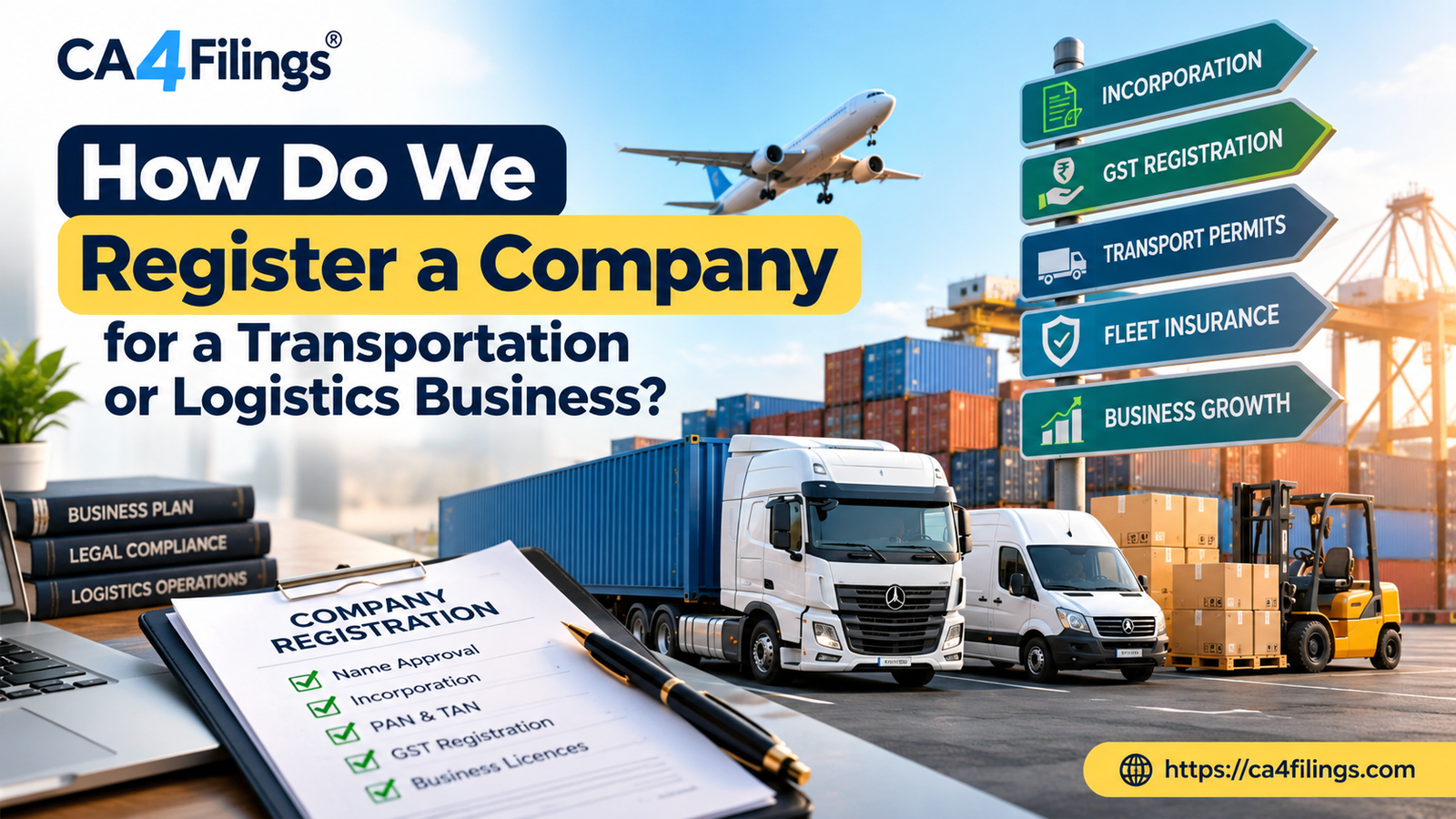
Starting a transportation or logistics business in India can be a promising opportunity, whether you plan to operate a fleet of trucks, provide goods delivery services, manage warehouses, or offer third-party logistics solutions. However, before accepting your first order, it is important to establish your business legally and understand the applicable registrations, licences, and compliance requirements.
Many entrepreneurs ask, how do we register a company for a transportation or logistics business without facing unnecessary delays or legal complications? The process involves choosing a suitable business structure, registering with the appropriate authorities, obtaining industry-specific permits, and arranging tax registrations where applicable. At CA4Filings, we help business owners navigate the Company Registration process with practical guidance so they can focus on building a reliable and profitable transportation business.
Let's understand the registration process step by step.
How Do We Register a Company for a Transportation Business in India?
The registration process depends on the nature of your operations, the number of owners, your investment plans, and whether you intend to operate within one state or across India.
For example, a small goods delivery business may begin with a few commercial vehicles, whereas a nationwide logistics company might require a larger fleet, warehouse facilities, employees, and contracts with corporate clients.
Here are the main steps involved.
Step 1: Choose the Right Business Structure
The first decision is to select a legal structure that suits your business goals.
Common options include:
Private Limited Company: Suitable for businesses planning to expand their fleet, attract investors, or enter into contracts with large corporate clients.
Limited Liability Partnership (LLP): A practical option for partners who want limited liability and a comparatively flexible management structure.
Partnership Firm: Suitable for a small business operated by two or more partners, subject to the applicable legal requirements.
Sole Proprietorship: Often considered by individuals starting a small local transportation or delivery operation.
For instance, if two entrepreneurs plan to establish a logistics company and eventually expand into several states, a Private Limited Company may provide a suitable foundation.
Your choice should consider liability, taxation, compliance costs, funding requirements, and future expansion plans.
Step 2: Obtain the Required Documents
Before proceeding with company incorporation, prepare the necessary documents for the proposed directors, shareholders, and registered office.
Generally, these include:
PAN card and identity proof of the proposed directors and shareholders.
Address proof, such as a bank statement or utility bill, where acceptable.
Recent photographs, where required.
Registered office address proof.
Electricity bill or another acceptable utility bill for the registered office.
No-objection certificate from the property owner, where applicable.
Rent agreement or ownership documents, depending on the premises.
The precise documentation depends on the business structure and the applicable incorporation requirements.
Keeping these documents ready helps reduce errors and avoid delays during verification.
Step 3: Complete Company Incorporation
If you choose a Private Limited Company, incorporation is generally completed through the Ministry of Corporate Affairs (MCA) using the applicable SPICe+ process.
The process normally involves:
Selecting a suitable company name that complies with MCA naming requirements.
Obtaining Digital Signature Certificates (DSCs) for the relevant signatories.
Preparing the incorporation forms and supporting documents.
Filing the applicable forms through the MCA portal.
Responding to any clarification or resubmission request, if raised.
Receiving the Certificate of Incorporation after approval.
The company also requires a suitable business activity description covering its intended transportation, freight, delivery, or logistics operations.
Once incorporated, the company becomes a separate legal entity. However, incorporation alone does not authorise every type of transport activity; additional licences and permits may be necessary.
Step 4: Apply for PAN, TAN, and GST Registration
Tax registrations are another important part of logistics entity setup.
PAN and TAN: A company requires a Permanent Account Number (PAN). Tax Deduction and Collection Account Number (TAN) is required when the business is liable to deduct tax at source under applicable provisions.
GST registration: GST registration depends on the business's turnover, the nature of its supplies, and the applicable statutory conditions. Certain transactions or categories of businesses may have specific registration requirements.
Transportation businesses should examine GST treatment carefully because the rules can differ depending on whether the company operates as a Goods Transport Agency (GTA), a courier service, or another type of logistics provider.
A GTA may have specific GST provisions concerning consignment notes, input tax credit, and the person liable to pay tax. Therefore, obtain professional advice before selecting the applicable tax treatment.
What Licences and Permits Does a Logistics Company Need?
After incorporation, identify the registrations and permissions required for your particular business model.
Vehicle Registration and Transport Permits
If your company operates commercial goods vehicles, ensure that each vehicle complies with the applicable motor vehicle requirements.
Depending on the vehicle and route, this may include:
Valid vehicle registration.
A fitness certificate, where applicable.
Appropriate commercial vehicle insurance.
A goods carriage permit.
National or interstate permits, where applicable.
Pollution Under Control (PUC) certification, as required.
Applicable road tax and other statutory payments.
The specific requirements depend on the vehicle category, permitted use, operating territory, and applicable central and state rules.
For example, a truck carrying goods between Delhi and Maharashtra may need permits and documentation appropriate for interstate operations. Before dispatch, verify the vehicle's authorisations and applicable interstate commerce laws.
Driver Compliance and Safety Requirements
Your drivers play a crucial role in protecting your business from operational and legal risks.
Establish a driver compliance system that includes:
Valid driving licences appropriate for the vehicle class.
Verification of driver credentials.
Compliance with applicable working-hour and rest requirements.
Vehicle inspection and maintenance records.
Safety training and accident-reporting procedures.
Required transport documents and emergency contact details.
For businesses transporting regulated goods, additional conditions may apply. Hazardous goods, for instance, can involve specialised training, vehicle requirements, and safety documentation.
Commercial Fleet Insurance
Commercial fleet insurance is an important consideration for businesses operating multiple vehicles. Depending on the policy and applicable law, coverage may address third-party liability, accidental damage, theft, and other specified risks.
Review the policy wording, exclusions, deductibles, and insured declared values before purchasing coverage. Goods-in-transit insurance may also be relevant, but it is different from insurance covering the vehicles themselves.
Do not assume that one policy automatically covers every vehicle, driver, cargo type, or route.
Do We Need a DOT Number Application for an Indian Logistics Business?
A dot number application generally refers to obtaining a USDOT number in the United States. It is not a standard registration requirement for a transportation company operating solely within India.
However, if your company plans to operate commercial motor vehicles in the United States, USDOT registration and other federal or state requirements may apply depending on the operation.
For an Indian domestic transportation business, focus instead on MCA incorporation, GST compliance where applicable, vehicle registrations, permits, insurance, and other relevant Indian regulatory requirements.
Understanding this distinction helps entrepreneurs avoid applying for registrations that do not apply to their operations.
What Other Registrations Should a Logistics Company Consider?
Depending on the scale and nature of your activities, the following may also be relevant:
Udyam registration: An optional registration that may be available to eligible micro, small, and medium enterprises.
Shops and Establishments registration: May be required under the applicable state law for the office or establishment.
Professional tax registration: Applicable in states that impose professional tax and where the business falls within the relevant provisions.
EPFO and ESIC registration: May apply when the business meets the relevant statutory coverage requirements.
Import Export Code (IEC): May be necessary if the company undertakes import or export activities requiring an IEC.
Local trade or establishment permissions: May be required depending on the location and activities.
If your company plans to operate a warehouse, also check local land-use permissions, fire safety requirements, and other applicable approvals.
Not every business needs every registration. A requirement-based assessment can help control initial costs and prevent unnecessary applications.
How Much Does It Cost to Register a Transportation Company?
The cost of registration varies according to the business structure, authorised capital, professional assistance, government fees, and the registrations required.
A realistic budget should consider:
Company incorporation and professional fees.
Applicable government filing and stamp duty charges.
GST registration and accounting support, where needed.
Transport permits and vehicle-related statutory costs.
Commercial fleet insurance premiums.
Office, warehouse, software, and employee expenses.
Remember that company incorporation costs are only one part of the total investment. Buying vehicles, hiring drivers, maintaining a fleet, and managing working capital can account for a much larger share of your budget.
Common Mistakes to Avoid During Logistics Company Registration
Entrepreneurs can reduce compliance problems by avoiding these common mistakes:
Choosing an unsuitable business structure: Consider liability, funding, and expansion before deciding.
Starting operations without checking permits: Confirm the applicable vehicle and route requirements before transporting goods.
Ignoring GST classification: Determine whether your services qualify as GTA, courier, or another category.
Overlooking insurance exclusions: Check whether your coverage matches your vehicles, routes, and operations.
Maintaining incomplete records: Keep invoices, transport documents, vehicle records, employee details, and tax filings organised.
Expanding without a compliance plan: New states, warehouses, and service lines can introduce additional regulatory obligations.
Professional advice at the planning stage can help you avoid costly corrections later.
Latest Updates
ca4filings.com Services

































