Evaluating the Hidden Costs of Post-Start Up Registration Compliance
Understand the hidden costs of start up registration compliance, from annual filings to taxes, and learn how to manage expenses with expert guidance.
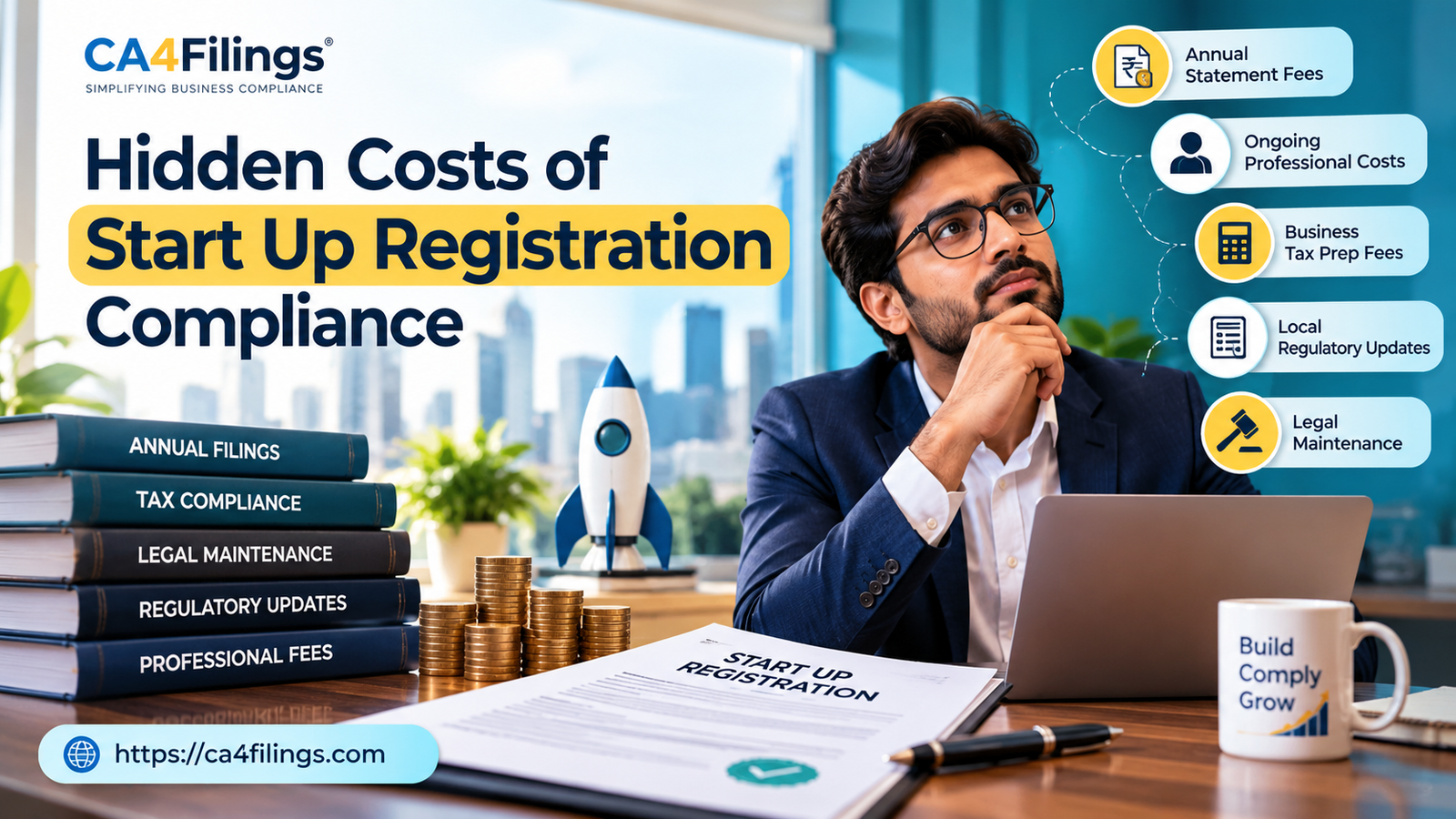
Starting a business is an exciting milestone, but registering your company is only the beginning of your compliance journey. Many entrepreneurs focus on incorporation charges, government fees, and initial documentation while overlooking the recurring expenses that follow. These hidden costs can gradually affect cash flow, especially for startups operating with limited budgets. Understanding the true cost of start up registration is therefore essential for building a financially sustainable business.
At CA4Filings, we regularly see business owners underestimate the time, money, and professional support required to maintain compliance after incorporation. Whether you are launching a private limited company, an LLP, or another business structure, planning your expenses beyond registration is crucial. Choosing professional Company Registration services can help you understand your obligations from the beginning and avoid unexpected compliance costs later.
In this article, we explain the hidden expenses associated with post-registration compliance in India, practical ways to control them, and how professional guidance can help your startup remain compliant without putting unnecessary pressure on its finances.
Why Start Up Registration Costs Do Not End After Incorporation
Completing start up registration establishes your business legally, but it also creates ongoing responsibilities. These obligations depend on your entity type, turnover, transactions, employee strength, and applicable registrations.
For example, a newly incorporated private limited company may have annual filing obligations even when it has generated little or no revenue. Similarly, an LLP must comply with its applicable annual filing requirements regardless of whether it has started commercial operations.
Common post-registration expenses include:
Annual statutory filings and government fees.
Accounting and bookkeeping services.
Income tax return preparation and filing.
GST compliance, where applicable.
Professional fees for company secretarial and legal work.
Licence renewals and regulatory updates.
Penalties arising from missed deadlines or incomplete filings.
The key lesson is simple: incorporation is a one-time milestone, whereas compliance is an ongoing responsibility.
Hidden Costs of Start Up Registration Compliance
1. Annual Statement Fees and Statutory Filing Expenses
One of the most overlooked expenses is the cost of preparing and filing annual returns and financial statements.
Companies registered under the Companies Act, 2013 generally need to prepare financial statements and complete applicable annual filings with the Ministry of Corporate Affairs (MCA). LLPs have their own filing requirements, including applicable annual returns and statements of account and solvency.
Although government filing fees may appear manageable, the overall expense can increase when professional assistance, document preparation, and additional forms are required.
For instance, a startup with limited transactions may still need proper books of account, financial statements, and statutory filings. Low revenue does not automatically eliminate these responsibilities.
Expert advice: Maintain a compliance calendar and budget separately for government fees and professional charges. Confirm the applicable filing requirements for your business structure instead of assuming every entity follows the same process.
2. Ongoing Registered Agent Costs and Professional Support
The term "registered agent" is commonly used in certain foreign jurisdictions. In India, businesses typically work with chartered accountants, company secretaries, advocates, and other authorised professionals for compliance support.
These ongoing registered agent costs, or equivalent professional support expenses, may cover registered office administration, statutory correspondence, document management, and assistance with regulatory filings, depending on the service arrangement.
A startup may initially choose the cheapest service provider. However, limited support can result in missed deadlines, incomplete documentation, and additional charges for work that was not included in the original package.
Before engaging a professional, clarify:
Which filings and services are included in the quoted fee?
Are government charges billed separately?
Will you receive deadline reminders?
Are additional consultations charged independently?
Who will monitor changes affecting your business?
Transparent pricing helps prevent small recurring expenses from becoming a significant annual burden.
3. Business Tax Prep Fees and Accounting Expenses
Tax compliance involves much more than submitting an income tax return once a year.
Depending on the business structure and applicable laws, a startup may require regular bookkeeping, reconciliation of bank transactions, preparation of financial statements, advance tax calculations, TDS compliance, GST returns, and income tax return filing.
These business tax prep fees can rise when accounting records are incomplete or transactions are not recorded consistently.
Consider a startup that records expenses only at the end of the financial year. Its accountant may need to reconstruct transactions, verify invoices, reconcile bank statements, and correct errors before preparing the return. This additional work can increase professional fees.
To control these costs, record transactions regularly, preserve invoices, reconcile bank accounts monthly, and maintain separate business and personal finances.
4. Local Regulatory Updates and Licence Renewals
Startups often operate across different locations, industries, and business models. Consequently, their compliance obligations may extend beyond MCA and income tax filings.
Depending on the activity and location, businesses may need GST registration, Shops and Establishments registration, professional tax compliance, FSSAI licensing, factory-related approvals, or other industry-specific permissions.
Local regulatory updates can affect renewal dates, documentation requirements, filing procedures, and applicable fees. A business that expands into another state or opens a physical office may also acquire new compliance responsibilities.
Practical tip: Review your registrations whenever you change your business address, introduce a new product, hire employees, or expand into another state. Do not assume that the registrations obtained at incorporation cover every future activity.
5. Legal Maintenance and Corporate Governance
Legal maintenance is another recurring expense that founders may overlook.
For companies, this can involve maintaining statutory registers, documenting board decisions, conducting applicable meetings, preparing resolutions, updating corporate records, and completing changes to directors or registered office details.
Certain corporate actions require additional filings and professional assistance. For example, appointing a new director or changing a company's registered office may involve documentation, approvals, and applicable government fees.
Keeping corporate records updated also helps when applying for funding, entering commercial agreements, or completing due diligence with investors.
A small investment in organised documentation can reduce the likelihood of expensive corrections later.
6. Penalties, Interest, and the Cost of Missed Deadlines
Late filing charges and other consequences can turn routine compliance into an avoidable financial problem.
For example, a founder who overlooks an applicable annual filing deadline may have to pay additional fees. Delayed tax payments can also attract interest or other consequences under the relevant provisions.
Repeated defaults may create further regulatory difficulties, depending on the nature of the violation.
These expenses are particularly damaging for early-stage businesses because they offer no direct commercial benefit.
The most effective solution is prevention. Assign responsibility for each filing, track due dates, and maintain a reserve for statutory payments. Verify current deadlines and fee rules through official sources or a qualified professional.
How to Reduce Post-Registration Compliance Costs
Managing compliance does not necessarily mean spending more. It means spending wisely and addressing obligations before they become urgent.
Follow these practical steps:
Create a compliance calendar: List annual returns, tax deadlines, licence renewals, and other applicable obligations.
Choose the right business structure: Understand the continuing compliance requirements of a company, LLP, or other suitable entity before registering.
Maintain accurate records: Keep invoices, bank statements, contracts, payroll records, and tax documents organised throughout the year.
Compare service packages carefully: Evaluate the scope of work, experience, responsiveness, and additional charges rather than choosing solely on price.
Review compliance quarterly: Identify upcoming obligations, outstanding documents, and changes in business activities.
Use digital tools: Accounting software and deadline reminders can reduce manual work and improve record accuracy.
Budget for recurring expenses: Estimate annual professional fees, government charges, accounting costs, and licence renewals when preparing your business budget.
A structured approach makes start up registration compliance easier to manage and allows founders to concentrate on sales, customers, and growth.
Latest Updates
ca4filings.com Services

































