Step-by-Step Process of Trademark Registration in India
Master the Step-by-Step Process of Trademark Registration in India with our expert guide to secure your brand name, logo, and business protection.
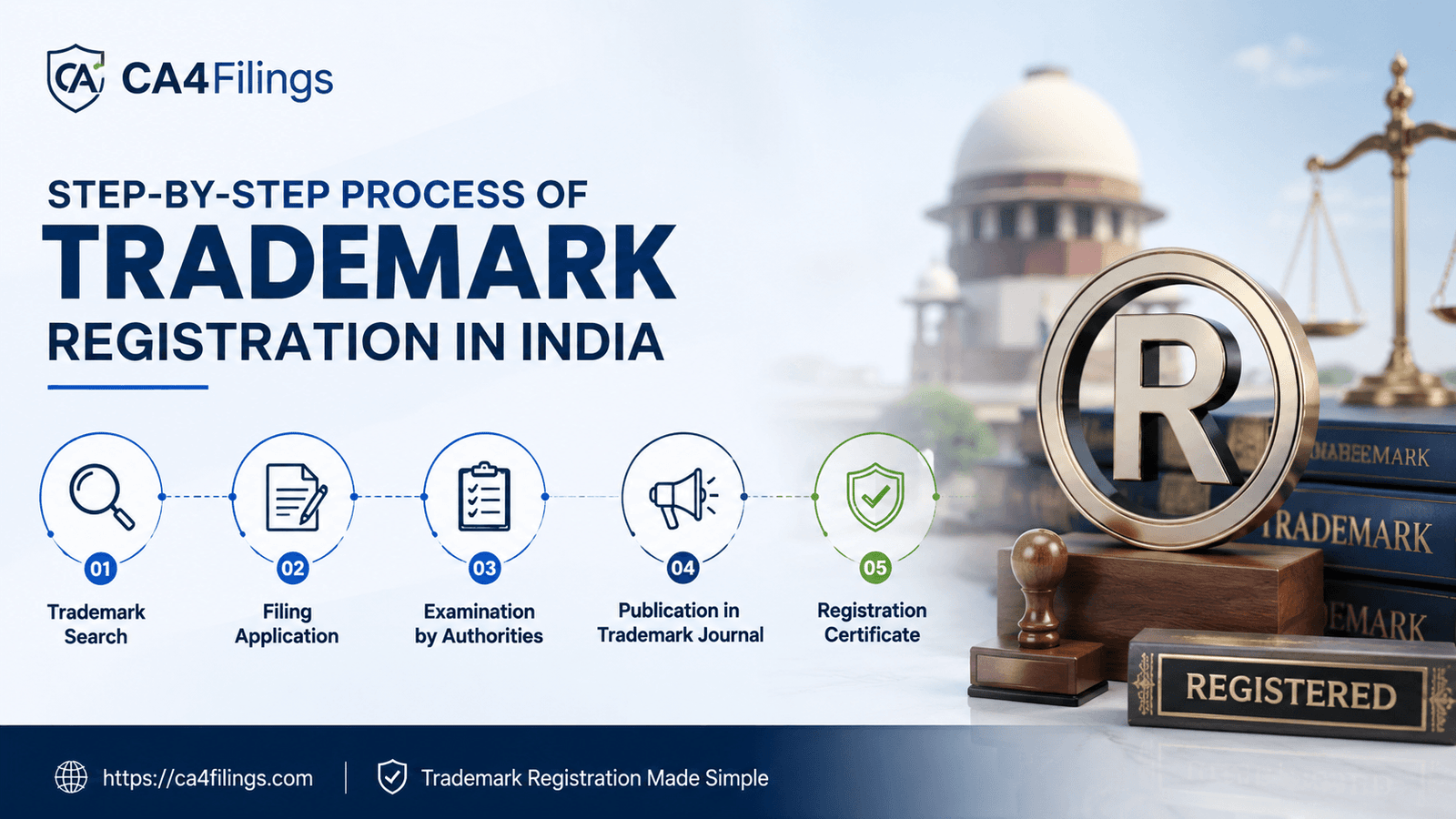
Imagine waking up one morning to find a competitor using your exact brand name, selling substandard products, and destroying the reputation you built over years of hard work. It is a nightmare scenario for any entrepreneur. In the bustling Indian market, your brand identity is your most valuable asset. To safeguard it, understanding the Step-by-Step Process of Trademark Registration in India is not just legal compliance—it is a foundational business strategy.
At CA4Filings, we encounter brilliant founders every day who pour their hearts into building a unique brand but leave their intellectual property completely unguarded. Securing a Trademark Registration is the definitive shield that grants you exclusive rights to your business name, logo, slogan, or even unique packaging. Let us demystify the legal corridors and walk you through the comprehensive, step-by-step process to achieve total brand protection and robust business protection in India.
What is a Trademark and Why Does Your Business Need It?
Before diving into the legal steps, let us clarify what we are protecting. A trademark is a recognizable sign, design, or expression that identifies your products or services from those of others. It can be a brand name like "Tata", a logo like the Nike swoosh, or a catchy tagline.
Obtaining a trademark registration in India offers several critical advantages:
Legal Ownership: It grants you the exclusive right to use the mark nationwide.
Asset Creation: A registered trademark is an intangible asset that can be sold, franchised, or commercially licensed.
Deterrence: It prevents rivals from using confusingly similar marks that could siphon off your hard-earned customer base.
The Step-by-Step Process of Trademark Registration in India
The journey from a creative idea to holding a government-issued registration certificate involves multiple stages. Here is the exact breakdown of how the process unfolds.
Step 1: Conducting a Comprehensive Trademark Search
The very first move in the Step-by-Step Process of Trademark Registration in India happens long before you fill out a single government form. It begins with conducting a search.
Many business owners mistakenly assume that if a domain name or a Ministry of Corporate Affairs (MCA) company name is available, their trademark is safe. This is a risky misconception. You must search the official Intellectual Property India (IP India) portal under the specific "Class" that matches your business operations. There are 45 different classes covering various goods and services.
Expert Insight from CA4Filings: Do not just look for exact matches. Look for phonetically similar names. For example, if you want to register "Kruz", a search might reveal an existing trademark for "Cruise". If they sound identical, the Trademark Registry will likely object to your application later.
Step 2: Determining the Correct Class and Gathering Documents
Once your search turns up clear, you need to identify your appropriate classes and compile the necessary paperwork. The standard checklist for filing an application includes:
The applicant’s name, address, and nationality.
A clear soft copy of the logo or brand name.
A specific description of the goods or services.
The user date (the exact date you started using the mark in India, backed by an affidavit and proof like invoices, or marked as "Proposed to be used").
A signed Power of Attorney authorizing your CA or attorney to act on your behalf.
Step 3: Filing an Application (Form TM-A)
With the documentation in order, we move to the official stage of filing an application. This is submitted through the comprehensive online portal of the Controller General of Patents, Designs and Trademarks.
As soon as Form TM-A is successfully submitted and the government fee is paid, you receive an official application number. This is the exact moment you earn the right to use the ™ symbol next to your brand name. It signals to the world that your brand is officially in the queue for legal protection.
Step 4: Examination by Trademark Office
After submission, your application goes through a meticulous examination by Trademark Office officials. The examiner reviews the application to ensure it complies with the law and does not conflict with any existing pending or registered trademarks.
Following this review, the office issues an Examination Report. This report will either accept the mark or state objections under absolute grounds (e.g., the name is too descriptive or generic) or relative grounds (e.g., it is identical to an existing mark). You or your representative must file a professional, legally sound written reply within 30 days to overcome these objections. If the examiner remains unsatisfied, a show-cause hearing is scheduled.
Step 5: Publication in the Official Journal
If your response satisfies the examiner, or if you clear the hurdles during the personal hearing, the Trademark Registry moves to the next milestone: the publication in official journal.
The Trademark Journal is an open, public record published weekly. The purpose of this publication is to give the public a fair chance to review your mark. Anyone who believes your brand name infringes on their existing rights has a strict window of 4 months from the publication date to file an opposition.
Step 6: Issuance of Registration Certificate
If no one opposes your application within those 4 months—or if an opposition is filed but the final legal ruling goes in your favor—your application achieves success.
The Registrar completes the Step-by-Step Process of Trademark Registration in India by handling the final issuance of registration certificate. This digital certificate bears the seal of the Trademark Registry. Once received, you can officially replace the ™ symbol with the highly coveted ® symbol. Your trademark is now fully registered and valid for a period of 10 years, renewable indefinitely after that.
Common Mistakes to Avoid During Registration
Navigating this terrain can be tricky. Over the years, our team at CA4Filings has spotted a few recurring mistakes that lead to abandoned applications:
Choosing a Generic Name: Trying to register a name like "Fresh Apples" for a fruit business will get rejected. Choose distinctive, invented, or arbitrary words (like "Apple" for computers).
Incorrect User Date: Claiming you have been using a mark since 2020 without solid documentary proof (like old bills or website archives) can stall your application during the examination phase.
Missing Government Deadlines: The Trademark Registry operates on strict timelines. Missing a 30-day window to reply to an examination report can cause your application to be marked as "Abandoned," wasting your time and money.
Frequently Asked Questions (FAQs)
1. How long does the entire trademark registration process take in India?
While you get the right to use the ™ symbol within 24 hours of filing, the complete journey to get the ® certificate generally takes anywhere between 6 to 12 months, assuming there are no major objections or third-party oppositions.
2. Can I register a trademark globally by filing in India?
No. Trademark rights are strictly territorial. A registration in India protects your brand only within Indian borders. However, you can use your Indian application as a base to apply internationally under the Madrid Protocol.
3. What is the validity of a registered trademark in India?
A registered trademark is valid for 10 years from the official date of application. You can renew it every 10 years indefinitely by paying the prescribed renewal fees.
4. Can an individual apply for a trademark, or do I need a registered company?
An individual, a partnership firm, an LLP, a private limited company, or even a trust can apply for a trademark. The government fees are actually lower for individuals, startups, and small enterprises (MSMEs) compared to large body corporates.
Protect Your Intellectual Property with CA4Filings
Securing your brand identity is one of the smartest business decisions you will ever make. While the Step-by-Step Process of Trademark Registration in India can appear straightforward on paper, interpreting legal objections, drafting precise examination replies, and choosing the right classes require professional expertise to prevent costly rejections.
Don't leave your brand's reputation to chance. Let our experienced legal and financial professionals handle the heavy lifting for you. From your initial comprehensive search to the final issuance of your registration certificate, we ensure a seamless, hassle-free experience.
Latest Updates
ca4filings.com Services

























-registration.png)